Tuesday, March 27, 2012

RARE COLLECTORS' ITEM - JAEGER LE COULTRE FUTUREMATIC POWER RESERVED GENTS WRISTWATCH


BRAND/JENAMA: AUTHENTIC VINTAGE JAEGER LECOULTRE FUTUREMATIC GENTS WRISTWATCH

MADE IN/BUATAN: SWISS

CIRCA/TAHUN: 1950's

MODEL: POWER RESERVED - FUTUREMATIC

CRYSTAL/CERMIN: ACRYLIC

MOVEMENT/ENJIN: JAEGER LECOULTRE 17 JEWELS AUTOMATIC BUMPER MOVEMENT- CAL.497

DIAL COLOR: GOLD TONE WITH POWER RESERVED DIAL AT 9:00

FUNCTION/FUNGSI: POWER RESERVED, HOUR, MINUTE AND SUB-SECOND DIAL AT 3:00

HANDS/JARUM: GOLD TONE METAL HANDS

MARKERS/TANDA WAKTU: RAISED GOLD TONE ARROW HEAD MARKERS

CASING : 10K GOLD FILLED

LUGS: 18mm

MEASUREMENT/UKURAN: 35mm WIDE and 44mm LUG TO LUG

BEZEL: 10K GOLD FILLED

DITANDA/ENGARVED BACK CASING: -

CROWN: NO SIDE CROWN - HAND ADJUSTED USING BACK BUTTON AT CASE BACK

STRAP/TALI: NEW BROWN LEATHER/TEXTILE BAND

SIZE STRAP/SAIZ TALI: 8.5" FULL LENGHT

DISCONTINUED LECOULTRE MODEL... RAREST!

EXCELLENT CONDITION, KEEPING GOODTIME AND RECENTLY SERVICED

PRICE/HARGA: USD1,500 (NEGOTIABLE)

SOLD FOR RM

A BRIEF HISTORY OF LE COULTRE WATCHES

A brilliant inventor and self-taught watchmaker, Antoine-LeCoultre founded his first workshop in 1833, following the invention of a machine to produce watchmaking pinions. Ever since, the Manufacture Jaeger-Lecoultre has developed constantly around the founder's original workshops.

Surprisingly enough, it was neither a physicist nor an engineer who first measured the micron; it was Antoine LeCoultre, in 1844. He had created watch components that were so perfect no tool could actually detect their degree of inaccuracy. He followed that up by inventing the world's most accurate instrument: the Millionometer, which served as a benchmark for over half a century.

In 1847, LeCoultre created a revolutionary system that was to do away with the need for keys to rewind and set watches. His simple and brilliant solution was a pushbutton that activated a lever to switch from one function to another. It was the first keyless winding mechanism, and the first reliable system that eliminated the need for keys to wind or set a watch.

In 1866, when Swiss watchmaking was still structured around small home-run workshops, Antoine LeCoultre and his son Elie decided to bring together under one rood the many skills involved in making watches, and installed a steam-driven machine to operate their new tools. LeCoultre & Cie thus became the first Manufacture in the Vallée de Joux.

It was in 1903 when the Parisian Edmond Jaeger set Swiss watchmakers the challenge of producing ultra-thin calibres. It would lead to the Calibre 145, the world's thinnest mechanical movement, measuring no more than 1.38 mm, and the friendship of Antoine LeCoultre's grandson, Jacques-Devid LeCoultre. These two men would give a rise to a range of horological wonders, and eventually the birth of the Jaeger-LeCoultre brand in 1937.

In the year 1908, the Manufacture created its first rectangular-shaped calibre in response to the challenge created to miniaturize watches to wear on the wrist. By the "Roaring 20s" (1920s), very small ladies' wristwatches were all the rage, but extreme miniaturization always led to a loss of reliability and precision. The Duoplan brilliantly solved this problem by arranging its parts on split levels. It would lead to the world's smallest movement, Calibre 101. Outdoing the Calibre 145, Jaeger-Lecoultre miniaturized the Duoplan caliber to the extreme, weighing in at barely one gram and comprising of 74 parts. Its record is still unmatched to this date.

Since its founding, the Manufacture has created and produced over 1,000 different calibres in many varieties. Over 200 patented inventions have contributed to the progress of Swiss watchmaking in the field of movements, as well as that of cases, bracelets, dials, and watch functions.

Sunday, March 25, 2012

AUTHENTIC FERRARI PADDOCK CHRONOGRAPH GENTS WRISTWATCH (SOLD)

FERRARI PADDOCK CHRONOGRAPH - BOUGHT FROM DEMI MASA BLOGGER!

I have a pre-owned Ferrari Paddock Chronograph bought from my friend, Demi Masa Blogger, which he bought in London direct from Ferrari HQ in October 2010. It is very rarely worn (he told me that he is quite sure, wore it not more than 10 times outdoor) and in a very mint condition indeed.


It is a quartz, so mechanical watch lovers might not be interested. It might however interest others who just want a beautiful, pre-owned but in a mint condition and affordable piece of chronograph timepiece. For those who wanted watch as one of his/her wedding hantaran, this is a perfect choice. What's more, one would not be able to buy this watch anywhere in Malaysia - thus you have an exclusivity there, if you want one. Last but not least, if you're a Ferrari afficianado but feels that the sports car is a bit steep in price, this is a perfect collection for you.


Ok, looking at the condition and the watch's rarity in Malaysia, a full set, i.e. watch, paper outer box, wooden box, warranty and instruction booklet and a warranty card (not dated nor named).


Thank you Ketua Pengawas and thanks guys for looking!


Genuine leather strap with deployant buckle, and caseback featuring Ferrari logo. Driven by quartz movement of Caliber Ronda 5050.C

On the left is the wooden inner box, while on the right is the outer paper box

Is that dial not beautiful and complete? Chrono function, day and date


The contents (including the pictures) contained in this write-up are the original work of the author, Pencinta Masa and are copyright protected. Posted here with the permission from Pencinta Masa. Any unauthorised use of any of the information or pictures is strictly prohibited.

Tuesday, March 20, 2012

VINTAGE LARGE ANDRE RIVALLE SPACE DIGITAL JUMPHOUR GENT WRISTWATCH (SOLD)


BRAND/JENAMA: AUTHENTIC ANDRE RIVALLE JUMP HOUR GENTS WRISTWATCH
MADE IN/BUATAN: SWISS
CIRCA/TAHUN: 1969
MODEL: JUMP HOUR WATCH
CRYSTAL/CERMIN: CLEAN ACRYLIC CRYSTAL
MOVEMENT/ENJIN: 17 JEWELS MANUAL WINDING MOVEMENT
DIAL COLOR: BLUE
FUNCTION/FUNGSI: HOUR, MINUTE
HANDS/JARUM: NONE - DIGITAL GOLD TONE NUMERICAL WITH BLUE BACKGROUND COLOR
MARKERS/TANDA WAKTU: NONE
CASING : GOLD PLATED STAINLESS STEEL
LUGS: 19mm
MEASUREMENT/UKURAN: 41mm DIAMETER W/O CROWN and 42mm LUG TO LUG
DITANDA/ENGARVED BACK CASING: S/N 12464
CROWN: GOLD PLATEDS
STRAP/TALI: GENUINE BLUE SHARK SKIN CALF LEATHER BAND
SIZE STRAP/SAIZ TALI: 8.5"
WORKING CONDITION, RECENTLY SERVICE & KEEPING TIME
PRICE/HARGA: RM585 (NEGOTIABLE)
SOLD:RM

Brief History of Andre Rivalle Watches

Armin Kauffman, an immigrant from Hungary migrated to USA in 1950. He acquired E.Gluck Trading Company in 1967.

Through Gluck, he made watches in Switzerland that sold in US retail markets in the $10 to $50 price range under the Sutton, Chateau, Precision, Adventura, and Andre Rivalle labels.

In 1975, digital watches with price tags ranging from $100-$ 150 were introduced under the Armitron and Quasar label. These electronic watches were Armins first attempt at manufacturing the timekeeping parts of watches itself

Friday, March 16, 2012

LUXURIOUS AUTHENTIC SOLID 18K YELLOW GOLD IWC (International Watc Co.) PORTOFINO GENTS WRISTWATCH


BRAND/JENAMA: AUTHENTIC 18K SOLID GOLD IWC PORTOFINO GENTS WRISTWATCH

MADE IN/BUATAN: SWISS BY INTERNATIONAL WATCH CO.

CIRCA/TAHUN: 1990's

MODEL: PORTOFINO

CRYSTAL/CERMIN: CLEAN ACCRYLIC CRYSTAL

MOVEMENT/ENJIN: IWC 17 JEWELS MANUAL WINDING MOVEMENT CAL. 89

DIAL COLOR: GOLD TONE

FUNCTION/FUNGSI: HOUR, MINUTES AND CENTER SWIPE

HANDS/JARUM: 18K SOLID GOLD

MARKERS/TANDA WAKTU: RAISED GOLD BATON

CASING : SOLID 18K GOLD WITH UNIQUE SHARK FINS LUGS

LUGS: 20mm

MEASUREMENT/UKURAN: 36mm DIAMETER WITH CROWN and 41mm LUG TO LUG

DITANDA/ENGARVED BACK CASING: NONE

CROWN: SOLID TITANIUM/ TITANIUM

STRAP/TALI: GENUINE BLACK LEATHER

SIZE STRAP/SAIZ TALI: 8"

EXCELLENT CONDITION, KEEPING TIME AND RECENTLY SERVICED

PRICE/HARGA: USD2,500 (NEGOTIABLE)

BRIEF FISTORY OF IWC AND PORSCHE DESIGN WATCHES

International Watch Co, also known as IWC, is a high-end Swiss watch manufacturer located in Schaffhausen, Switzerland. IWC is an active member of the Federation of the Swiss Watch Industry FH.

IWC Schaffhausen is notable for being the only major Swiss watch factory located in eastern Switzerland, as the majority of the well-known Swiss watch manufacturers are located in western Switzerland. Notwithstanding the lingua franca of IWC is German.

An interesting fact you may or may not know: International Watch Company (IWC) is possibly the only major Swiss watch company whose founder was an American!

During the 1860's, three manufacturers dominated the American watch industry: Elgin, Howard and Waltham. Combined, these firms produced upwards of 100,000 pocket watches. Times were changing in the industry as pocket watches went from being a status symbol that only the wealthiest individuals could afford, to an everyday item available to the middle class. As a result, production methods had to be improved; for example, most parts for watches were still being made by hand. Costs were also high because the pool of available, qualified watchmakers was relatively small.

In Boston, Massachusetts, Florentine Ariosto Jones, who had worked in the American watch industry for a number of years, keenly observed the failure of Aaron Lufkin Dennison, a leader in the watch business, whose efforts to move production to Switzerland to benefit from lower wages and Swiss watchmaking know-how, failed miserably. Undaunted, Jones took over the failed enterprise and soon set up his own company in Switzerland. His plan was to assemble watches in Switzerland and import them into the United States, hence the name International Watch Company.

Fortuitously, Jones made the acquaintance of one Johann Heinrich Moser, a watchmaker whose hometown of Schaffhausen was conveniently located near the Rhine. Following Moser's advice, a dam was built in order to harness the mighty river and generate hydro-power to drive the machines used in manufacturing facilities throughout Schaffhausen.

A watch factory was built in Schaffhausen to take advantage of the cheap hydro-power and production commenced in 1868. Despite the company's unique business plan, the enterprise was doomed from the start. For one thing, Jones had trouble selling the watches in America, due to a high tariff on imported finished watches. An even worse problem: Jones was undercapitalized and encountered technical problems with the machines. By 1875, he was scrambling to find new investors, amid allegations by disgruntled stockholders that the company was on the verge of collapse. Inevitably, the company filed for bankruptcy and Jones was forced to relinquish control of his company.

A Swiss consortium acquired IWC's shares and put another American, Frederick Seeland, at its helm. Although the company's fortunes improved somewhat, the improvement was not deemed sufficient enough. As a result, the company was put up for sale again. This time, one of IWC's stockholders, Johannes Raschenbach-Vogel, bought the company at auction for 280,000 francs. Technical achievements and increased sales soon followed with the production of the first pocket watches with digital time indication, as well as development of the famous Calibre 52 movement, which at the time was quite revolutionary in its concept and construction.

Although the company experienced significant growth, following World War I, the company's fortunes again hit rock bottom under the proprietorship of Ernst Homberger-Rauschenbach. Fortunately, a major modernization effort paid off when the advent of World War II resulted in increased military demand. It was thus during World War II that IWC created the first oversize anti-magnetic pilot's watch, followed by the famous Mark X, featuring its new in-house movement, Calibre 83. In 1944, IWC had a close call when the Allies mistakenly bombed Schaffhausen. As luck would have it, the factory narrowly escaped destruction.

In the aftermath of the war, International Watch Company lived up to its name and became a company of international scope. Exports to the United States increased and the brand became best known for its specialty watches, such as the Mark XI and Ingenieur - the first automatic IWC with a soft-iron inner case that protected the movement against magnetic fields - as well as for its elegant dress watches. Needless to say, vintage IWC's from the 1940's and 50's are highly collectible today and in great demand, as they are somewhat under-priced compared to other high-end watch brands of that era.

Although IWC entered the quartz era with its first quartz watch in 1969, using the Beta 21 movement, the company was ultimately unable to remain under family ownership. In 1978, a majority interest in the company was sold to VDO Adolf Schindling AG.

Subsequent developments include the debut of the Porsche series of sports watches, which remain in production to this day, as well as the creation of the "DaVinci" - a perpetual calendar chronograph wristwatch that is mechanically programmed for the next 500 years. This watch caused quite a stir when first introduced and set new standards with its "user friendly" perpetual calendar. In 1993, the company again stunned the watch world when it unveiled the remarkable Il Destriero, which at the time was the most complicated wristwatch in the world.

The year 2000 is no less exciting for the company, as it introduces a new advertising campaign, as well as the 5000 calibre, a new mechanical movement with a power reserve of seven days and an automatic movement. The automatic, an IWC exclusive, is a further development of the patented Pellaton system. The pocket watch-size movement is featured in the latest addition to the Portuguese line: an automatic with a power reserve display. It should also be noted that 1999 was the most successful year in IWC's history, with 39,000 watches sold, 115 million Swiss francs in revenue, and over 350 employees.

In closing, the company's philosophy is best summed up by IWC's current CEO, Michael Sarp, who recently stated: "We shall produce watches of the highest quality with unique technical and design characteristics and thus continue to experience the pleasures of innovation." If you should have an opportunity to examine an IWC, you will quickly realize that Mr. Sarp speaks the truth

Thursday, March 15, 2012

VINTAGE AUTHENTIC LONGINES CONQUEST GENTS WRISTWATCH (SOLD)


BRAND/JENAMA : VINTAGE LONGINES CONQUEST GENTS DRESS WATCH
MODEL : 1558-1 CONQUEST
MOVEMENT/ENJIN : Longines Manual Winding Cal. 6942 - 17 Jewels Swiss Movement
ORIGIN/BUATAN : Longines
NO. SIRI/SERIAL NO. : 52127033
CIRCA/TAHUN : 1960's
CASING/KEMASAN : GOLD PLATED 20 MICRON TOP & STAINLESS STEEL BACK. 35mm w/o CROWN X 43mm LUG TO LUG
FUNCTION/FUNGSI : HOUR, MINUTES, SWIPE SECOND
DIAL: CHAMPAGNE GOLD with RAISED BATON MARKERS
BEZEL: GOLD PLATED 20 MICRON
MARKINGS/TANDA JENAMA : DIAL, MOVEMENT
BAND/TALI :
GENUINE BROWN LEATHER BAND WITH ORIGINAL LONGINES BUCKLE FIT 8" WRIST
LUGS SIZE: 19mm
BAND WIDTH: 120mm
LENS/CERMIN : HARDLEX ACCRYLIC CRYSTAL
MEASUREMENT/UKURAN : 34mm WITHOUT CROWN X 39mm LUG TO LUG
WATER RESISTANT: NOT TESTED
CONDITION/KONDISI : EXCELLENT WORKING CONDITION - COMES WITH ORIGINAL WITTNAUER BOX AND SERVICE PAPER
PRICE/HARGA:RM750 (SOLD TO MR LKY FROM PJ))
SOLD RM

BRIEF HISTORY OF LONGINES-WITTNAUER WATCHES
As soon as Ernest Francillon opened a small manufacturing plant, which started to produce the following year, the story of Longines started in 1866. Francillon, who was the grandson of Auguste Agassiz (a pioneer of Swiss horology whose name appears on wrist and pocket watches of high-quality), learned his trade at his grandfather's watch assembly shop, the "comptoir". He would finally become director of the shop, but this thirty-two-year old man got acquainted with the limits of the comptoir and the areas in which he would be more likely to have a better production.
The first Longines watches arrived in America in 1868. A few years later, Longines was awarded a gold medal for precision and reliability at the Universal Exposition of Vienna. To prevent himself from imitation, Francillon decided to trademark the dials on his watches with a winged clepsydra and the word "Longines".A clepsydra is an ancient device which measured time by marking the regulated flow of water though a small opening. Looking carefully at the centre of the Longines trademark a small box that represents this device is seen.
The company eventually departed from this procedure fairly quickly because there are several Longines watches that do not have the logo. In 1889, Longines provided five chronometers to the Italian explorer Luigi Amedeo, who did his best to reach the North Pole. His failure is hardly noted in history books, but the mark Longines'illuswtrious history as the watch choice by explores and adventurers.
In 1904, Longines furnished chronometers to a U.S. naval exploration of the North Polar Region. Unfortunately, Robert E. Peary was the first to reach the North Pole in 1909. Longines, unfortunately, missed the chance to be part of that event. At the beginning of 1900s, Longines started to express an interest in gentlemen's wrist watches and joined other Swiss makers which showed the same interest as well.
The Longines Co. states that the first wrist watch was cased in 1905. The first wrist chronographs to appear in the sports market were seen in 1910s. Moreover, Longines produced military watches for World War, some of the, with pierced shrapnel covers, "demi-hunter" cased varieties, and others for being used at sea and in the air.
Around 1920 - 1930s the golden years for Longines started. The factory had a remarkable growth from 20 to 2.500 workers, who produced more than 122.000 pieces every year. Longines would be recognized as the constant and steady companion of many pioneering aviator in a decade that aeroplanes and airships were recognized as military and exploration tools of great importance. Aeroplanes started to experience several problems such as magnetism, moisture, low temperatures, issues which had to be overcome right away. And Longines was acquainted with theses issues after having experienced the Artic cold temperatures. It was during this era that Longines would produce its most famous two wrist watches -- the Weems and the Lindbergh models. (The Lindbergh is also referred to as the Hour Angle Watch.) In 1930, Admiral Richard E. Byrd would arrive to the South Pole for the first time. His trips would always find him with a Longines on his wrist.
The A. Wittnauer Co. would become the exclusive sales agent for Longines in1880. This relationship lasted for the next 114 years. In 1936, the Wittnauer family sold A. Wittnauer Co. and renamed the Longines-Wittnauer Co. the name became so pervasive that some people think that the watches are synonymous. But, of course, they are not. Their movements are distinct and not interchangeable with one another.
World War II and beyond
The company began to produce military issue watches during the Second World War. Most of these watches were for the European forces. In 1994, Longines and Wittnauer parted company, and Swiss giant SMH, which holds title to Hamilton, Omega and Tissot, got the name.
Chronographs
The company started to show its affinity with sporting events during the 30s and 40s, producing a lot of unusual types of chronographs. Many were manufacturer with Longines's own movement, unlike the rest of the companies which would rather buy chronograph from other companies. Therefore, the Longines chronographs, those which were produced from the 20s to the 50s are highly prized and have their own separate niche in the collecting world.
The best of Longines's chronograph movements was said to be the Caliber 13 ZN. It was first released in Longines' 2-register models, but was later adapted for use in its 3-register models. The following chronographs would show movements made by Valjoux and others. These are not recognized nearly as collectible as the chronographs with Longines' own movements.

VERY RARE VINTAGE AUTHENTIC LeCoulter GENTS MILITARY WRISTWATCH


BRAND/JENAMA: AUTHENTIC VINTAGE LE-COULTRE GENTS MILITARY WRISTWATCH

MADE IN/BUATAN: SWISS

CIRCA/TAHUN: 1940's

MODEL: DRESS

CRYSTAL/CERMIN: ACRYLIC - MINOR SCRATCHES HARDLY VISIBLE

MOVEMENT/ENJIN: VERY RARE VACHERON-LECOULTRE (VXN) 17 JEWELS MANUAL WINDING MOVEMENT CAL. 450/3A - S/N299151

DIAL COLOR: CREAM TONE MILITARY DIAL WITH BULLHEAD 24HRS MARKERS- NICE PATINA

FUNCTION/FUNGSI: HOUR, MINUTES AND SWIPE SECOND

HANDS/JARUM: LUMINOUS BROWN BLUE METAL HANDS (NO LONGER LUMED)

MARKERS/TANDA WAKTU: LUMINOUS ARABIC MILITARY MARKERS (NO LONGER LUMED)

CASING : SOLID STAINLESS STEEL/KELULI SEPENUHNYA

LUGS: 16mm

MEASUREMENT/UKURAN: 32mm DIAMETER INCLUDING CROWN and 36mm LUG TO LUG

BEZEL: SOLID STAINLESS STEEL

DITANDA/ENGARVED BACK CASING: S/N 424453

CROWN: ORIGINAL CROWN - UNSIGNED

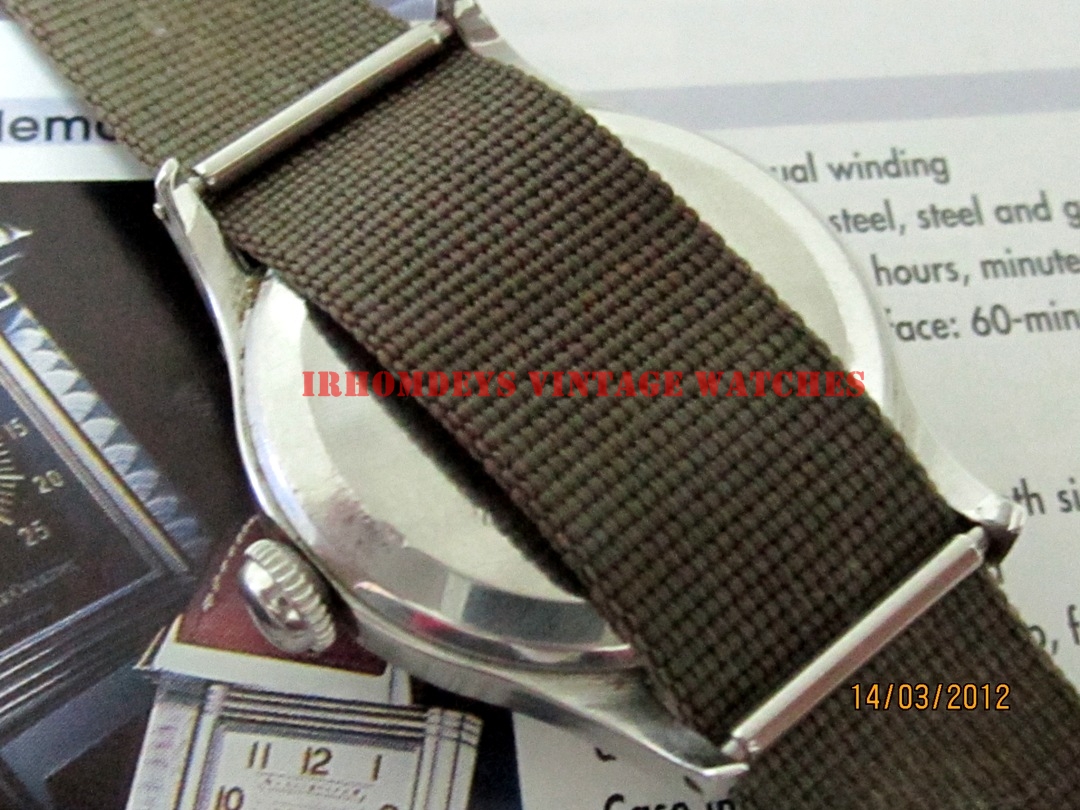
STRAP/TALI: BROWN MILITARY TEXTILE BAND

SIZE STRAP/SAIZ TALI: 7.5"

DISCONTINUED LECOULTRE MILTARY MODEL... RAREST!

BEAUTIFUL PATINA DIAL, GOOD CONDITION AND KEEPING TIME

PRICE/HARGA: UDD1,600 (NEGOTIABLE/BOLEH DIRUNDING)

A BRIEF HISTORY OF LE COULTRE WATCHES

A brilliant inventor and self-taught watchmaker, Antoine-LeCoultre founded his first workshop in 1833, following the invention of a machine to produce watchmaking pinions. Ever since, the Manufacture Jaeger-Lecoultre has developed constantly around the founder's original workshops.

Surprisingly enough, it was neither a physicist nor an engineer who first measured the micron; it was Antoine LeCoultre, in 1844. He had created watch components that were so perfect no tool could actually detect their degree of inaccuracy. He followed that up by inventing the world's most accurate instrument: the Millionometer, which served as a benchmark for over half a century.

In 1847, LeCoultre created a revolutionary system that was to do away with the need for keys to rewind and set watches. His simple and brilliant solution was a pushbutton that activated a lever to switch from one function to another. It was the first keyless winding mechanism, and the first reliable system that eliminated the need for keys to wind or set a watch.

In 1866, when Swiss watchmaking was still structured around small home-run workshops, Antoine LeCoultre and his son Elie decided to bring together under one rood the many skills involved in making watches, and installed a steam-driven machine to operate their new tools. LeCoultre & Cie thus became the first Manufacture in the Vallée de Joux.

It was in 1903 when the Parisian Edmond Jaeger set Swiss watchmakers the challenge of producing ultra-thin calibres. It would lead to the Calibre 145, the world's thinnest mechanical movement, measuring no more than 1.38 mm, and the friendship of Antoine LeCoultre's grandson, Jacques-Devid LeCoultre. These two men would give a rise to a range of horological wonders, and eventually the birth of the Jaeger-LeCoultre brand in 1937.

In the year 1908, the Manufacture created its first rectangular-shaped calibre in response to the challenge created to miniaturize watches to wear on the wrist. By the "Roaring 20s" (1920s), very small ladies' wristwatches were all the rage, but extreme miniaturization always led to a loss of reliability and precision. The Duoplan brilliantly solved this problem by arranging its parts on split levels. It would lead to the world's smallest movement, Calibre 101. Outdoing the Calibre 145, Jaeger-Lecoultre miniaturized the Duoplan caliber to the extreme, weighing in at barely one gram and comprising of 74 parts. Its record is still unmatched to this date.

Since its founding, the Manufacture has created and produced over 1,000 different calibres in many varieties. Over 200 patented inventions have contributed to the progress of Swiss watchmaking in the field of movements, as well as that of cases, bracelets, dials, and watch functions.