Showing posts with label OMEGA MOONWATCH. Show all posts

Friday, October 29, 2010

RARE COLLECTION ~ AUTHENTIC OMEGA SPEEDMASTER PROFESSIONAL MOON WATCH CHRONOGRAPH CAL. 861 GENTS WRISTWATCH (SOLD)


PERSONAL COLLECTION ~ OMEGA SPEEDMASTER MOON WATCH CHRONOGRAPH PROFESSIONAL CAL. 861 but SOLD to Alang Harris

SPEEDMASTER IN SPACE

On 1st March 1965, OMEGA's Speedmaster chronograph was "flight-qualified by NASA for all manned space missions".
The OMEGA website also features a Speedmaster special site dedicated to the world’s most iconic chronograph. Click here for even more information about the OMEGA Speedmaster line and its legacy:
Witness over 50 years of history
Launch the Speedmaster site

Nearly half a century of adventures in space

It was the only wristwatch to have withstood all of the U.S. space agency's severe tests under conditions of zero gravity and magnetic fields, extreme shocks, vibrations and temperatures ranging from -18 to +93 degrees Celsius.
In the same month, the watch was the Speedmaster was worn on board the Gemini 3 mission. It was the first “official” trip for the rugged chronograph but it had already flown in space twice during Project Mercury.

The most memorable moment in the Speedmaster's history was undoubtedly 21 July 1969 at 02:56 GMT, when it recorded man's first steps on the Moon's surface. The Apollo 11 mission was a milestone in history and the Speedmaster became the first watch (and the only watch since) to be worn on the Moon. With this unique accomplishment came a unique nickname: the Moonwatch.
“. . . flight qualified by NASA for all manned space missions.”
In April 1970, the OMEGA Speedmaster contributed to the rescue of the Apollo 13 mission from a potential disaster, earning OMEGA the "Snoopy Award", the highest distinction awarded by the NASA astronauts. In another historical event, the Speedmaster was worn on the wrists of both the American astronaut Tom Stafford and the Russian cosmonaut Alexei Leonov during the historic Apollo-Soyuz space rendezvous. This was the first time the cosmonauts also wore the OMEGA Speedmaster. Ever since, the Speedmaster has been the official chronograph of all Russian manned space missions.
As space exploration continued to break through new frontiers, the OMEGA Speedmaster was again selected by NASA in 1978 as its official chronograph for the new Space Shuttle programme following a new series of harsh tests.
The Speedmaster was later subjected to additional gruelling tests on board the Russian space station MIR between July 1993 and July 1994. The success of these exceptional endurance tests was attested by a certificate initialled by the MIR crew. The OMEGA Speedmaster had become the most tested watch in the world.
Russia's pioneering space station MIR was again used as an orbiting test laboratory in 1998 for OMEGA's X-33 multifunction chronograph. After successful completion of the tests, MIR also offered a unique opportunity to introduce the watch to the public via a live satellite link-up with the Houston Space Center.
The Speedmaster X-33 has been flight-qualified by both NASA and the Russian space agency and is part of the standard equipment avaliable to all astronauts and cosmonauts. However, the legendary OMEGA Speedmaster Professional also remains the only watch certified for extra-vehicular activity.

Friday, May 21, 2010

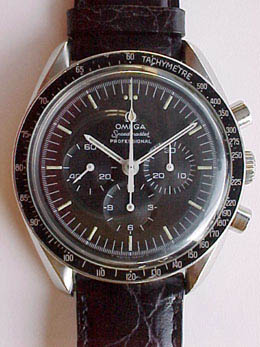
PREVIEW RAREST - OMEGA SPEEDMASTER PROFESSIONAL CHRONOGRAPH "THE MOON WATCH" GENTS WRISTWATCH (SOLD)


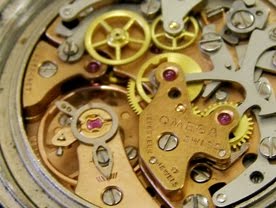
RARE COLLECTION - OMEGA SPEEDMASTER PROFESSIONAL CHRONOGRAPH THE SAME MODEL WORN BY ASTRONAUTS WHO WERE THE FIRST MEN LANDED ON THE MOON. OMEGA 17 JEWELS MANUAL WINDING CAL.861 SERIAL NO. 32834987 CIRCA 1970, A YEAR AFTER APOLLO 11 LANDED ON THE MOON.

WILL KEEP IT AS MY PERSONAL COLLECTION BECAUSE OF DIFFICULTY TO FIND AND RARITY OF THIS WATCH BUT I'M WILLING TO PART WITH IT FOR RM6,500 AND NON NEGOTIABLE

SOLD TO REPEAT BUYER, MR VUDUC FROM BELGIUM

History of the Omega Speedmaster
The first chronograph with the name "Speedmaster" appeared in 1957. And that is pretty much the same Speedmaster as we know it today. On first sight.
Through the years, a lot of things were changed on this watch. For instance, the word "Professional" in 1966 when it was approved for NASA use (more on that later), in 1968 they (Omega) changed the movement from a calibre 321 (with "schaltrad") to a cheaper to produce, but more accurate calibre 861 (with shuttlesystem). Both movements were based on Lemania movements. Todays Speedmaster Professional watch still uses the 861 movement. Before 1957, there were also some chronographs (since 1942) using the 321 calibre but they had no "Speedmaster" written on the dial.
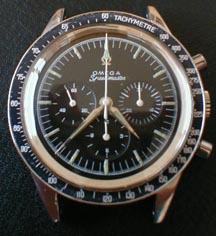
The first Speedmaster (1957) looked like this :
First  Speedmaster
Foto scanned from Time Capsule
This model, referenced as CK2915 was created in 1957 and is nowadays hard to find. The watch has the 1/5th seconds, minute and hours markings in white on a black dial. The counters are located on 3 o' clock, 6 o' clock and 9 o' clock. The bezel contains engraved tachymetre figures (not very clear on the photo above).
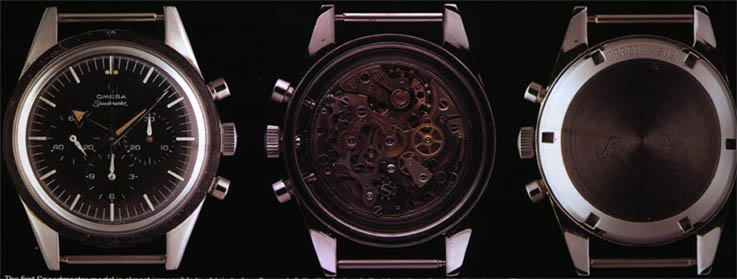
The caseback is the one with the Seamaster logo because this type of watchcase was originally developed for the Seamaster (triple-shield case to enable it to withstand high pressure). The diameter of the watch-case was 39mm.
The movement used in this watch was a 27 CHRO C12, better known as the Cal.321 (manual winding).
The 27 stands for 27mm, the CHRO stands for "chronograph" and C12 indicates that the watch has an 12-hour counter (at 6 o'clock).This movement was designed by Albert Piguet (who worked for Lemania during those days) in 1942. It took Omega 15 years to produce this watch as it was released in 1957.
In 1959 they produced a slightly modified Speedmaster, known as CK2998. The watch-case diameter expanded from 39mm to 40mm and they added a so called O-ring gasket around the push buttons.
Speedmaster  CK2998
CK2998
Until 1966 there were no big changes on the watch (look for the "Differences through the years" in the menu for details). The NASA bought a Speedmaster along with some other chronograph watches to test it for use on their missions. Read all about it in the "Nasa tests" section of this website. After long and rigirous testing of the watch, the NASA concluded that the Omega Speedmaster was the most suitable watch for 'the' job. Omega decided to make this watch the Omega Speedmaster Professional. So the word "Professional" was added but it was still the same watch. The watch got also the 145.012 reference number. There are also watches from 1966 with 145.003, these are the non-Professionals from 1966.
In 1968, Omega decided to replace the cal.321 movement by a more accurate movement which was also cheaper to produce, the cal. 861 which was also produced by Lemania. This movement is still being used in the current line of Omega Speedmaster Professionals. The movement was a bit more accurate, 21600A/h instead of 18000A/h. It also uses a shuttle cam instead of a "schaltrad" for the chronograph. Changes on the outside : white marked Omega-symbol instead of metal applied Omega-symbol and a flat dial.
Speedmaster
In 1969, the first man walked on the moon.. Neil Armstrong. He didn't wear his Omega Speedmaster Professional. The clock inside the Lunar Module went broke, and he hung his Omega Speedmaster Professional in the Lunar Model as a clock-replacement. Buzz Aldrin, he did wear his Omega Speedmaster Professional. So his watch was the first watch worn on the moon. It was a Omega Speedmaster Professional with a cal. 321 movement (confirmed by Omega). A few months after the landing on the moon, Buzz's watch was stolen and never returned.
In 1978, the watch was produced with an engraved caseback. "Fligt Qualified by NASA for all manned space missions - The first watch worn on the moon". Some casebacks have another text or logo engraved, No explanation at this time.