Showing posts with label ROLEX DATEJUST. Show all posts

Sunday, March 24, 2013

AUTHENTIC VINTAGE ROLEX DATEJUST 1601 GENTS WRISTWATCH


AUTHENTIC VINTAGE ROLEX OYSTER PERPETUAL DATEJUST 
GENTS WRISTWATCH
MADE IN/BUATAN: SWISS
CIRCA/TAHUN: 1975 -
MODEL: OYSTER PERPETUAL DATE JUST MODEL 1601
CRYSTAL/CERMIN: ACRYLIC
MOVEMENT/ENJIN: ROLEX 25 JEWELS AUTOMATIC WINDING MOVEMENT CAL. 1570
DIAL COLOR: BLACK DIAL
FUNCTION/FUNGSI: HOUR, MINUTES AND SECOND. NON QUICK SET DATE AT 3:00
HANDS/JARUM: WHITE GOLD/BLACK HANDS
MARKERS/TANDA WAKTU: RAISED WHITE GOLD TONE BATON MARKERS
CASING : SOLID STAINLESS STEEL/ KELULI SEPENUHNYA
LUGS: 19mm
MEASUREMENT/UKURAN: 37mm DIAMETER EXCLUDING CROWN and 42mm LUG TO LUG
BEZEL: SOLID 18K WHITE GOLD RING
DITANDA/ENGARVED BACK CASING: -
CROWN: ORIGINAL ROLEX 1 STEPS SOLID 18K WHITE GOLD CROWN
STRAP/TALI: GENUINE ROLEX JUBILEE STAINLESS STEEL BAND
SIZE STRAP/SAIZ TALI: 8.5"
DISCONTINUED ROLEX MODEL... RARE MINT DIAL!
EXCELLENT CONDITION, KEEPING GOODTIME AND RECENTLY SERVICED
PRICE:  SOLD TO KENNETH LEE FROM SETAPAK
LIST RM6,500 SOLD:RM

A History of Rolex Watches

Hans Wilsdorf founded the company we now know as Rolex in 1905. Born in Kulmbach, Germany in 1881, the company, Wilsdorf & Davies, was based in London. By 1908 it had become one of the leading watch companies in the UK. It was in this year that he coined the name Rolex.
Official Chronometer Certification was awarded to Rolex in 1910 from the "Bureau Officiel" in Switzerland, the first time this had ever been given to a wristwatch. This was to be the first of many accolades awarded to the watch, including the Class A Precision from the Kew Observatory in 1914.
In 1926 the Rolex Oyster was released. It was the first wristwatch to be considered waterproof, proven a year later when the watch was worn by the swimmer Mercedes Gleitze in his successful bid to cross the English Channel. This was beneficial to Wilsdorf whom had sponsored the event and gained considerable exposure for his new Oyster Watch. Wilsdorf recognized the importance of advertising and marketing his creation in order to gain publicity and prestige. 1931 saw the creation of the Perpetual Rotor, a mechanism now seen as the basis for self-winding movements. In the following years Rolex released the first Oyster Perpetual Lady-date (1954) the GMT Master with dual time zone function (1955) and the first Day-Date (1956).
Andre Heiniger took over the company following the death of Hans Wildorf on 06 July 1960. Rolex continued to invent and innovate in terms of technical skill and style throughout the 2nd half of the century. The Sea-dweller (1967) was certified as reaching depths of up to 1,220 meters making it the choice for Professional Divers - a point that was quickly adopted in advertising the model. The Explorer II (1978) and Cosmograph Daytona (1988) were also released to international waiting lists securing Rolex as one of the worlds most prestigious watch brands.

Rolex Dateline

  • 1905 - Hans Wildorf establishes a London firm specialising in the distribution of watches.
  • 1908 - Wildorf coins a brand name in which to sign his creations: Rolex.
  • 1910 - In Switzerland, Rolex obtains the first official chronometer certification ever awarded to a wristwatch.
  • 1914 - The Kew Observatory in Great Britain awards the Rolex wristwatch a CLASS A precision certificate.
  • 1926 - Rolex develops and patents the first airtight, dustproof and waterproof watch - named the Oyster.
  • 1927 - The Rolex Oyster crosses the English Channel unscathed.
  • 1931 - Birth of the Perpetual Rotor, a self winding mechanism later found in every modern automatic watch.
  • 1945 - The Oyster Datejust is invented. The first watch to display the date automatically.
  • 1953 - Rolex has created the diving watch of reference - the Submariner.
  • 1954 - The Oyster Perpetual Ladydate is introduced.
  • 1955 - The Oyster GMT Master is designed making it possible to read the time in any two time zones.
  • 1956 - The Oyster Day-Date is created.
  • 1960 - The so called Bathyscaphe is created and plunges 35,787 feet into the Mariana Trench in the Pacific Ocean.
  • 1967 - The Oyster Sea-Dweller is invented - waterproof to a depth of 610 m / 2001 ft.
  • 1971 - The Oyster Explorer II is designed.
  • 1978 - The Oyster Perpetual Date Sea-Dweller is tested waterproof to a depth of 1220 m / 4003 ft.
  • 1988 - The first Cosmograph Daytona is fitted with a perpetual rotor.
  • 1992 - A new model is added to the Professioanl range - the Yacht-Master.
  • 2004 - Submariner celebrates its 50th Anniversary. Rolex celebrates with a special commemorative model with a green bezel and unique black dial.

Saturday, October 29, 2011

SOLD - BEAUTIFUL COLLECTION - SOLID 18K BEZEL RING ROLEX OYSTER PERPETUAL DATEJUST 1601 GENTS WRISTWATCH


BRAND/JENAMA: AUTHENTIC VINTAGE ROLEX OYSTER PERPETUAL DATEJUST GENTS WRISTWATCH
MADE IN/BUATAN: SWISS
CIRCA/TAHUN: 1975 - S/N 4152481
MODEL: OYSTER PERPETUAL DATE JUST MODEL 1601
CRYSTAL/CERMIN: ACRYLIC
MOVEMENT/ENJIN: ROLEX 25 JEWELS AUTOMATIC WINDING MOVEMENT CAL. 1570
DIAL COLOR: BLACK DIAL
FUNCTION/FUNGSI: HOUR, MINUTES AND SECOND. DATE AT 3:00
HANDS/JARUM: GOLD TONE HANDS
MARKERS/TANDA WAKTU: RAISED GOLD TONE BATON MARKERS
CASING : SOLID STAINLESS STEEL/ KELULI SEPENUHNYA
LUGS: 19mm
MEASUREMENT/UKURAN: 37mm DIAMETER EXCLUDING CROWN and 42mm LUG TO LUG
BEZEL: SOLID 18K ROSE GOLD RING
DITANDA/ENGARVED BACK CASING: -
CROWN: ORIGINAL ROLEX 1 STEPS SOLID 18K ROSE GOLD CROWN
STRAP/TALI: BLACK LEATHER BAND
SIZE STRAP/SAIZ TALI: 8.5" FULL LENGHT

DISCONTINUED ROLEX MODEL... RARE MINT DIAL!
EXCELLENT CONDITION, KEEPING GOODTIME AND RECENTLY SERVICED
PRICE: SOLD TO AZUAN FROM DENGKEL
SOLD RM5700
LIST RM7,500 SOLD:RM

A History of Rolex Watches

Hans Wilsdorf founded the company we now know as Rolex in 1905. Born in Kulmbach, Germany in 1881, the company, Wilsdorf & Davies, was based in London. By 1908 it had become one of the leading watch companies in the UK. It was in this year that he coined the name Rolex.
Official Chronometer Certification was awarded to Rolex in 1910 from the "Bureau Officiel" in Switzerland, the first time this had ever been given to a wristwatch. This was to be the first of many accolades awarded to the watch, including the Class A Precision from the Kew Observatory in 1914.
In 1926 the Rolex Oyster was released. It was the first wristwatch to be considered waterproof, proven a year later when the watch was worn by the swimmer Mercedes Gleitze in his successful bid to cross the English Channel. This was beneficial to Wilsdorf whom had sponsored the event and gained considerable exposure for his new Oyster Watch. Wilsdorf recognized the importance of advertising and marketing his creation in order to gain publicity and prestige. 1931 saw the creation of the Perpetual Rotor, a mechanism now seen as the basis for self-winding movements. In the following years Rolex released the first Oyster Perpetual Lady-date (1954) the GMT Master with dual time zone function (1955) and the first Day-Date (1956).
Andre Heiniger took over the company following the death of Hans Wildorf on 06 July 1960. Rolex continued to invent and innovate in terms of technical skill and style throughout the 2nd half of the century. The Sea-dweller (1967) was certified as reaching depths of up to 1,220 meters making it the choice for Professional Divers - a point that was quickly adopted in advertising the model. The Explorer II (1978) and Cosmograph Daytona (1988) were also released to international waiting lists securing Rolex as one of the worlds most prestigious watch brands.

Rolex Dateline

  • 1905 - Hans Wildorf establishes a London firm specialising in the distribution of watches.
  • 1908 - Wildorf coins a brand name in which to sign his creations: Rolex.
  • 1910 - In Switzerland, Rolex obtains the first official chronometer certification ever awarded to a wristwatch.
  • 1914 - The Kew Observatory in Great Britain awards the Rolex wristwatch a CLASS A precision certificate.
  • 1926 - Rolex develops and patents the first airtight, dustproof and waterproof watch - named the Oyster.
  • 1927 - The Rolex Oyster crosses the English Channel unscathed.
  • 1931 - Birth of the Perpetual Rotor, a self winding mechanism later found in every modern automatic watch.
  • 1945 - The Oyster Datejust is invented. The first watch to display the date automatically.
  • 1953 - Rolex has created the diving watch of reference - the Submariner.
  • 1954 - The Oyster Perpetual Ladydate is introduced.
  • 1955 - The Oyster GMT Master is designed making it possible to read the time in any two time zones.
  • 1956 - The Oyster Day-Date is created.
  • 1960 - The so called Bathyscaphe is created and plunges 35,787 feet into the Mariana Trench in the Pacific Ocean.
  • 1967 - The Oyster Sea-Dweller is invented - waterproof to a depth of 610 m / 2001 ft.
  • 1971 - The Oyster Explorer II is designed.
  • 1978 - The Oyster Perpetual Date Sea-Dweller is tested waterproof to a depth of 1220 m / 4003 ft.
  • 1988 - The first Cosmograph Daytona is fitted with a perpetual rotor.
  • 1992 - A new model is added to the Professioanl range - the Yacht-Master.
  • 2004 - Submariner celebrates its 50th Anniversary. Rolex celebrates with a special commemorative model with a green bezel and unique black dial.

Saturday, November 6, 2010

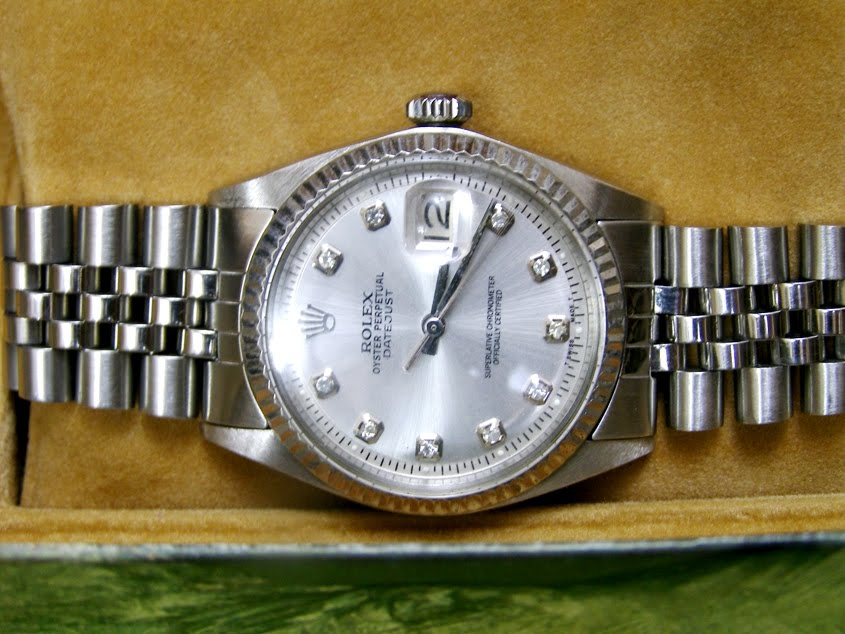
AUTHENTIC VINTAGE ROLEX OYSTER PERPETUAL DATEJUST SOLID 18K WHITE GOLD BEZEL AND GENUINE DIAMONDS DIAL GENTS WRISTWATCH (SOLD)


AUTHENTIC VINTAGE ROLEX OYSTER PERPETUAL DATEJUST 18 SOLID WHITE GOLD BEZEL AND GENUINE DIAMONDS DIAL GENTS WRISTWATCH
BRAND/JENAMA : ROLEX
MADE IN/BUATAN :
ROLEX MONTRES SA, SWITZERLANDMODEL NO : RARE MODEL 1603SERIAL NO : 2133731
MOVEMENT :
ROLEX 26 JEWELS AUTOMATIC MOVEMENT CAL. 1570CIRCA/TAHUN BUATAN : 1971FUNCTION/FUNGSI : LUXURIOUS CASUAL WATCHCRYSTAL : SAPPHIRE CRYSTAL WITH ENLARGED LENS FOR DATE AT 3:00DIAL : ROLEX
DATE WINDOW : YES AT 3:00, NON QUICKSET
DAY WINDOW : NO
CHRONOGRAPH : NO
MARKERS/TANDA WAKTU :
10 GENUINE DIAMOND VVS1 MARKERS FACTORY FITTEDHANDS/JARUM WAKTU : LUMINOUS SILVER TONE HANDSCASING : SOLID STAINLESS STEEL
SIZE :
35mm EXCLUDING CROWN and 44mm LUG TO LUG
BEZEL :
SOLID 18K WHITE GOLD FLUTTED BEZEL
CROWN :
ORIGINAL 18K WHITE GOLD 2 STEPS SCREW DOWN ROLEX CROWN STRAPS/TALI: ORIGINAL ROLEX JUBILEE STAINLESS STEEL DOUBLE CLASP LUGS SIZE: 22mm
CONDITION/KONDISI:
EXCELLENT WORKING CONDITION, KEEPING TIME AND RECENTLY SERVICEDCOMMENTS: BEAUTIFUL MINT CONDITION. RETAILED PREOWNED FOR RM45,000
ORIGINAL ROLEX DATEJUST BOX &; NO PAPER

PRICE/HARGA:
RM25,000 (SOLD TO MR YAU FROM PJ)


BRIEF HISTORY OF ROLEX AND TUDOR WATCHES

The Rolex brand was created by a visionary named Hans Wilsdorf, who was born in Bavaria in the year 1881. Just before the turn of the century young Hans moved to Geneva, and at the age of nineteen discovered the industry of watchmaking. At that time the wristwatch was considered vulgar and uncouth; gentlemen of the day carried pocketwatches. Wristwatches were worn only by women, and the tiny delicate movements were unreliable and imprecise. Leading watchmakers were convinced that the challenges involved in creating an accurate timekeeping device in such a small package were insurmountable. Hans Wilsdorf disagreed. He saw much room for improvement in an industry dominated by traditional thinking.

In 1905 Wilsdorf relocated to London and founded Wilsdorf & Davis in association with his brother-in-law Alfred, a company which manufactured watch cases and distributed wristwatches. Wilsdorf always maintained a very high standard for the quality of his products, so he was continually seeking ways to improve the design of his cases and movements. In cooperation with the firm of Aegler in Bienne, Switzerland, he developed and improved the small-caliber lever escapement movement, and was confident enough to stake a loan of five times the total capital of Wilsdorf & Davis in the first order. From then on, Wilsdorf made and sold watches; his own cases with movements imported from Switzerland. After the turn of the century as wristwatches started to enter the mainstream (as soldiers wore watches on their wrists and the general perception changed from the earlier notion that wristwatches were strictly feminine), Wilsdorf quickly saw how he could take advantage of their emerging popularity by offering a variety of case designs: formal, sporty, casual, etc. He also realized the importance of brand recognition. Until then the custom had been for the retailer�s name to appear on both the dial and the movement, but Wilsdorf wanted to distinguish his watches from those of his competitors, which he considered inferior since they did not submit their products to the exacting tests which he insisted be performed on all of his own. Hence in 1908 he coined the name Rolex, which would henceforth appear on all parts of the watch, including dial, movement, case, and bracelet. No one knows for sure where he got the name; there are many theories on the subject. But everyone agrees that Rolex is a name anyone in Europe or the world at large could easily pronounce, and is short enough to fit comfortably on the dial of any wristwatch.

History was first made by Rolex in 1910 when a movement was sent to the School of Horology at Bienne, and was awarded a chronometer bulletin. This was the first time a wristwatch had ever received the chronometer rating, and suddenly Hans Wilsdorf's brand earned the respect of horologists the world over. Four years later a Rolex movement was awarded a Class A Certificate by the Royal Observatory at Kew, again the first small caliber watch movement to receive the award. Thereupon Wilsdorf decided that all Rolex timepieces should be submitted to similar tests carried out by impartial institutes. No Rolex watch would ever again be sold without its Official Timing Certificate. After World War I, Wilsdorf moved his operation to Geneva to avoid the exorbitant import taxes in England, and renamed his company Montres Rolex S.A., and later simply Rolex S.A. The Aegler company of Bienne provided watch movements to many companies, but only Rolex demanded that each and every movement undergo a weeklong battery of meticulous tests before they would be accepted. Any irregularity whatsoever meant the movement was returned to the workshops. It was due to these stringent methods of quality control that Rolex was able to achieve such high standards in accuracy and make such advancements in the world of horology.

Wilsdorf had long ago realized that for a watch to be accurate over the long term, its case would need not only to withstand the attack of dust and water, but would need to be self winding to protect the mainspring from stress caused by overwinding. The first problem was overcome in 1926 with the creation of the Rolex "Oyster", in which the winding crown was screwed down onto the case using a twin lock system. This brilliant watch was totally protected from the environment since the case was air tight as well as waterproof. In a well publicized event the following year, the Oyster was celebrated after being worn on the wrist by Mercedes Gleitze when she swam the English Channel. The watch made world headlines for keeping perfect time after being immersed in salt water for 15 hours. The Oyster was displayed in jewelry shop windows inside aquariums; keeping time while fish swam through the bracelet.

The first self-winding movement was invented by Abram-Louis Perrelet in the mid 1800's, and later perfected by Abram-Louis Breguet, but was never widely adopted because the mechanism was too delicate for daily use. In 1923 a British watchmaker named John Harwood patented a self-winding watch movement based on a "hammer winding system", which had a semi-circular weight that pivoted at the center of the movement and swung through a 300 degree arc. The swinging weight was actuated by the movement of the wearer. Wilsdorf discarded this system as too impractical. For one thing, Harwood's watch was unable to be set except by turning the bezel, and it used an unreliable friction plate to prevent overwinding. According to Wilsdorf, a truly self-winding watch should be completely automatic, silent, able to revolve in both directions, smooth in action and completely free of buffer springs. These obstacles were surmounted in 1931 when Emile Borer, the technical head of Rolex, invented the "Rotor", whose winding mass could turn both clockwise and counter-clockwise and pivot freely on its axis. The new movement was dubbed the Rolex Oyster Perpetual, and immediately became the world standard, imitated by every watchmaker since.