Sunday, July 6, 2014

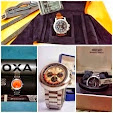
AUTHENTIC VINTAGE WALTHAM RETRO DRESS GENTS WRISTWATCH


MADE IN: USA
CIRCA: 1960's
MODEL: RETRO DRESS
CRYSTAL: ACRYLIC
MOVEMENT: HIGH GRADE WALTHAM 25 JEWELS AUTOMATIC MOVEMENT
DIAL COLOR: CREAM GOLD IN MINT CONDITION
FUNCTION: HOUR, MINUTE AND CENTER SWIPE SECOND
HANDS: LUMINOUS ARROW GOLD TONE METAL
MARKERS: RAISED GOLD TONE DIAMOND SHAPE MARKER
CASING : BASE METAL GP TOP/STAINLESS STEEL BACK
HINGING LUGS: 18mm
MEASUREMENT: 36mm DIAMETER INCLUDING CROWN and 37mm LUG TO LUG
BACK CASE ENGRAVING: -WALTHAM~SHOCK RESISTANT~WATERPROOF~ANTI MAGNETIC~ BASE METAL BEZEL~STAINLESS STEEL BACK
CROWN: ORIGINAL WALTHAM GP CROWN
STRAP: NEW GOLD PLATED BRACELET
STRAP SIZE: 8.5"
EXCELLENT CONDITION, WORKING, KEEPING TIME, DISCONTINUED MODEL & VERY RARE AND VERY HARD TO FIND
PRICE: USD120 (NEGOTIABLE)

BRIEF HISTORY OF WALTHAM WATCHES
American Waltham Watch Company, founded in 1850, were one of the largest watch makers of the 19th Century. The company was founded on a relationship between three men, in Massachusetts USA.
Mr David Davis, a Mr Dension and a Mr Howard. It was based on a dream that they could produce watches that were of good quality, yet were not made from some of the more expensive materials usually found on watches of the era.
By 1851, the trio had there own production house, and the name 'American Horology Company' was adopted.
In 1852 the company had renamed themselves and watches were being produced with the signature 'The Warran Mfg. Co.' after a Revolutionary War Hero.
Watches 1 - 17, the first from the production line, were not placed on the market but were instead given to the company officials, and executives.
From then on the company went through a number of name changes, with watches #18 - 110 being engraved with "Warren Boston", the next 800 were marked "Samuel Curtis" (The Main Financial Backer of the Company) and a few were marked "Fellows and Schel" and were sold for $40.
In September 1853 the name was changed yet again to 'Boston Watch Company' an d a factory was erected in Waltham, Massachusetts in October 1854. The movements produced at this building are marked #1,001 to #5,000 and were marked with the engraving of "Dennison, Howard & Davis,", "C.T.Parker", and "P.S. Bartlett".
Times were hard and the Boston Watch Company failed in 1857, and was subsequently sold at Auction to Royal E Robbins.
In May 1857, the company was shuffled and became "Appleton, Tracey & Co.", and the watches produced in this time carried the serial numbers between, 5,001 and 14,000 ,model 1857. The C.T.Parker movement was re-introduced as Model 1857 and was sold for $12, 399 were made. In 1855 brass watches were being sold for $1. Also at this time 598 chronometers were made, and by January 1858 the P.S.Bartlet watch was made.
In January 1859, the Waltham Improvement Company and Appleton, Tracey & Co. merged to form The American watch Company.
Also an interesting fact is that, according to the biography by Carl Sandburg, Abraham Lincoln himself carried an American Waltham wrist watch, the 'William Ellory' Model, produced by Waltham, in 1863 and was an 18 size, 1859 ¾ plate model with steel balance.
The Waltham name is synonymous with quality and craftmanship, and remain to this day, very desirable timpieces and some of the Waltham finest watches were made in Le Locke, Switzerland.
This is a peculiar Waltham watch from the 60s, during the height of the “jewel war” Another interesting sight to note is the swiss movement, which was identical to those used in many early Blancpain Bathyscaphe watches. It was know that after the closure of Waltham manufacturing facilities in US in the early 60s, it imported and marketed Swiss watches in US, including the some of the famous divewatches made by Blancpain and LIPS.
Company Name History:
Approximate Date
Company Name
1850, September
Howard, Davis and Dennison, Roxbury Mass
1851 (for 6 months.)
American Horology Co., Roxbury Mass.
1851-1853
The Warren Mfg. Co., Roxbury Mass.
1853 (Sept) - 1857 (May)
Boston Watch Co., Roxbury Mass & Waltham Mass.
1857
Tracy Baker & Co., Waltham Mass.
1857-1859
Appleton Tracy and Co., Waltham Mass.
1859-1885
American Watch Co., Waltham Mass.
1885-1923
American Waltham Watch Co., Waltham Mass.
1923-1957
Waltham Watch Co., Waltham Mass.


Saturday, July 5, 2014

AUTHENTIC VINTAGE TUDOR PRINCE DATE HYDRONAUT GENTS DIVER WRISTWATCH


BRAND: AUTHENTIC TUDOR PRINCE DATE HYDRONAUT GENTS DIVER WRISTWATCH
MADE IN: SWISS
CIRCA: 2005
MODEL: PRINCE DATE HYDRONAUT - MODEL 85190P S/N 769816
CRYSTAL: SAPPHIRE CRYSTAL
MOVEMENT: ROLEX TUDOR PRINCE 35 JEWELS AUTOMATIC MOVEMENT
DIAL COLOR: WHITE
FUNCTION: HOUR, MINUTE, CENTER SECOND, QUICKSET DATE AT 3:00
HANDS: LUMINOUS SILVER TONE
MARKERS: WHITE LUMINOUS RAISED BATON MARKERS
CASING : SOLID STAINLESS STEEL
LUGS: 20mm
MEASUREMENT: 39mm DIAMETER INCLUDING CROWN and 42mm LUG TO LUG
BEZEL: GREY DIVER BEZEL UNI TURN n CLICK
BACK CASE INSCRIPTION: TUDOR PRINCE GENEVA~TUDOR LOGO
CROWN: ORIGINAL TUDOR SS CROWN
STRAP: ORIGINAL STAINLESS STEEL BRACELET WITH ORIGINAL TUDOR SHIELD SINGLE CLAP FOLD
STRAP SIZE: 7.5"

EXCELLENT CONDITION, KEEPING TIME AND RECENTLY SERVICED. COMES WITH ORIGINAL TUDOR RED BOX. NO PAPER BUT GUARANTEED AUTHENTIC
PRICE: PERSONAL COLLECTION - RECOMMENDED RETAIL PRICE PREOWNED USD2,350
BRIEF HISTORY OF ROLEX AND TUDOR WATCHES

The Rolex brand was created by a visionary named Hans Wilsdorf, who was born in Bavaria in the year 1881. Just before the turn of the century young Hans moved to Geneva, and at the age of nineteen discovered the industry of watchmaking. At that time the wristwatch was considered vulgar and uncouth; gentlemen of the day carried pocketwatches. Wristwatches were worn only by women, and the tiny delicate movements were unreliable and imprecise. Leading watchmakers were convinced that the challenges involved in creating an accurate timekeeping device in such a small package were insurmountable. Hans Wilsdorf disagreed. He saw much room for improvement in an industry dominated by traditional thinking.

In 1905 Wilsdorf relocated to London and founded Wilsdorf & Davis in association with his brother-in-law Alfred, a company which manufactured watch cases and distributed wristwatches. Wilsdorf always maintained a very high standard for the quality of his products, so he was continually seeking ways to improve the design of his cases and movements. In cooperation with the firm of Aegler in Bienne, Switzerland, he developed and improved the small-caliber lever escapement movement, and was confident enough to stake a loan of five times the total capital of Wilsdorf & Davis in the first order. From then on, Wilsdorf made and sold watches; his own cases with movements imported from Switzerland. After the turn of the century as wristwatches started to enter the mainstream (as soldiers wore watches on their wrists and the general perception changed from the earlier notion that wristwatches were strictly feminine), Wilsdorf quickly saw how he could take advantage of their emerging popularity by offering a variety of case designs: formal, sporty, casual, etc. He also realized the importance of brand recognition. Until then the custom had been for the retailer�s name to appear on both the dial and the movement, but Wilsdorf wanted to distinguish his watches from those of his competitors, which he considered inferior since they did not submit their products to the exacting tests which he insisted be performed on all of his own. Hence in 1908 he coined the name Rolex, which would henceforth appear on all parts of the watch, including dial, movement, case, and bracelet. No one knows for sure where he got the name; there are many theories on the subject. But everyone agrees that Rolex is a name anyone in Europe or the world at large could easily pronounce, and is short enough to fit comfortably on the dial of any wristwatch.

History was first made by Rolex in 1910 when a movement was sent to the School of Horology at Bienne, and was awarded a chronometer bulletin. This was the first time a wristwatch had ever received the chronometer rating, and suddenly Hans Wilsdorf's brand earned the respect of horologists the world over. Four years later a Rolex movement was awarded a Class A Certificate by the Royal Observatory at Kew, again the first small caliber watch movement to receive the award. Thereupon Wilsdorf decided that all Rolex timepieces should be submitted to similar tests carried out by impartial institutes. No Rolex watch would ever again be sold without its Official Timing Certificate. After World War I, Wilsdorf moved his operation to Geneva to avoid the exorbitant import taxes in England, and renamed his company Montres Rolex S.A., and later simply Rolex S.A. The Aegler company of Bienne provided watch movements to many companies, but only Rolex demanded that each and every movement undergo a weeklong battery of meticulous tests before they would be accepted. Any irregularity whatsoever meant the movement was returned to the workshops. It was due to these stringent methods of quality control that Rolex was able to achieve such high standards in accuracy and make such advancements in the world of horology.

Wilsdorf had long ago realized that for a watch to be accurate over the long term, its case would need not only to withstand the attack of dust and water, but would need to be self winding to protect the mainspring from stress caused by overwinding. The first problem was overcome in 1926 with the creation of the Rolex "Oyster", in which the winding crown was screwed down onto the case using a twin lock system. This brilliant watch was totally protected from the environment since the case was air tight as well as waterproof. In a well publicized event the following year, the Oyster was celebrated after being worn on the wrist by Mercedes Gleitze when she swam the English Channel. The watch made world headlines for keeping perfect time after being immersed in salt water for 15 hours. The Oyster was displayed in jewelry shop windows inside aquariums; keeping time while fish swam through the bracelet.

The first self-winding movement was invented by Abram-Louis Perrelet in the mid 1800's, and later perfected by Abram-Louis Breguet, but was never widely adopted because the mechanism was too delicate for daily use. In 1923 a British watchmaker named John Harwood patented a self-winding watch movement based on a "hammer winding system", which had a semi-circular weight that pivoted at the center of the movement and swung through a 300 degree arc. The swinging weight was actuated by the movement of the wearer. Wilsdorf discarded this system as too impractical. For one thing, Harwood's watch was unable to be set except by turning the bezel, and it used an unreliable friction plate to prevent overwinding. According to Wilsdorf, a truly self-winding watch should be completely automatic, silent, able to revolve in both directions, smooth in action and completely free of buffer springs. These obstacles were surmounted in 1931 when Emile Borer, the technical head of Rolex, invented the "Rotor", whose winding mass could turn both clockwise and counter-clockwise and pivot freely on its axis. The new movement was dubbed the Rolex Oyster Perpetual, and immediately became the world standard, imitated by every watchmaker since.

This watch was completely overhauled/serviced in July 2006. Fully serviced, this nice Rolex Tudor Military watch is running strong and keeping perfect time. It also comes with its original Rolex bracelet. This timepiece is a keeper and will attract tons of attentions. The perfect condition dial is ORANGE in color with large bold Luminous BATON Markers and a pair nice luminous mercedes hands. The date number is black. The dial is marked, “TUDOR OYSTER PRINCE TIGER HYDRONAUT SWISS MADE
The smooth polished bezel has nice satin finishes surface. The lugs are solid and brushed with no sign of wear.


The screw down winding crown is Rolex marked and is in perfect condition.

The stainless steel case has satin finishes on both sides of the watch. No scratch or dents are noted on the case.

The crystal is in perfect condition with a cyclop to magnify the date.

Inside the back case has Rolex markings and it is in excellent condition. There are some inscription which is off view. Other than this, it has a perfect score.

This super cool timepiece is powered by Rolex precision movement. It is a high grade 17 Jewels precision manual wind mechanism. The movement was stripped pieces by pieces, cleaned, oiled and timed 2 months ago by specialist. It is in excellent running order and keeps perfect time.

Thursday, July 3, 2014

AUTHENTIC MERCEDES TRUCK LIMITED EDITION CHRONOGRAPH GENTS WRISTWATCH (SOLD)


BRAND : AUTHENTIC MERCEDES TRUCK LIMITED EDITION CHRONOGRAPH GENTS WRISTWATCH
MODEL : CHRONOGRAPH
MOVEMENT : 7JEWELS QUARZ CHRONOGRAPH MOVEMENT
ORIGIN : SWISS
SERIAL NO. : -
CIRCA : 1990's
CASING : SOLID AND HEAVY STAINLESS STEEL 
FUNCTION : HOUR, MINUTES, 3 REGISTERS CHRONOGRAPH, QUICKSET DATE AT 3:00
DIAL: BLACK
CROWN: UNSIGNED SS CROWN
MARKINGS: DIAL, CASEBACK, MOVEMENT
BAND : NEW GREEN TEXTILE MILITARY BAND
LUGS SIZE: 20mm
BAND WIDTH: 20mm
LENS/CERMIN : SCRATCH FREE SAPPHIRE CRYSTAL
MEASUREMENT : 37mm w/o CROWN X 44mm LUG TO LUG
WATER RESISTANT: 300M (3 ATM)
CONDITION/KONDISI : EXCELLENT WORKING CONDITION AND KEEPING TIME, NO BOX NO PAPER BUT GUARANTEED AUTHENTIC
PRICE: SOLD

Wednesday, July 2, 2014

AUTHENTIC MATHEY TISSOT TANQ UNISEX WRISTWATCH


BRAND: MATHEY TISSOT
MADE IN: SWISS
CIRCA:  2009
MODEL: DRESS  TANQ
CRYSTAL: ACRYLIC CRYSTAL
MOVEMENT: MATHEY TISSOT SWISS QUARTZ ETA MOVEMENT
DIAL COLOR: BLACK
FUNCTION: HOUR, MINUTE, SUB SECOND AT 6:00
HANDS: GOLD TONE 
MARKERS: LUME GOLD TONE ROMAN
CASING : STAINLESS STEEL
LUGS: 18mm
MEASUREMENT: 28mm DIAMETER EXCLUDING CROWN and 36mm LUG TO LUG
BACK CASE INSCRIPTION: MATHEY TISSOT ~STAINLESS STEEL
CROWN: GP
STRAP: GENUINE BROWN MT LEATHER BANDS
STRAP SIZE: 8.5"
EXCELLENT CONDITION, WORKING, NO LONGER PRODUCED BY MATHEY TISSOT
PRICE: SOLD(SOLD TO Cikgu Zul from Sabah, Borneo)
History of  Mathey Tissot Watch Co
Near the center of the Swiss Jura Mountains, at an altitude of 3.000 feet, lies the village of Les Ponts de Martel, nestled in one of Switzerland’s most beautiful valleys. Here, in the year 1886, the Mathey-Tissot Watch Company was founded. Then began a unique story based on quality, integrity and personal service.

Mathey-Tissot initially specialised in "repeteater" watches, timepieces that chime the hour and halfhour. Soon afterwards, the company undertook the production of chronographs (stop-watches), crafted with such ingenuity and precision that they were immediately successful. In fact, numerous prizes and awards for superlative quality were collected throughout Europe.

In 1890 the Boer War between England and South Africa erupted, and the demand for Mathey- Tissot's fine watches became so great that a new larger factory was built. (Among the orders received was one from a jeweller in Scotland who had been commissioned by a local nobelman to supply a gold repeater watch to each oficer in his son's regiment, and a sterling silver model for each enlisted mall. Small though it may appear today, that order for 2'500 watches was enormous by prevailing standards.)

In the Kew Observatory Competition of 1914, Mathey-Tissot was represented by six chronographs, each with split-second timing. All not only passed the Class A rating with mention of "specially good", but one had a record never previously attained. Later that same year Mathey-Tissot followed this accomplishment with the award of the Grand Prix at Berne's Swiss National Exhibition. As the years passed, a striking array of other honors was earned by the famed craftsmaen of Mathey-Tissot. During World War I, Mathey-Tissot was called on to supply the United States Army Corps of Engineers with large quantities of precision chronographs, and Gen. John J. Pershing, Commander of the United States Expeditionary Forces, selected Mathey-Tissot as the watch to award to members of his staff.

In addition to its regular business of producing fine watches for jewellers throughout the world, Mathey-Tissot before and during World War II turned out thousands of timepieces for the United States armed forces and the British Navy.

Today Mathey-Tissot offers a rare blend of expertise, quality styling and personalized handling that unfortunately has all but gone from the watch industry. The key word is "Flexibility". Buyers, large or small are not just numbers - they are names and friends.
The Mathey-Tissot story has really just begun. Never content to " sit on its laurels", the company has big plans for the future - "big" in the sense that new, innovative watches and ideas will continue to position Mathey-Tissot in the forefront of super quality Swiss watch companies but "small" enough never to forget that relations with its customers is paramount.

EXTREMELY RARE 10K GOLD FILLED GRUEN LARGE MILITARY ARTDECO GENTS WRISTWATCH


BRAND: EXTREMELY RARE 10K GOLD FILLED GRUEN LARGE MILITARY ARTDECO GENTS WRISTWATCH
MADE IN: SWISS
CIRCA: 1950 based on style no 707 stamped on the caseback
MODEL: ARTDECO
CRYSTAL: ACRYLIC
MOVEMENT: SWISS AGLEAR GRUEN GUILD 15 JEWELS MANUAL WINDING MOVEMENT CAL. 707
DIAL COLOR: SILVER - NICE PATINA
FUNCTION: HOUR, MINUTE AND SUB SECOND DIAL AT 6:00
HANDS: BLUE METAL
MARKERS: BLACK ARABIC MILITARY
CASING : 10K GOLD FILLED - 33mm with crown and 38mm lug to lug
LUGS: 16mm UNIQUE DESIGN HARD TO FIND
CROWN: LARGE 10K GOLD FILLED
BACK CASE INSCRIPTION: GRUEN
STRAP: NEW GENUINE BROWN LEATHER BAND
STRAP SIZE: 8.5"
WORKING CONDITION, KEEPING TIME, DISCONTINUED MODEL & HARD TO FIND
PRICE: USD400 (NEGOTIABLE)

Gruen Watch Company
On June 12, 1874 Dietrich Gruen applied for a patent on an improved safety pinion, which was granted on December 22. He was 27 years old.

In 1876 he formed the Columbus Watch Manufacturing Company in the basement of a downtown Columbus, Ohio bank building.

In his Columbus workshop, Dietrich modified, finished and cased raw movements that were imported from Switzerland. These new watches included his patented safety pinion. Dietrich introduced 16-size watches as an alternative to the heavy and thick 18-size and larger watches that were prevalent at the time. He also introduced the first stemwind watches sold in the U.S. market.

As the company grew, they moved to two floors in a commerical building a few blocks away.

In 1882, in collaboration with a number of new partners, the company was reorganized as the Columbus Watch Company and moved to a newly-constructed factory building located on Thurman Street, in the 'German Village' section of Columbus. Dietrich was President of the new corporation.

By 1888 production was about 45 watches per day; the company would grow to 300 employees and output to 150 watches per day. Although the company continued to issue stemwind watches, they also manufactured keywind movements for some of their less-expensive models.

After a series of disagreements with the other partners, Dietrich Gruen and his son Fred left the Columbus Watch Company in 1894, shortly before the business went bankrupt. Dietrich had lost his share of the company to the investors, and was faced with the prospect of staying on as a salaried employee at the company that he had founded. He chose to leave rather than bear this indignity. After the departure of the Gruens the firm was reorganized, refinanced and renamed "The New Columbus Watch Company."

The New Columbus Watch Company survived until 1903. The contents of the factory, including all the tooling and stocks of movements, were eventually purchased by the Studebaker family, moved to Indiana (along with many key employees) and used to start the South Bend Watch Company. Some early South Bend watches were sold with signed Columbus movements in them.

In 1894, Fred Gruen and Dietrich Gruen decided to try to start a new watch company. Using money borrowed from friends and relatives, Dietrich and Fred formed the partnership "D. Gruen and Son.".

These first Gruen watches are of very high quality and are beautifully made. Both 18 and 16 size versions were manufactured, each in both open face and hunter styles, and in 18- and 21-jewel versions. The earliest D. Gruen & Son serial numbers started around 62000. The Gruens dealt directly with individual jewelry stores; there were no wholesalers or jobbers involved in the distribution of their watches.

In 1898 George Gruen joined the firm as treasurer and financial officer. The company incorporated and its name changed to D. Gruen, Sons & Company.

In 1903 Gruen introduces its "VeriThin" line of watches.

In 1908 Gruen introduced both men's and women's wristwatches. These proved popular only with women. Gruen was one of a very few companies to take wristwatches seriously this early, seeing their potential in spite of disappointing early sales to male customers.

Gruen made both wrist and pocket watches for the military during World War I. Most had silver cases, which would tarnish but would not corrode under adverse conditions. To satisfy U.S. military regulations, these watches all have luminous dial markings and hands.

1911 Dietrich Gruen dies suddenly. Fred Gruen takes control of the company.

In 1913 the company purchased Nanny Goat Hill, a pasture just outside of Cincinnati, and renamed it Time Hill. Work began on a new building designed by architect Guy C. Burroughs at a construction cost estimated at $50,000 USD. The company moved to the new location in 1917.

1921: Gruen introduces The Cartouche wrist watch calling it "The logical wrist watch shape".

1922: Gruen introduces "The Pentagon" pocket watch. "the Croix de Guerre of American achievement"

Up until 1922 there had actually been three Gruen companies: D. Gruen, Sons & Company; The Gruen National Watch Case Company of Cincinnati; and The Gruen Watch Manufacturing Company of Biel, Switzerland. In 1922 all three businesses were merged to form the Gruen Watch Company, with Fred as President.

In 1924, Gruen released a special pocket watch in an edition of 600 to commemorate their 50th anniversary. The watch cost $500 at the time.

In 1925, Gruen introduced the men's Quadron. These were rectangular watches containing very high-quality 15-j or 17-j tonneau-shaped movements.

In 1928 Gruen releases The Techni-Quadron. The famous Techni-Quadron "doctor's watches" are so-called because the large seconds dial was handy for timing a patient's pulse.

In 1935 Fred Gruen, now 63 years old, became Chairman of the Board and Benjamin S. Katz was brought in as President of the Gruen Watch Company. In 1935, Gruen was about $1.8 million USD (roughly $36 million USD today) in debt; nervous stockholders and investors were behind the change. Fred would retire in 1940, but continued to sit on the board for the rest of his life.

In 1935 Gruen introduces the most famous Gruen wristwatch- "The Curvex". These watches are one of the greatest examples of 1930s streamlined design.

1937: Gruen introduces "The Ristside" or "driver's" watches.

In 1938, continuing the success of their VeriThin pocket watches, Gruen also launched a series of Veri-Thin wristwatches. Contemporary Curvex and Veri-Thin movements often are closely related, and can share many parts. By the 1940s, most Gruen wristwatches were either Veri-Thin or Curvex models.

Although Gruen did not manufacture watches for the U.S. military, they offered the public a collection of eight military-style watches, to be used as personal watches.

In 1949, the company introduced their first watches made entirely in the U.S., a line of 21-jewel men's models called the "Gruen 21". The movements are marked "Cincinnati" or "US" instead of the usual "Switzerland."

Fred Gruen retired in 1940 and died in 1945, and his brother George died in 1952. In 1953 the Gruen family sold their interest in the company. The same year, Gruen president Benjamin Katz was forced into retirement after a scandal, and in 1954 the company bought out his shares for $2 million USD.

In 1953, the Gruen Watch Company had its highest sales in its entire history.Gruen, Rolex and Aegler

One of the most deeply-held myths about Gruen is that Gruen and Rolex at one time manufactured movements for each other's watches. Both firms did use some of the same movements—the best known examples are the Gruen Techi-Quadron and its twin, the Rolex Prince. In reality, these movements were manufactured by a third company, Aegler, who was a very close neighbor to the Gruen Precision Factory. They were Aegler's biggest customers, and were both large shareholders as well—the full company name at one time was, Aegler, Societe Anonyme, Fabrique des Montres Rolex & Gruen Guild A. Gruen and Rolex both occasionally showed pictures of the huge Aegler factory in their advertising, making the implication that this was a Gruen- or Rolex-owned facility, although ownership at the time was divided among Gruen, Rolex and Aegler itself. Gruen sold their Aegler shares in the 1930s, after they moved all production to the Precision Factory. After this time, Aegler became increasingly tied to Rolex through the sale of stock. Today, the main Rolex building in Biel is the old Aegler factory, and though it is now owned by Rolex, it is still run by the Aegler family.

This article taken from Complete Price Guide to Watches, American Wriswatches, Rolex Wristwatches: Best of Time and Gruen Master Book