Tuesday, June 3, 2014

AUTHENTIC VINTAGE OMEGA FULL 14K GOLD FILLED GENTS WRISTWATCH (SOLD)


BRAND/JENAMA: AUTHENTIC VINTAGE OMEGA FULL 14K GOLD FILLED GENTS WRISTWATCH
MADE IN/BUATAN: SWISS
CIRCA/TAHUN: 1954 (S/N 14850796)
MODEL: DRESS
CRYSTAL/CERMIN: ACRYLIC
MOVEMENT/ENJIN: VERY RARE OMEGA 17 JEWELS AUTOMATIC BUTTERFLY MOVEMENT CAL.500
DIAL COLOR: BLACK
FUNCTION/FUNGSI: HOUR, MINUTES, SECONDS
HANDS/JARUM: GOLD TONE ARROW HANDS
MARKERS/TANDA WAKTU: GOLD TONE ARROW HEAD AND ARABIC (3,6,9,12) MARKER
CASING : FULL 14K GOLD FILLED CASING WITH THICK LUGS
FAT LUGS: 18mm 
MEASUREMENT/UKURAN: 34mm DIAMETER without CROWN and 42mm LUG TO LUG
BACK CASE INSCRIPTION: 14K GOLDFILLED
CROWN: ORIGINAL GP OMEGA CROWN
STRAP/TALI: GENUINE BLACK LEATHER STRAP with OMEGA Buckle  FITS 8.5" WRIST
STRAP SIZE: 8.5"
EXCELLENT CONDITION, WORKING, KEEPING TIME, DISCONTINUED MODEL & VERY RARE AND VERY HARD TO FIND
PRICE: :SOLD (MARUNI MARI FROM MIRI, SARAWAK)
listing: USD700 sold USD700
History of Omega Watch Co
The History of a Successful Company Omega was founded by Louis Brandt at La Chaux – de – Fonds, Switzerland in 1848 as a assembly workshop. In 1879, after his death, his two sons Louis Paul and César started the in-house manufacturing so they started having total production control. One year later, Omega moved into a small factory that became a huge one when 12 months later they bought the entire building. In 1903, they both died leaving the company in 24 years old, Paul Emile Brandt’s hands. Because of the crisis that the Second World War left, he had to work really hard in order to face the economic difficulties. He merged Omega with Tissot calling the new company SSIH. The SSIH group continued to grow and multiply under his leadership and, by the seventies, it had become Switzerland’s number one producer of finished watches and number three in the world.
In 1985, the holding company was taken over by a group of private investors under Nicolas Hayek leadership. It was immediately renamed SMH (Société suisse de Microélectronique et d'Horlogerie). SMH had a rapid growth and success becoming today's top watch producer in the world. Named Swatch Group in 1998, it now includes Blancpain and Breguet.

 AUTHENTIC VINTAGE GRUEN PRECISION  DAYDATE AUTOWIND GENTS WRISTWATCH


BRAND: AUTHENTIC VINTAGE GRUEN PRECISION  DAYDATE AUTOWIND GENTS WRISTWATCH
MADE IN: SWITZERLAND
CIRCA/TAHUN: 1970's based on personal inscription on the caseback
MODEL: DAYDATE PRECISION AUTOWIND
CRYSTAL: ACRYLIC
MOVEMENT: SWISS AGLEAR GRUEN 17 JEWELS AUTOMATIC WINDING MOVEMENT CAL. 550 SS CD
DIAL COLOR: BLUE with OPAL PATTERN
FUNCTION: HOUR, MINUTE, SWIPE CENTER SECOND, DAYDATE AT 3:00
HANDS: GOLD TONE HANDS LUMINESCENT 
MARKERS: RAISED GOLD TONE BATON MARKERS
CASING : G 16 KARAT GOLD PLATE BEZEL and STAINLESS STEEL BACK - 36mm without crown and 42mm lug to lug
LUGS:  19mm
CROWN:  GP UNSIGNED
BACK CASE INSCRIPTION: GRUEN, SWISS MADE, 16 KARAT GOLD ELECTROPLATE BEZEK, STAINLESS STEEL BACK, 'BOB 6-70'
STRAP: NEW GENUINE SS WIRE MESH BAND
STRAP SIZE: 8.5"
WORKING CONDITION, KEEPING TIME, DISCONTINUED MODEL & HARD TO FIND
PRICE/HARGA:  USD250 (NEGOTIABLE)

Gruen Watch Company
On June 12, 1874 Dietrich Gruen applied for a patent on an improved safety pinion, which was granted on December 22. He was 27 years old.

In 1876 he formed the Columbus Watch Manufacturing Company in the basement of a downtown Columbus, Ohio bank building.

In his Columbus workshop, Dietrich modified, finished and cased raw movements that were imported from Switzerland. These new watches included his patented safety pinion. Dietrich introduced 16-size watches as an alternative to the heavy and thick 18-size and larger watches that were prevalent at the time. He also introduced the first stemwind watches sold in the U.S. market.

As the company grew, they moved to two floors in a commerical building a few blocks away.

In 1882, in collaboration with a number of new partners, the company was reorganized as the Columbus Watch Company and moved to a newly-constructed factory building located on Thurman Street, in the 'German Village' section of Columbus. Dietrich was President of the new corporation.

By 1888 production was about 45 watches per day; the company would grow to 300 employees and output to 150 watches per day. Although the company continued to issue stemwind watches, they also manufactured keywind movements for some of their less-expensive models.

After a series of disagreements with the other partners, Dietrich Gruen and his son Fred left the Columbus Watch Company in 1894, shortly before the business went bankrupt. Dietrich had lost his share of the company to the investors, and was faced with the prospect of staying on as a salaried employee at the company that he had founded. He chose to leave rather than bear this indignity. After the departure of the Gruens the firm was reorganized, refinanced and renamed "The New Columbus Watch Company."
The New Columbus Watch Company survived until 1903. The contents of the factory, including all the tooling and stocks of movements, were eventually purchased by the Studebaker family, moved to Indiana (along with many key employees) and used to start the South Bend Watch Company. Some early South Bend watches were sold with signed Columbus movements in them.

In 1894, Fred Gruen and Dietrich Gruen decided to try to start a new watch company. Using money borrowed from friends and relatives, Dietrich and Fred formed the partnership "D. Gruen and Son.".

These first Gruen watches are of very high quality and are beautifully made. Both 18 and 16 size versions were manufactured, each in both open face and hunter styles, and in 18- and 21-jewel versions. The earliest D. Gruen & Son serial numbers started around 62000. The Gruens dealt directly with individual jewelry stores; there were no wholesalers or jobbers involved in the distribution of their watches.

In 1898 George Gruen joined the firm as treasurer and financial officer. The company incorporated and its name changed to D. Gruen, Sons & Company.

In 1903 Gruen introduces its "VeriThin" line of watches.

In 1908 Gruen introduced both men's and women's wristwatches. These proved popular only with women. Gruen was one of a very few companies to take wristwatches seriously this early, seeing their potential in spite of disappointing early sales to male customers.

Gruen made both wrist and pocket watches for the military during World War I. Most had silver cases, which would tarnish but would not corrode under adverse conditions. To satisfy U.S. military regulations, these watches all have luminous dial markings and hands.

1911 Dietrich Gruen dies suddenly. Fred Gruen takes control of the company.

In 1913 the company purchased Nanny Goat Hill, a pasture just outside of Cincinnati, and renamed it Time Hill. Work began on a new building designed by architect Guy C. Burroughs at a construction cost estimated at $50,000 USD. The company moved to the new location in 1917.

1921: Gruen introduces The Cartouche wrist watch calling it "The logical wrist watch shape".

1922: Gruen introduces "The Pentagon" pocket watch. "the Croix de Guerre of American achievement"

Up until 1922 there had actually been three Gruen companies: D. Gruen, Sons & Company; The Gruen National Watch Case Company of Cincinnati; and The Gruen Watch Manufacturing Company of Biel, Switzerland. In 1922 all three businesses were merged to form the Gruen Watch Company, with Fred as President.

In 1924, Gruen released a special pocket watch in an edition of 600 to commemorate their 50th anniversary. The watch cost $500 at the time.

In 1925, Gruen introduced the men's Quadron. These were rectangular watches containing very high-quality 15-j or 17-j tonneau-shaped movements.

In 1928 Gruen releases The Techni-Quadron. The famous Techni-Quadron "doctor's watches" are so-called because the large seconds dial was handy for timing a patient's pulse.

In 1935 Fred Gruen, now 63 years old, became Chairman of the Board and Benjamin S. Katz was brought in as President of the Gruen Watch Company. In 1935, Gruen was about $1.8 million USD (roughly $36 million USD today) in debt; nervous stockholders and investors were behind the change. Fred would retire in 1940, but continued to sit on the board for the rest of his life.

In 1935 Gruen introduces the most famous Gruen wristwatch- "The Curvex". These watches are one of the greatest examples of 1930s streamlined design.

1937: Gruen introduces "The Ristside" or "driver's" watches.

In 1938, continuing the success of their VeriThin pocket watches, Gruen also launched a series of Veri-Thin wristwatches. Contemporary Curvex and Veri-Thin movements often are closely related, and can share many parts. By the 1940s, most Gruen wristwatches were either Veri-Thin or Curvex models.

Although Gruen did not manufacture watches for the U.S. military, they offered the public a collection of eight military-style watches, to be used as personal watches.

In 1949, the company introduced their first watches made entirely in the U.S., a line of 21-jewel men's models called the "Gruen 21". The movements are marked "Cincinnati" or "US" instead of the usual "Switzerland."

Fred Gruen retired in 1940 and died in 1945, and his brother George died in 1952. In 1953 the Gruen family sold their interest in the company. The same year, Gruen president Benjamin Katz was forced into retirement after a scandal, and in 1954 the company bought out his shares for $2 million USD.

In 1953, the Gruen Watch Company had its highest sales in its entire history.Gruen, Rolex and Aegler

One of the most deeply-held myths about Gruen is that Gruen and Rolex at one time manufactured movements for each other's watches. Both firms did use some of the same movements—the best known examples are the Gruen Techi-Quadron and its twin, the Rolex Prince. In reality, these movements were manufactured by a third company, Aegler, who was a very close neighbor to the Gruen Precision Factory. They were Aegler's biggest customers, and were both large shareholders as well—the full company name at one time was, Aegler, Societe Anonyme, Fabrique des Montres Rolex & Gruen Guild A. Gruen and Rolex both occasionally showed pictures of the huge Aegler factory in their advertising, making the implication that this was a Gruen- or Rolex-owned facility, although ownership at the time was divided among Gruen, Rolex and Aegler itself. Gruen sold their Aegler shares in the 1930s, after they moved all production to the Precision Factory. After this time, Aegler became increasingly tied to Rolex through the sale of stock. Today, the main Rolex building in Biel is the old Aegler factory, and though it is now owned by Rolex, it is still run by the Aegler family.

This article taken from Complete Price Guide to Watches, American Wriswatches, Rolex Wristwatches: Best of Time and Gruen Master Book

AUTHENTIC VINTAGE FULL 14K GOLDFILLED MOVADO GENTS DRESS WRISTWATCH


BRAND: AUTHENTIC MOVADO BLACK DRESS GENTS WRISTWATCH
MADE IN: SWISS
CIRCA: 1960's
MODEL: DRESS WATCH
CRYSTAL:  ACRLIC CRYSTAL
MOVEMENT: HIGH GRADE MOVADO 17 JEWELS AUTOMATIC MOVEMENT CAL.1798 stamped MXL
DIAL COLOR: BLACK SHINNING
FUNCTIONS: HOUR, MINUTE & SWIPE SECOND
HANDS: GOLDTONE ARROW HANDS
MARKERS: RAISED GOLD TONE ARROW HEAD MARKERS
CASING : 14K GOLD FILLED FULL CASE
LUGS: 18mm
MEASUREMENT: 34mm DIAMETER without CROWN and 43mm LUG TO LUG
BACK CASE INSCRIPTION:14K GOLDFILLED
CROWN: ORIGINAL UNSIGNED MOVADO CROWN
STRAP: NEW BLACK LEATHER STRAP
STRAP SIZE: 8.5"
WORKING CONDITION, KEEPING TIME, DISCONTINUED MODEL & HARD TO FIND
PRICE/HARGA : USD650  (NEGOTIABLE)
list :USD650.00 sold USD650.00
THE BRIEF HISTORY OF MOVADO WATCHES
Movado, a company whose name means "always in motion" in Esperanto, began its life in 1881 in a small workshop in La Chaux-de-faunds, Switzerland. Founded by talented watchmaker Achille Ditisheim and his team of six employees, all watches were manufactured and assembled by hand.
By 1899, their hard work and determination had paid off. They were awarded six first-class Official Rating Certificates in their class, and in the following year, they were awarded the Silver Medal at the Universal Exhibition in Paris.
By 1905, the company had settled on its now famous name, Movado, and began in earnest its now famous pursuit of excellence in design and function. They won the 1910 Grand Prix Exhibitions in Paris, Rome, Brussels and Rio de Janeiro for their introduction of 8 ligne wristwatch movements. The introduction of the Polyplan watch in 1912 took the watch community by storm, and these watches are highly sought after at auction today.
In 1947, American designer Nathan George Horwitt created the first Museum Watch. It featured an uncluttered dial, with a simple gold dot marker at the 12:00 position. He likened the design to that of a sun-dial, like recognizing the sun at its zenith at high noon.
The black Museum Watch was already well known, and the company expanded the line to include dozens of variants. There were at least 24 different watches being sold under the name Movado Museum Watch in 1986, and some of these were a far cry from the gaunt simplicity of Horwitt's original design. One watch even had numbers on the dial, and it was ringed with diamonds. The name "Museum Watch" had a certain cachet that the company's advertising exploited as well as it could. The Museum of Modern Art, which displayed the original Horwitt watch, even put up a disclaimer in 1984, noting that "the Movado watch is not a Museum of Art watch, nor is there any connection between the Museum of Modern Art and the Movado Watch Corporation." Sol Flick, a lawyer for North American Watch countered that the "museum" in "Museum Watch" might refer to any museum. "It could be the Museum of Natural History," he said in a November 1986 Consumer Reports article.
Movado later teamed up with designers and artists such as Andy Warhol to create one-of-a-kind limited edition watches, which reside in museums, galleries, and collections today.
Movado is returning to its roots today. It has re-introduced the KingMatic series, which was originally introduced in the 1950's, and featured the first automatic movement and sweeping second hand, both driven from a central rotor. Today, the KingMatic features an all stainless steel case, stainless steel or leather bracelet, sapphire crystal, automatic movement, and is water resistant to 50 meters.

AUTHENTIC VINTAGE GRUEN OVAL DAYDATE AUTOWIND GENTS WRISTWATCH


BRAND: AUTHENTIC VINTAGE GRUEN OVAL DAYDATE AUTOWIND GENTS WRISTWATCH
MADE IN: SWITZERLAND
CIRCA/TAHUN: 1952 based on Style no 780 stamped on inner caseback
MODEL: DAYDATE OVAL
CRYSTAL: ACRYLIC
MOVEMENT: SWISS AGLEAR GRUEN 17 JEWELS AUTOMATIC WINDING MOVEMENT CAL. 760 CD
DIAL COLOR: BLUE with OPAL PATTERN
FUNCTION: HOUR, MINUTE, SWIPE CENTER SECOND, DAYDATE AT 6:00
HANDS: SILVER TONE HANDS LUMINESCENT 
MARKERS: RAISED SILVER TONE BATON MARKERS
CASING : SOLID STAINLESS STEEL - 37mm without crown and 39mm lug to lug
LUGS: 20mm
CROWN:  SS UNSIGNED
BACK CASE INSCRIPTION: GRUEN, SWISS MADE, STAINLESS STEEL CASE, AUTOMATIC
STRAP: NEW GENUINE SS WIRE MESH BAND
STRAP SIZE: 8.5"
WORKING CONDITION, KEEPING TIME, DISCONTINUED MODEL & HARD TO FIND
PRICE/HARGA:  USD250 (NEGOTIABLE)

Gruen Watch Company
On June 12, 1874 Dietrich Gruen applied for a patent on an improved safety pinion, which was granted on December 22. He was 27 years old.

In 1876 he formed the Columbus Watch Manufacturing Company in the basement of a downtown Columbus, Ohio bank building.

In his Columbus workshop, Dietrich modified, finished and cased raw movements that were imported from Switzerland. These new watches included his patented safety pinion. Dietrich introduced 16-size watches as an alternative to the heavy and thick 18-size and larger watches that were prevalent at the time. He also introduced the first stemwind watches sold in the U.S. market.

As the company grew, they moved to two floors in a commerical building a few blocks away.

In 1882, in collaboration with a number of new partners, the company was reorganized as the Columbus Watch Company and moved to a newly-constructed factory building located on Thurman Street, in the 'German Village' section of Columbus. Dietrich was President of the new corporation.

By 1888 production was about 45 watches per day; the company would grow to 300 employees and output to 150 watches per day. Although the company continued to issue stemwind watches, they also manufactured keywind movements for some of their less-expensive models.

After a series of disagreements with the other partners, Dietrich Gruen and his son Fred left the Columbus Watch Company in 1894, shortly before the business went bankrupt. Dietrich had lost his share of the company to the investors, and was faced with the prospect of staying on as a salaried employee at the company that he had founded. He chose to leave rather than bear this indignity. After the departure of the Gruens the firm was reorganized, refinanced and renamed "The New Columbus Watch Company."

The New Columbus Watch Company survived until 1903. The contents of the factory, including all the tooling and stocks of movements, were eventually purchased by the Studebaker family, moved to Indiana (along with many key employees) and used to start the South Bend Watch Company. Some early South Bend watches were sold with signed Columbus movements in them.

In 1894, Fred Gruen and Dietrich Gruen decided to try to start a new watch company. Using money borrowed from friends and relatives, Dietrich and Fred formed the partnership "D. Gruen and Son.".

These first Gruen watches are of very high quality and are beautifully made. Both 18 and 16 size versions were manufactured, each in both open face and hunter styles, and in 18- and 21-jewel versions. The earliest D. Gruen & Son serial numbers started around 62000. The Gruens dealt directly with individual jewelry stores; there were no wholesalers or jobbers involved in the distribution of their watches.

In 1898 George Gruen joined the firm as treasurer and financial officer. The company incorporated and its name changed to D. Gruen, Sons & Company.

In 1903 Gruen introduces its "VeriThin" line of watches.

In 1908 Gruen introduced both men's and women's wristwatches. These proved popular only with women. Gruen was one of a very few companies to take wristwatches seriously this early, seeing their potential in spite of disappointing early sales to male customers.

Gruen made both wrist and pocket watches for the military during World War I. Most had silver cases, which would tarnish but would not corrode under adverse conditions. To satisfy U.S. military regulations, these watches all have luminous dial markings and hands.

1911 Dietrich Gruen dies suddenly. Fred Gruen takes control of the company.

In 1913 the company purchased Nanny Goat Hill, a pasture just outside of Cincinnati, and renamed it Time Hill. Work began on a new building designed by architect Guy C. Burroughs at a construction cost estimated at $50,000 USD. The company moved to the new location in 1917.

1921: Gruen introduces The Cartouche wrist watch calling it "The logical wrist watch shape".

1922: Gruen introduces "The Pentagon" pocket watch. "the Croix de Guerre of American achievement"

Up until 1922 there had actually been three Gruen companies: D. Gruen, Sons & Company; The Gruen National Watch Case Company of Cincinnati; and The Gruen Watch Manufacturing Company of Biel, Switzerland. In 1922 all three businesses were merged to form the Gruen Watch Company, with Fred as President.

In 1924, Gruen released a special pocket watch in an edition of 600 to commemorate their 50th anniversary. The watch cost $500 at the time.

In 1925, Gruen introduced the men's Quadron. These were rectangular watches containing very high-quality 15-j or 17-j tonneau-shaped movements.

In 1928 Gruen releases The Techni-Quadron. The famous Techni-Quadron "doctor's watches" are so-called because the large seconds dial was handy for timing a patient's pulse.

In 1935 Fred Gruen, now 63 years old, became Chairman of the Board and Benjamin S. Katz was brought in as President of the Gruen Watch Company. In 1935, Gruen was about $1.8 million USD (roughly $36 million USD today) in debt; nervous stockholders and investors were behind the change. Fred would retire in 1940, but continued to sit on the board for the rest of his life.

In 1935 Gruen introduces the most famous Gruen wristwatch- "The Curvex". These watches are one of the greatest examples of 1930s streamlined design.

1937: Gruen introduces "The Ristside" or "driver's" watches.

In 1938, continuing the success of their VeriThin pocket watches, Gruen also launched a series of Veri-Thin wristwatches. Contemporary Curvex and Veri-Thin movements often are closely related, and can share many parts. By the 1940s, most Gruen wristwatches were either Veri-Thin or Curvex models.

Although Gruen did not manufacture watches for the U.S. military, they offered the public a collection of eight military-style watches, to be used as personal watches.

In 1949, the company introduced their first watches made entirely in the U.S., a line of 21-jewel men's models called the "Gruen 21". The movements are marked "Cincinnati" or "US" instead of the usual "Switzerland."

Fred Gruen retired in 1940 and died in 1945, and his brother George died in 1952. In 1953 the Gruen family sold their interest in the company. The same year, Gruen president Benjamin Katz was forced into retirement after a scandal, and in 1954 the company bought out his shares for $2 million USD.

In 1953, the Gruen Watch Company had its highest sales in its entire history.Gruen, Rolex and Aegler

One of the most deeply-held myths about Gruen is that Gruen and Rolex at one time manufactured movements for each other's watches. Both firms did use some of the same movements—the best known examples are the Gruen Techi-Quadron and its twin, the Rolex Prince. In reality, these movements were manufactured by a third company, Aegler, who was a very close neighbor to the Gruen Precision Factory. They were Aegler's biggest customers, and were both large shareholders as well—the full company name at one time was, Aegler, Societe Anonyme, Fabrique des Montres Rolex & Gruen Guild A. Gruen and Rolex both occasionally showed pictures of the huge Aegler factory in their advertising, making the implication that this was a Gruen- or Rolex-owned facility, although ownership at the time was divided among Gruen, Rolex and Aegler itself. Gruen sold their Aegler shares in the 1930s, after they moved all production to the Precision Factory. After this time, Aegler became increasingly tied to Rolex through the sale of stock. Today, the main Rolex building in Biel is the old Aegler factory, and though it is now owned by Rolex, it is still run by the Aegler family.

This article taken from Complete Price Guide to Watches, American Wriswatches, Rolex Wristwatches: Best of Time and Gruen Master Book

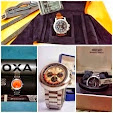
RARE COLLECTION - AUTHENTIC VINTAGE CITIZEN LEOPARD SUPER BEAT 28800 GENTS WRISTWATCH


Japan CITIZEN automatic watch LEOPARD Super Beat Circa 1970's 
Movement: 7210, CITIZEN, Auto winding 24 Jewels, Hi Beat 28800 bps
Dial: Original, signed "JAPAN 6-720773-Y".
Glass: Original, crystal glass, many scratches.
Case number: 4-720539 Y
Case diameter: 36 mm
Case material: Stainless Steel
Crown: Original, signed "C". S/N 00427400
Band: Aftermarket SS bracelet
Day/Date: Changed fine automatically and manually. English.
Condition: Used. It was recently serviced, It runs well, keeps good time.
Price : USD350 (Negotiable)

BRIEF HISTORY OF CITIZEN WATCHES

Citizen Holdings Co., Ltd. (シチズンホールディングス株式会社 Shichizun Hōrudingusu Kabushiki-gaisha) is the core company of a Japanese global corporate group based in Tokyo Japan. The company was originally founded as Shokosha Watch Research Institute in 1918 and is currently known as the manufacturer of CINCOM precision lathe machine tools as well as CITIZEN watches. The trade name originated from a pocket watch CITIZEN sold in 1924. It is one of the world's largest producers of watches. For almost eight decades, Citizen has been ahead of its time. Citizen brand has always stood for innovations and high precision that make life better for everyday people and now they are raising their sights to meet the needs of the new Millennium.
In 1924, when Citizen's forerunner, the Shokosha Watch Research Watch Institute produced its first pocket watch the "CITIZEN". The then Mayor of Tokyo, Mr Shimpei Goto, named the watch "CITIZEN" with the hope that the watch, a luxury item of those times, would become widely available to ordinary citizens and be sold throughout the world.
Time and again Citizen has pioneered groundbreaking technologies and helped to make watches an indispensable part of modern life. Introduced in 1956, Parashock was the first shock resistant watch made by a Japanese manufacturer. And three years later, Parawater was hailed as the country's first water resistant watch.
One of the latest milestones is our Eco-Drive system. Bringing new thinking to the art of watchmaking, this is a light powered solution that eliminates the need to change batteries - a revolution that made it the first watch technology to receive the Japan Environment Association's Eco Mark for environmentally friendly products.
And in 2003, Citizen continues to evolve and be ahead of its time with the launch of Stiletto. This is the World's thinnest light powered watch - a watch so revolutionary it combines eco-drive technology with a refined, sleek and sophisticated case and bracelet from 4.4mm thick.
Citizen is, however more diverse then simply watches. In fact watches only represent less than 40% of the company's business. Today Citizen is drawing on a heritage of proven quality and technologies as we develop the market for watches, clocks, jewellery, eyeglass frames and health care products.
BRIEF INFORMATION ON RARE COLLECTION OF CITIZEN LEOPARD HI-BEAT
Some 40 years ago, as the 1960's drew to a close, the development of Citizen's automatic wrist watches was reaching its peak, in terms of both range and quality. Around the middle of that decade the company switched from it's geared 'jet' rotor design to the more reliable and widely used oscillating weight type, and the late '60's saw the launch of the Chrono Master high grade automatic alongside a range of other new models.
In 1969 Citizen launched the evocatively named Leopard line, based on the 7200 calibre. Although this movement was used in other models, the Leopards were distinguished by one key characteristic not to be found in the others – they were all high-beat, running at either 28,800 beats per hour (bph) or 36,000bph. These were Citizen's first watches to run at these speeds, reflecting the quality and reliability they could achieve by that time. These fine movements also all feature a micro adjuster on the balance to assist with accurate regulation.
In a relatively short space of time the Leopard line offered an extensive range of watches, with different jeweling, styles and price points, and can perhaps be best described as 'upper mid' to 'high' grade pieces.
Besides the high-beat common denominator, the Leopards are also characterized by their jewel counts, which are always even numbers – i.e. 28, 26, 24, and later in the production run, 22. Other models using the same base movement usually carry odd number jewel counts, for example the Custom V2 and Seven Star V2, with jewel counts of 25, 23, and 21 (the only exception to this I can identify is calibre 7790, running at 21,600bph with 22, 24 and 26 jewels).

The production run of the Leopards was short-lived – just as the development of mechanical watches was reaching new heights, the introduction of the much more accurate and soon the much cheaper quartz module in the early to mid-1970's brought that development to a halt. The latest Leopard movements entered the market in 1971, just two years after the first model was introduced.
(This articles on Citizen Leopard was brilliantly written by Mr Stephen Netherwood, who has made a lot of research about this watch. His original article on this Citizen Leopard can be viewed at
http://seikoholics.yuku.com/sreply/344/Citizen-Leopard)