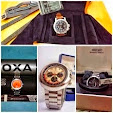
LONGINES SUB SECOND MILITARY STYLE GENTS WRISTWATCH
MADE IN/BUATAN: SWISS
CIRCA/TAHUN: 1930's
MODEL: MILITARY STYLE
CRYSTAL/CERMIN: ACCRYLIC
MOVEMENT/ENJIN: SWISS 17 JEWELS LONGINES MOVEMENT CAL.10.68Z
DIAL COLOR: GOLD CHAMPAGNE WITH SUB-DIAL AT 6:00
FUNCTION/FUNGSI: HOUR, MINUTE, SUB SECOND
HANDS/JARUM: METAL GOLD COLOR DAUPHANE HANDS
MARKERS/TANDA WAKTU: GOLD RAISED ARABIC
BEZEL: GP
CASING : STAINLESS STEEL BACK
LUGS: 18mm
MEASUREMENT/UKURAN: 32mm DIAMETER EXCLUDING CROWN and 38mm LUG TO LUG
LUG SIZE: 18mm
DITANDA/ENGARVED BACK CASING: -
CROWN: GP
STRAP/TALI: BROWN SPORT LEATHER BAND "
STRAP/SAIZ TALI: 8.5"
WORKING CONDITION, KEEPING TIME, DISCONTINUED MODEL & HARD TO FIND
PRICE/HARGA: USD550 (NEGOTIABLE)
BRIEF HISTORY OF LONGINES-WITTNAUER WATCHES
As soon as Ernest Francillon opened a small manufacturing plant, which started to produce the following year, the story of Longines started in 1866. Francillon, who was the grandson of Auguste Agassiz (a pioneer of Swiss horology whose name appears on wrist and pocket watches of high-quality), learned his trade at his grandfather's watch assembly shop, the "comptoir". He would finally become director of the shop, but this thirty-two-year old man got acquainted with the limits of the comptoir and the areas in which he would be more likely to have a better production.
The first Longines watches arrived in America in 1868. A few years later, Longines was awarded a gold medal for precision and reliability at the Universal Exposition of Vienna. To prevent himself from imitation, Francillon decided to trademark the dials on his watches with a winged clepsydra and the word "Longines".A clepsydra is an ancient device which measured time by marking the regulated flow of water though a small opening. Looking carefully at the centre of the Longines trademark a small box that represents this device is seen.
The company eventually departed from this procedure fairly quickly because there are several Longines watches that do not have the logo. In 1889, Longines provided five chronometers to the Italian explorer Luigi Amedeo, who did his best to reach the North Pole. His failure is hardly noted in history books, but the mark Longines'illuswtrious history as the watch choice by explores and adventurers.
In 1904, Longines furnished chronometers to a U.S. naval exploration of the North Polar Region. Unfortunately, Robert E. Peary was the first to reach the North Pole in 1909. Longines, unfortunately, missed the chance to be part of that event. At the beginning of 1900s, Longines started to express an interest in gentlemen's wrist watches and joined other Swiss makers which showed the same interest as well.
The Longines Co. states that the first wrist watch was cased in 1905. The first wrist chronographs to appear in the sports market were seen in 1910s. Moreover, Longines produced military watches for World War, some of the, with pierced shrapnel covers, "demi-hunter" cased varieties, and others for being used at sea and in the air.
Around 1920 - 1930s the golden years for Longines started. The factory had a remarkable growth from 20 to 2.500 workers, who produced more than 122.000 pieces every year. Longines would be recognized as the constant and steady companion of many pioneering aviator in a decade that aeroplanes and airships were recognized as military and exploration tools of great importance. Aeroplanes started to experience several problems such as magnetism, moisture, low temperatures, issues which had to be overcome right away. And Longines was acquainted with theses issues after having experienced the Artic cold temperatures. It was during this era that Longines would produce its most famous two wrist watches -- the Weems and the Lindbergh models. (The Lindbergh is also referred to as the Hour Angle Watch.) In 1930, Admiral Richard E. Byrd would arrive to the South Pole for the first time. His trips would always find him with a Longines on his wrist.
The A. Wittnauer Co. would become the exclusive sales agent for Longines in1880. This relationship lasted for the next 114 years. In 1936, the Wittnauer family sold A. Wittnauer Co. and renamed the Longines-Wittnauer Co. the name became so pervasive that some people think that the watches are synonymous. But, of course, they are not. Their movements are distinct and not interchangeable with one another.
World War II and beyond
The company began to produce military issue watches during the Second World War. Most of these watches were for the European forces. In 1994, Longines and Wittnauer parted company, and Swiss giant SMH, which holds title to Hamilton, Omega and Tissot, got the name.
Chronographs
The company started to show its affinity with sporting events during the 30s and 40s, producing a lot of unusual types of chronographs. Many were manufacturer with Longines's own movement, unlike the rest of the companies which would rather buy chronograph from other companies. Therefore, the Longines chronographs, those which were produced from the 20s to the 50s are highly prized.