Showing posts with label VENTURA. Show all posts

Thursday, October 18, 2012

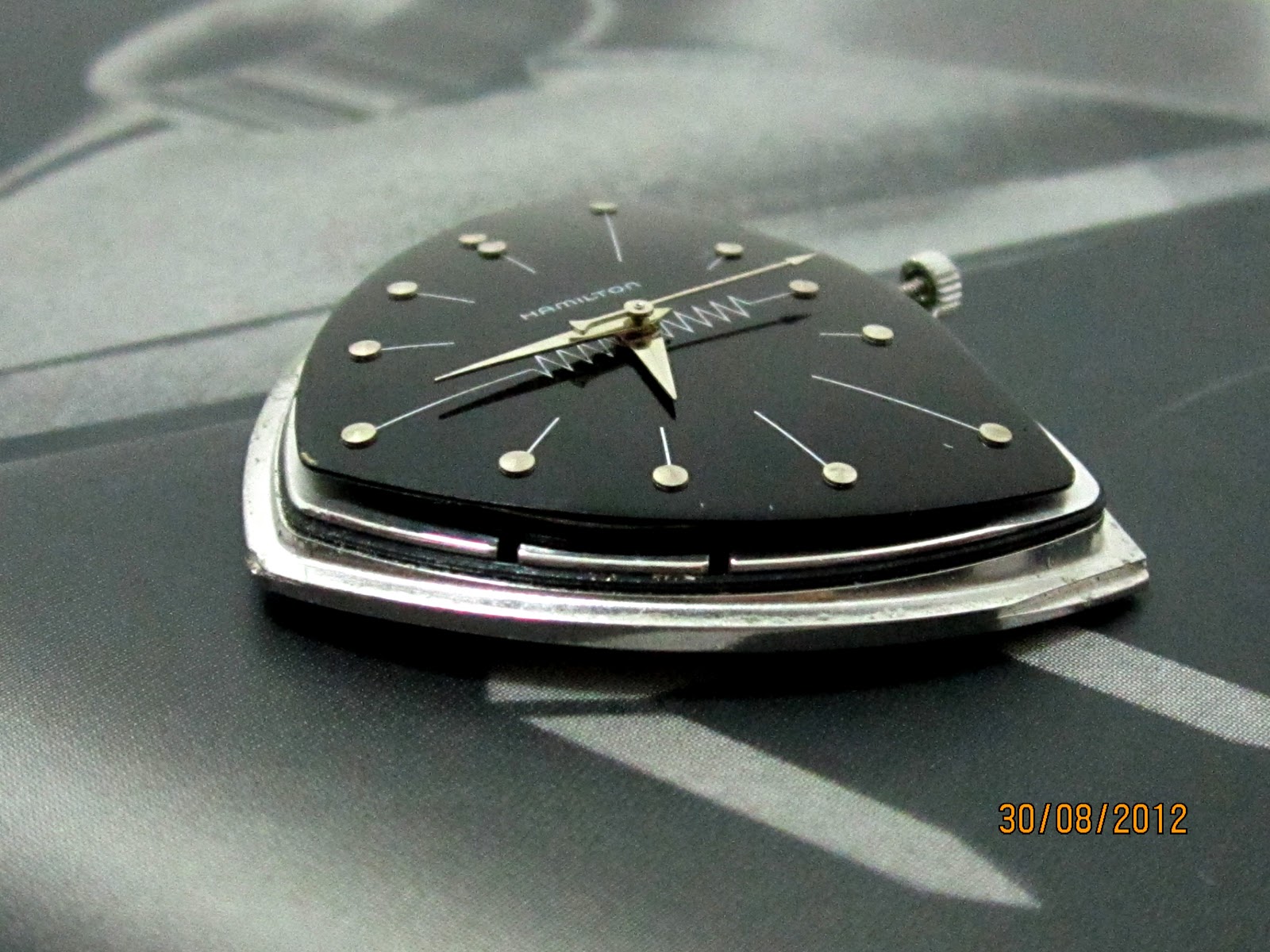
SOLD-HIGHLY COLLECTIBLE PREOWNED AUTHENTIC "MEN IN BLACK" HAMILTON VENTURA GENTS WRISTWATCH


MADE IN/BUATAN: SWISS
CIRCA/TAHUN: 2009
MODEL: HAMILTON VENTURA "MEN IN BLACK"
CRYSTAL/CERMIN: SAPPHIRE CRYSTAL
MOVEMENT/ENJIN: SWISS ETA QUARTZ MOVEMENT
DIAL COLOR: BLACK "MEN IN BLACK" WITH ELETRIC CHARGE SYMBOL
FUNCTION/FUNGSI: DRESS WATCH
HANDS: SIVER TONE
MARKERS: SILVER TONE DOT
CASING : SOLID STAINLESS STEEL (SOME FLAKING ON THE EDGES)
BEZEL: STAINLESS STEEL
LUGS: 20mm
MEASUREMENT: 35mm DIAMETER INCLUDING CROWN and 52mm LUG TO LUG
ENGRAVING ON BACK CASING: HAMILTON~ H LOGO~S/N:6109~WATER RESISTANT~50M~SWISS MADE~
CROWN: ORIGINAL SS
STRAP/TALI: ORIGINAL USED HAMILTON GENUINE BLACK LIZARD WITH DOUBLE FOLDED CLASP/ TALI KULIT ORI HAMILTON
SIZE STRAP/SAIZ TALI: 8.5" FULL LENGHT
NO BOX OR PAPER
PRICE: SOLD (SOLD TO MR BRAD FROM JB) RRP WHEN NEW IS USD649.00


BRIEF INFORMATION ON HAMILTON VENTURA WATCHES
Though not even Elvis could save the original by wearing it in his 1961 movie, Blue Hawaii, the Hamilton Ventura watch is making a come-back in a technologically updated reproduction model. Thanks to the blockbuster movie Men In Black, which featured the watches (they sport a futuristic look even to today’s audiences), Hamilton is once again at the top of the American watch market.
Designed by Richard Arbib in the 1950’s, the Hamilton Ventura 500 was intended to look like a bomb, only with a 90 degree rotation. It is, perhaps, prophetic that the Ventura (and its electric brethren) contributed heavily to the downfall of Hamilton over the next two decades. Although it reached immediate success as the first electric watch ever to reach the consumer market, its recurring problems with accuracy and with worn-out electrical contact pads had the watch returning to stores at an unprecedented rate as well. Nevertheless, the extraordinary appearing Ventura was the fastest selling gold watch Hamilton had made. At the same time as releasing the Ventura, Hamilton also released a traditional looking electric model, the Van Horn, which was badly outsold by its futuristic companion. Because of this, Hamilton issued several outstanding watches in the 1960’s also designed by Arbib and similar designers, like the Hamilton Pacer, Victor and Spectra.
The device itself was relatively simple, as electronic watches had not yet truly distinguished themselves from their mechanical counterparts. Their movement was still traditionally mechanical, but the mainspring had been replaced by a battery for the power source. In spite of this simplicity, the Ventura required extensive fine-tuning and Hamilton did not provide service manuals to their dealers (watches were expected to be returned to the factory for service). Combined with their all-too-frequent troubles, these factors tarnished the reputation Hamilton had in the watch market. Hamilton would go from being one of America’s leading watchmakers to near-bankruptcy in just over a decade.

By the time that the King wore one, the Ventura (now the 505 model) had been updated with with a better system to protect the contact pads. Both methods had been considered by Hamilton when they designed the original Ventura in 1957, but were discarded due to cost and internal design questions. It was feared that a radical design change in watch function would deter some potential buyers. Thanks to the accuracy of quartz watches, the original problems of the Ventura are long past and the new replicas mark a resurgence by Hamilton in the lives of business men and women, academicians and watch aficionados. Because Hamilton released a ladies’ model with its new line, the Ventura has doubled its potential market. It has garnered particular support among young professionals of both genders. The Ventura, as featured in Men In Black represents excellence in modern watch production and can be expected to avoid the problems of its forebears, but to continue striking amazement in anyone who sees it.

Thursday, August 16, 2012

RARE VINTAGE COLLECTIBLE GLASHUTTE VENTURASPEZIMATIC LARGE GENTS WATCH


BRAND/JENAMA : GLASHUTTE SPEZIMATIC
MODEL : SPEZIMATIC
MOVEMENT/ENJIN :SUPERB 26 RUBIES GLASHUTTE GUB AUTOMATIC MOVEMENT CAL.75
ORIGIN/BUATAN : GERMANY
NO. SIRI/SERIAL NO. : -
CIRCA/TAHUN : 1980's
CASING/KEMASAN : ROSEGOLD PLATED & STAINLESS STEEL BACK
FUNCTION/FUNGSI : HOUR, MINUTES, SECOND, DATE AT 3:00
DIAL: TEXTURED GOLD
CROWN: UNSIGNED GP CROWN
BEZEL: -
MARKINGS/TANDA JENAMA : DIAL, CASEBACK, MOVEMENT
BAND/TALI :
NEW GENUINE BLACK LEATHER BAND FIT 8" WRIST
HIDDEN LUGS SIZE: 20mm
BAND WIDTH: 20mm
LENS/CERMIN : ACCRYLIC CRYSTAL
MEASUREMENT/UKURAN : 34mm W/O CROWN X 42mm LUG TO LUG
WATER RESISTANT: NOT STATED
CONDITION/KONDISI : COLLECTORS' ITEM- EXCELLENT WORKING CONDITION AND KEEPING TIME
PRICE/HARGA:RM1650 (NEGOTIABLE)
ISTING: RM SOLD:

Brief History of Glashutte Watches

Glashutte Original was created in 1845, when the German master watchmakers, Ferdiand Al Lange, Julius Assmann, Ludwig Strasser, Johannes Durrstein, Adolf Schneider, Strasser and Rohde, Ernst Kassiske settled in the region of Glasshutte. These master watchmakers were awarded various gold model at the world exhibition and international competitions, thus creating the foundation and reputation of watching making industry of Glashutte. In 1878, Moritz Grossmann founded the German School of Watchmaking, hence building groundwork for more skillful watchmakers in the region of Glashutte and transforming the region into a reputed symbol of watchmaking excellence.
In the beginning of World War II, the watch manufactories in Glasutte was still in the production of military watches for the Navy and Air Force. Later, in the last day of War World II, Glashutte was bombed from the sky and the factories were badly destroyed. The reminding unaffected factories merged and found the VEB Glashutter Uhrenbetriebe under the rule of East German state.

HISTORY OF GLASHUTTER UHRENBETRIEB (GUB)

Compares the pictures of Glashuette Original movements in older catalogues with those printed in the recent ones, the different movement designations are immediately evident: The older watches are equipped with the movement cal. 10-30, whereas the newer ones have the cal. 39. However, aside from the drastically improved optical finish, the two movements seem to be the same: the same wheels and the same screws seem to be located in the same places on both movements. So where are the differences that justify that new designation, or is this just a try to cheat, to pretend a new movement where there is none?
When the communist German Democratic Republic found its end as a souvereign state, the state-owned “Glashuetter Uhrenbetrieb(GuB) was busy developing a new selfwinding movement. Solid it should be, and efficient. Before the works could be finished, the company was sold to the French movement manufacturer France Ebauches SA. This company tried to save itself from bankruptcy by means of German know-how and the cheap labour in Eastern Germany. The new selfwinding movement should compete with the Swiss movements produced by ETA, and was therefore developed specifically with a high momentum and maximum universality in mind. Before the short-time owner of the Glashuette watch manufactory had to develop a new movement, they found already a good movement in Glashuette: In 1978, the V.E.B. ("Volkseigener Betrieb" = People's owned company) Glashuetter Uhrenbetriebe (GUB) brought out their last completely new construction, the cal. 11-26, dubbed Spezichron.
This Spezichron was modernized in several steps under control of first the France Ebauches, then the Treuhand-Anstalt, and finally of Heinz W. Pfeifer, until it found its way as cal. 10-30 into the new watches of Glashuette Original. Under control of the Treuhandanstalt, which, from 1990 to 1994, took over the former East German state-owned companies and sought to bring them into the private sector, the movement cal. 10-30 was completed and used in a new and very cheap line of watches after 1993.
The Spezichron cal. 11-27 movement was the successor of the popular "Spezimatic", which was produced from 1964 until 1980. Compared to the Spezimatic, the new Spezichron was smaller and faster: 28,800 A/h, while the Spezimatic only had 18,000. With that movement, the East German GUB could compete with the common movements of Swiss origins. The Spezichron was solid and accurate. Additionally, a version with weekday display was made; it was designated cal. 11-27.
Yet there were plans for more complications, which could not be based on the trusted 10-30 movement; a new development was necessary. However, it was neither economically feasible nor desirable to have completely new cases and dials produced for the new base movement. Therefore, the starting point of the effort was the condition, that the new movement had the same dimensions, as well as the location of important parts, such as the winding stem, must be the same as in the old 10-30. Additionally, the planned new complication modules should have enough space on the movement’s front.
All elements of the 10-30 movement, which were tried and reliable, were taken over into the new construction, above all the complete escapement was transferred. Even these parts were refined, however, with the addition of a swan neck adjustement, for example. The result of the development was the new cal. 39 movement, which from the outside, looked like the old 10-30. Yet of the originally 130 parts, only 17 remained unchanged. The new movement had more jewels, a better adjustment, and, above all, a better ability to wear additional complication modules.
With the 10-30, every module had to be autonomous; that means, that each module had to consist of an upper an a lower baseplate, so that the final movement had four plate layers. The new cal. 39 movement was constructed in a way that its upper baseplate could serve as the lower base of the module, resulting in a “sandwich” of only three plate layers. This saves space which can be used for more complicated modules.
Finally, the optical qualities of the new movement were drastically improved: skeletonized rotor, finely grinded wheels, angled plates and teeth, the decoration work entirely done by hand. In spite of the still solid base of a movement designed to compete with the ETA-workhorses, the Glashuette Original cal. 39 without doubt is one of the finest selfwinding movements on the market.
The cal. 26 movement found in the watches of UNION/Glashuette, is based on that cal. 39 movement, but is changed in two essential ways: It consists of 12 parts less than its GO counterpart (mainly in the fine adjustement area), and its decoration is mostly machine-made. This saves a lot of money and enables UNION, to offer fine inhouse movements in well-made, competitively priced watches.
This movement was the successor of the popular "Spezimatic", which was produced from 1964 until 1980. Compared to the Spezimatic, the new Spezichron was smaller and faster: 28,800 A/h, while the Spezimatic only had 18,000. With that movement, the East German GUB could compete with the common movements of Swiss origins. The Spezichron was solid and accurate. Additionally, a version with weekday display was made; it was designated cal. 11-27.

A year later, in 1994, the company was bought by Heinz W. Pfeifer, and immediately the cal. 10-30 was thoroughly revised in order to equip high-class watches. More than 60 changes were made, until the movement, which internally was designated cal. 10-30/2, was used for the then new “Klassik”-line. However, the movement’s potential for refinement was exhausted. It was used in all self-winding Glashuette Original watches, including the chronographs, which added a chrono module to the base movement.
Yet there were plans for more complications, which could not be based on the trusted 10-30 movement; a new development was necessary. However, it was neither economically feasible nor desirable to have completely new cases and dials produced for the new base movement. Therefore, the starting point of the effort was the condition, that the new movement had the same dimensions, as well as the location of important parts, such as the winding stem, must be the same as in the old 10-30. Additionally, the planned new complication modules should have enough space on the movement’s front.

Wednesday, July 27, 2011

VENTURA SPARC PX AUTOMATIC GENERATOR MEN'S DIGITAL WATCH


Modell: W 11 R

Case: steel
Strap: caoutchouc, Durinox folding buckle
  • The worlds first and only generatoroperated
  • automatic digital watch.
  • time, date with 4-years automatic date
  • user-selectable 12 or 24h indication
  • sapphire crystals
  • water resistant 3 bar (30m/100ft)
  • mvt. VEN_99, (no battery)
  • h 42.50 x w 32.50 mm
  • Stainless steel case
  • comes with original ventura box and papers
  • original ventura worn leather band
  • replacement stainless steel shark mesh bracelet
VENTURA WEBSITE
RECOMMENDED RETAIL PRICE - €1,219.00 excl. VAT

Sunday, January 24, 2010

HIGHLY COLLECTIBLE AUTHENTIC "MEN IN BLACK" HAMILTON VENTURA GENTS WRISTWATCH (SOLD)


MADE IN/BUATAN: SWISS

CIRCA/TAHUN: 2009

MODEL: HAMILTON VENTURA "MEN IN BLACK"

CRYSTAL/CERMIN: SAPPHIRE CRYSTAL

MOVEMENT/ENJIN: SWISS ETA QUARTZ MOVEMENT

DIAL COLOR: BLACK "MEN IN BLACK" WITH ELETRIC CHARGE SYMBOL

FUNCTION/FUNGSI: DRESS WATCH

HANDS/JARUM: SIVER TONE/ KEPERAKAN

MARKERS/TANDA WAKTU: SILVER TONE DOT/DOT KEPERAKAN

CASING : SOLID STAINLESS STEEL/ KELULI SEPENUHNYA

BEZEL: STAINLESS STEEL

LUGS: 20mm

MEASUREMENT/UKURAN: 35mm DIAMETER INCLUDING CROWN and 52mm LUG TO LUG

DITANDA/ENGARVED BACK CASING: HAMILTON~ H LOGO~S/N:H244110~WATER RESISTANT~50M~SWISS MADE~

CROWN: ORIGINAL SS/ KELULI

STRAP/TALI: ORIGINAL HAMILTON GENUINE BLACK LIZARD WITH DOUBLE FOLDED CLASP/ TALI KULIT ORI HAMILTON

SIZE STRAP/SAIZ TALI: 8.5" FULL LENGHT

COMES WITH ORIGINAL BOX, OUTER BOX, MANUAL AND INTERNATIONAL WARRANTY (1 YEAR LEFT)

PRICE/HARGA: (SOLD TO TUAN SALIM FROM KELANA JAYA)


JAM INI DIBELI DI TOKYO SEMASA LAWATAN KERJA DI SANA PADA 2009. HARGA PASARAN PADA MASA ITU IALAH JPY63,000 (RM2,400)


BRIEF INFORMATION ON HAMILTON VENTURA WATCHES
Though not even Elvis could save the original by wearing it in his 1961 movie, Blue Hawaii, the Hamilton Ventura watch is making a come-back in a technologically updated reproduction model. Thanks to the blockbuster movie Men In Black, which featured the watches (they sport a futuristic look even to today’s audiences), Hamilton is once again at the top of the American watch market.
Designed by Richard Arbib in the 1950’s, the Hamilton Ventura 500 was intended to look like a bomb, only with a 90 degree rotation. It is, perhaps, prophetic that the Ventura (and its electric brethren) contributed heavily to the downfall of Hamilton over the next two decades. Although it reached immediate success as the first electric watch ever to reach the consumer market, its recurring problems with accuracy and with worn-out electrical contact pads had the watch returning to stores at an unprecedented rate as well. Nevertheless, the extraordinary appearing Ventura was the fastest selling gold watch Hamilton had made. At the same time as releasing the Ventura, Hamilton also released a traditional looking electric model, the Van Horn, which was badly outsold by its futuristic companion. Because of this, Hamilton issued several outstanding watches in the 1960’s also designed by Arbib and similar designers, like the Hamilton Pacer, Victor and Spectra.

The device itself was relatively simple, as electronic watches had not yet truly distinguished themselves from their mechanical counterparts. Their movement was still traditionally mechanical, but the mainspring had been replaced by a battery for the power source. In spite of this simplicity, the Ventura required extensive fine-tuning and Hamilton did not provide service manuals to their dealers (watches were expected to be returned to the factory for service). Combined with their all-too-frequent troubles, these factors tarnished the reputation Hamilton had in the watch market. Hamilton would go from being one of America’s leading watchmakers to near-bankruptcy in just over a decade.

By the time that the King wore one, the Ventura (now the 505 model) had been updated with with a better system to protect the contact pads. Both methods had been considered by Hamilton when they designed the original Ventura in 1957, but were discarded due to cost and internal design questions. It was feared that a radical design change in watch function would deter some potential buyers. Thanks to the accuracy of quartz watches, the original problems of the Ventura are long past and the new replicas mark a resurgence by Hamilton in the lives of business men and women, academicians and watch aficionados. Because Hamilton released a ladies’ model with its new line, the Ventura has doubled its potential market. It has garnered particular support among young professionals of both genders. The Ventura, as featured in Men In Black represents excellence in modern watch production and can be expected to avoid the problems of its forebears, but to continue striking amazement in anyone who sees it.