Showing posts with label *TRADE-IN. Show all posts

Saturday, January 12, 2013

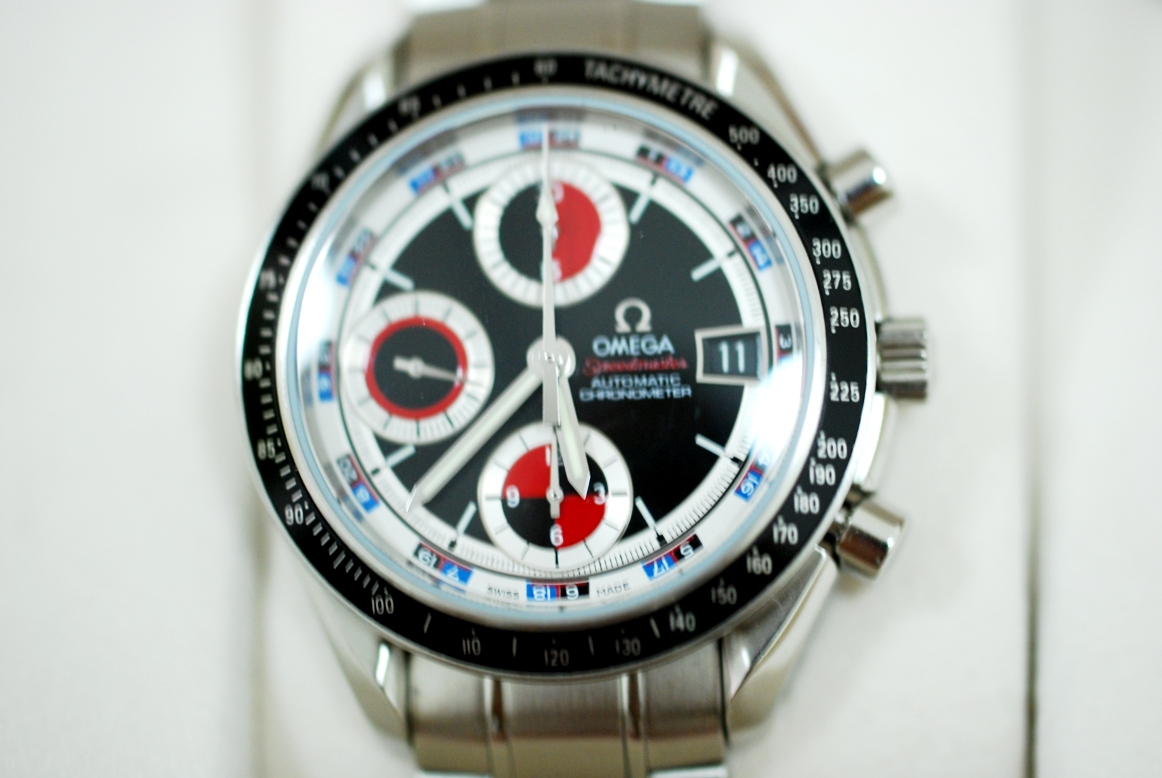
AUTHENTIC OMEGA SPEEDMASTER SPORT CHRONOGRAPH GENTS WRISTWATCH (TRADE IN)


BRAND/JENAMA: AUTHENTIC OMEGA SPEEDMASTER SPORT CHRONOGRAPH GENTS WRISTWATCH
MADE IN/BUATAN: SWISS
CIRCA/TAHUN: 2009 S/N 84503650
MODEL: 3210.52 SPEEDMASTER SPORT
CRYSTAL/CERMIN: SAPPHIRE CRYSTAL
MOVEMENT/ENJIN: OMEGA 24 JEWELS AUTOMATIC WINDING CAL. 1164
DIAL COLOR: BLACK WITH RED 3 REGISTERS COUNTERS
FUNCTION/FUNGSI: CHRONOGRAPH 3 REGISTERS
HANDS/JARUM: LUMINOUS DAUPHINE HANDS
MARKERS/TANDA WAKTU: LUMINOUS BATON MARKERS
CASING : STAINLESS STEEL/ KELULI SEPENUHNYA
LUGS: 22mm
MEASUREMENT/UKURAN: 40mm DIAMETER W/O CROWN and 46mm LUG TO LUG
DITANDA/ENGARVED BACK CASING: SPEEDMASTER SEAMONSTER LOGO AND OMEGA LOGO MARK
CROWN: ORIGINAL OMEGA SS
STRAP/TALI: GENUINE OMEGA SPEEDMASTER SS BRACELET FULL SET
SIZE STRAP/SAIZ TALI: 8.5"
EXCELLENT CONDITION, WORKING, KEEPING TIME, DISCONTINUED MODEL.COMES WITH ORIGINAL OUTER BOX, INNER LEATHER BOX, CARD
PRICE/HARGA: RM7,900 (TRADE IN WITH ML PONTOS - MOHD SHAFFIQ )


History of the Omega Speedmaster
The first chronograph with the name "Speedmaster" appeared in 1957. And that is pretty much the same Speedmaster as we know it today. On first sight.
Through the years, a lot of things were changed on this watch. For instance, the word "Professional" in 1966 when it was approved for NASA use (more on that later), in 1968 they (Omega) changed the movement from a calibre 321 (with "schaltrad") to a cheaper to produce, but more accurate calibre 861 (with shuttlesystem). Both movements were based on Lemania movements. Todays Speedmaster Professional watch still uses the 861 movement. Before 1957, there were also some chronographs (since 1942) using the 321 calibre but they had no "Speedmaster" written on the dial.
The first Speedmaster (1957) looked like this :
First  Speedmaster
Foto scanned from Time Capsule
This model, referenced as CK2915 was created in 1957 and is nowadays hard to find. The watch has the 1/5th seconds, minute and hours markings in white on a black dial. The counters are located on 3 o' clock, 6 o' clock and 9 o' clock. The bezel contains engraved tachymetre figures (not very clear on the photo above).
The caseback is the one with the Seamaster logo because this type of watchcase was originally developed for the Seamaster (triple-shield case to enable it to withstand high pressure). The diameter of the watch-case was 39mm.
The movement used in this watch was a 27 CHRO C12, better known as the Cal.321 (manual winding).
The 27 stands for 27mm, the CHRO stands for "chronograph" and C12 indicates that the watch has an 12-hour counter (at 6 o'clock).This movement was designed by Albert Piguet (who worked for Lemania during those days) in 1942. It took Omega 15 years to produce this watch as it was released in 1957.
In 1959 they produced a slightly modified Speedmaster, known as CK2998. The watch-case diameter expanded from 39mm to 40mm and they added a so called O-ring gasket around the push buttons.
Speedmaster  CK2998
CK2998
Until 1966 there were no big changes on the watch (look for the "Differences through the years" in the menu for details). The NASA bought a Speedmaster along with some other chronograph watches to test it for use on their missions. Read all about it in the "Nasa tests" section of this website. After long and rigirous testing of the watch, the NASA concluded that the Omega Speedmaster was the most suitable watch for 'the' job. Omega decided to make this watch the Omega Speedmaster Professional. So the word "Professional" was added but it was still the same watch. The watch got also the 145.012 reference number. There are also watches from 1966 with 145.003, these are the non-Professionals from 1966.
In 1968, Omega decided to replace the cal.321 movement by a more accurate movement which was also cheaper to produce, the cal. 861 which was also produced by Lemania. This movement is still being used in the current line of Omega Speedmaster Professionals. The movement was a bit more accurate, 21600A/h instead of 18000A/h. It also uses a shuttle cam instead of a "schaltrad" for the chronograph. Changes on the outside : white marked Omega-symbol instead of metal applied Omega-symbol and a flat dial.
Speedmaster
In 1969, the first man walked on the moon.. Neil Armstrong. He didn't wear his Omega Speedmaster Professional. The clock inside the Lunar Module went broke, and he hung his Omega Speedmaster Professional in the Lunar Model as a clock-replacement. Buzz Aldrin, he did wear his Omega Speedmaster Professional. So his watch was the first watch worn on the moon. It was a Omega Speedmaster Professional with a cal. 321 movement (confirmed by Omega). A few months after the landing on the moon, Buzz's watch was stolen and never returned.
In 1978, the watch was produced with an engraved caseback. "Fligt Qualified by NASA for all manned space missions - The first watch worn on the moon". Some casebacks have another text or logo engraved, No explanation at this time.

Monday, October 31, 2011

AUTHENTIC VINTAGE 10K GOLD FILLED LECOULTRE MEMOVOX WRISTALARM GENTS WRISTWATCH (SOLD)


LARGE AND BRIGHTLY LUMINOUS AND LOUD LECOULTRE
WRISTALARM WATCH


BRAND/JENAMA: AUTHENTIC VINTAGE LARGE 10K GOLD FILLED LECOULTRE WRISTALARM GENTS WRISTWATCH
MADE IN/BUATAN: SWISS
CIRCA/TAHUN: 1950's
MODEL: ALARM - MEMOVOX
CRYSTAL/CERMIN: ACRYLIC
MOVEMENT/ENJIN: RARE LECOULTRE 17 JEWELS MANUAL MOVEMENT CAL.814 BY VACHERON CONSTATIN AXN
DIAL COLOR: CREAM GOLD
FUNCTION/FUNGSI: HOUR, MINUTE, SECOND AND ALARM DISC
HANDS/JARUM: GOLD TONE AND BLUE METAL SECOND HAND
MARKERS/TANDA WAKTU: VERY BRIGHT LUMINOUS DOT, LUMINOUS ARABIC AND RAISED GOLD TONE BARROW HEAD MARKERS
CASING : 10K GOLD FILLED
LUGS: 18mm
MEASUREMENT/UKURAN: 37mm DIAMETER INCLUDING CROWN and 42mm LUG TO LUG
BEZEL: 10K GOLD FILLED BEZEL
DITANDA/ENGARVED BACK CASING: None
CROWN: UNSIGNED ORIGINAL CROWN
STRAP/TALI: BROWN LEATHER BAND
SIZE STRAP/SAIZ TALI: 9.5" FULL LENGHT

DISCONTINUED LECOULTRE MODEL... ALARM SET AND LOUD!
EXCELLENT CONDITION, KEEPING GOODTIME AND RECENTLY SERVICED
PRICE/HARGA: (trade-in with TN. SIRAJUDDIN)
A BRIEF HISTORY OF LE COULTRE WATCHES
A brilliant inventor and self-taught watchmaker, Antoine-LeCoultre founded his first workshop in 1833, following the invention of a machine to produce watchmaking pinions. Ever since, the Manufacture Jaeger-Lecoultre has developed constantly around the founder's original workshops.
Surprisingly enough, it was neither a physicist nor an engineer who first measured the micron; it was Antoine LeCoultre, in 1844. He had created watch components that were so perfect no tool could actually detect their degree of inaccuracy. He followed that up by inventing the world's most accurate instrument: the Millionometer, which served as a benchmark for over half a century.
In 1847, LeCoultre created a revolutionary system that was to do away with the need for keys to rewind and set watches. His simple and brilliant solution was a pushbutton that activated a lever to switch from one function to another. It was the first keyless winding mechanism, and the first reliable system that eliminated the need for keys to wind or set a watch.
In 1866, when Swiss watchmaking was still structured around small home-run workshops, Antoine LeCoultre and his son Elie decided to bring together under one rood the many skills involved in making watches, and installed a steam-driven machine to operate their new tools. LeCoultre & Cie thus became the first Manufacture in the Vallée de Joux.
It was in 1903 when the Parisian Edmond Jaeger set Swiss watchmakers the challenge of producing ultra-thin calibres. It would lead to the Calibre 145, the world's thinnest mechanical movement, measuring no more than 1.38 mm, and the friendship of Antoine LeCoultre's grandson, Jacques-Devid LeCoultre. These two men would give a rise to a range of horological wonders, and eventually the birth of the Jaeger-LeCoultre brand in 1937.
In the year 1908, the Manufacture created its first rectangular-shaped calibre in response to the challenge created to miniaturize watches to wear on the wrist. By the "Roaring 20s" (1920s), very small ladies' wristwatches were all the rage, but extreme miniaturization always led to a loss of reliability and precision. The Duoplan brilliantly solved this problem by arranging its parts on split levels. It would lead to the world's smallest movement, Calibre 101. Outdoing the Calibre 145, Jaeger-Lecoultre miniaturized the Duoplan caliber to the extreme, weighing in at barely one gram and comprising of 74 parts. Its record is still unmatched to this date.
Since its founding, the Manufacture has created and produced over 1,000 different calibres in many varieties. Over 200 patented inventions have contributed to the progress of Swiss watchmaking in the field of movements, as well as that of cases, bracelets, dials, and watch functions.

Sunday, April 25, 2010

VERY RARE - AUTHENTIC VINTAGE 14K GOLD FILLED UNVERSAL GENEVE AUTOMATIC BUMPER GENTS WRISTWATCH (TRADE-IN)


BRAND/JENAMA: AUTHENTIC VINTAGE 14K GOLD FILLED UNIVERSAL GENEVE AUTOMATIC BUMPER GENTS WRISTWATCH

MADE IN/BUATAN: SWISS

CIRCA/TAHUN: 1960's

MODEL: DRESS WATCH - 677-330

CRYSTAL/CERMIN: ACCRYLIC

MOVEMENT/ENJIN: UNIVERSAL GENEVE 17 JEWELS AUTOMATIC BUMPER MOVEMENT CAL. 138 SS

DIAL COLOR: CHAMPAGNE GOLD/KEEMASAN

FUNCTION/FUNGSI: DRESS/CASUAL WATCH

HANDS/JARUM: GOLD TONE/ KEEMASAN

MARKERS/TANDA WAKTU: GOLD TONE RAISED STICK & ARABIC

CASING: 14K GOLD FILLED/ EMAS TAMPALAN 14K

LUGS: 18mm

MEASUREMENT/UKURAN: 35mm DIAMETER INCLUDING CROWN and 41mm LUG TO LUG

DITANDA/ENGARVED BACK CASING: 14K GOLD FILLED

CROWN: GP/ SADUR EMAS

STRAP/TALI: JB WIRE MESH GP BAND

SIZE STRAP/SAIZ TALI: 8.5"

EXCELLENT CONDITION, WORKING, KEEPING TIME, DISCONTINUED MODEL

PRICE/HARGA : (TRADE-IN DGN ANAKNDA WAFEE)

LISTING: RM900.00 SOLD: RM COST:


BRIEF HISTORY OF UNIVERSAL GENEVE WATCHES


In Locle, one of the most important watch centers in Switzerland, located in the mountains of the Jura on the 18th of January 1894, 8 o'clock in the morning on a Thursday, the company "Universal Watch" was founded. The two watch manufacturers Numa-Emile Descombes (born at Locle in 1863) and Ulysse Georges Perret (born at Locle in 1868) registered the name "Universal Watch" at the rue du Collège for the "production of watch-cases, domes, watch dials, movement, fitted boxes and packaging for watches". This was a classical formula at that time, which enabled the protection of the make and all related promotional material. In the same year they patented a 24 hour indication watch. Just three years later Numa-Emile Descombes died at the early age of 34. Consequently on the 22nd July 1897, all makes were transferred to the names of Ulysse Georges Perret and Louis-Edouard Berthoud.

Universal Watch was amongst the first to recognize the enormous potential of wrist-watches and chronographs in particular. In 1898 superior quality wrist-watches with chronograph and 30 minutes recorder were introduced. During the following years the brand "Universal Watch" profitted from rapidly growing reputation in Europe and the two Americas. The company decided to move the headquarter to Geneva, rue de l'Arquebuse in 1919. Research on self-winding systems for wrist-watches was undertaken. In 1925 Universal created the model "Auto-Rem", a self-winding system with an oscillating weight mechanism with spring-buffers, similar to the system of John Harwood. On the 12th of August 1933 Georges Perret died. The management of the company was taken by his son Raoul. Supported by new investors the company changed to "Universal Watch Co Ltd. Genève" in 1934. During the same year the first chronograph wrist-watch with two push-buttons was presented. In 1935 the company moved to 43, Rue du Rhône with an entrance at the famous Grand Quai, next to Patek Philippe. The name "Universal" was registered. Parallel to this, a chronograph with an additional 12 hour register was presented as a world premiere.

With the registration of the brand "Universal Genève" a new logo was introduced in 1937. Despite of the world-wide economic depression, the models "Compur" and "Compax" were such a great success, that the factory in Geneva could no longer meet the demand. As a result a chronograph factory was opened in Pont-de-Martel in 1941. The famous "Tri-Compax" model was presented in 1944. Selling watches all around the world, Universal was getting a synonym for quality, reliability and good taste. Louis-Edouard Berthoud died on the 3rd March of 1947 just before the introduction of the new precision automatic calibre 138 with an oscillating mass with single direction winding. Shortly after the inauguration of the new factory in Geneva on the 28th of April 1954 the model "Polarouter", later on renamed to "Polerouter", was presented. The watch, fitted with above mentioned movement, was used by the SAS crews during their polar flights. On the 2nd of March 1955 Universal Genève patented the calibre 215 "Microtor", a new form of an automatic calibre with the rotor mass incorporated in the movement.

Since the first chronograph wrist watches, Universal's endeavour was to combine quality with good classic taste. The make had many admirer, from Harry Truman to Juan Peron. The artist Jean Cocteaux composed the dedication "Les temps lui-meme regarde l'heure à la montre Universal", which can be found on the dials of the new tourbillons. Various sheiks and arabic ministers ordered luxurious custom made watches. Golden watches with exquisite enamel dials are still very sought after. Gerald Genta, considered to be one of the most famous watch designers of the twentieth century, contributed to the success of this make by, designing two models which have subsequently become world-famous: the "Polerouter" in 1954 and the "Golden Shadow" in 1966. These two watches gained Universal the "New York Diamond Award", the "Golden Rose" in Baden-Baden, the Grand Prix of the "Ville de Genève", the "Città di Basilea" prize and the 1st price in the "Exposition Nationale Suisse" in 1964.
After the company was managed by the heirs of the founders for generations, in 1986 Lennard Oldman was appointed as new President of Universal Genève. In 1988 the headquarter moved to 29, Rue de Jussy in Geneva-Thônex. In the same year the logo changed to its present design. After a prolonged crisis which had struck the Swiss watch industry, Universal was acquired by the Stelux holding group, Hong Kong on the 1st of April 1989. A new production unit was open at Bienne in 1993. After several relocations the head office is now located in Geneva-Acacias. Today Universal Genève is focusing on its qualities and tradition. The actual collection includes several watches in a very attractive "retro-design" with reference to some of the most fascinating models of the company history. The objective is to create new models, derived from the famous Calibre 66, which will become the new generation of Universal Genève watches. Recent highlights besides the revolving Janus models with two dials include complications like Solar-Equation and Tourbillon.