Showing posts with label BUMPER. Show all posts

Thursday, January 31, 2013

AUTHENTIC VINTAGE WITTNAUER AUTOMATIC BUMPER MILITARY GENTS WRISTWATCH


BRAND/JENAMA : AUTHENTIC VINTAGE WITTNAUER AUTOMATIC GENTS MILITARY WRISTWATCH
MODEL : BY LONGINES
MOVEMENT/ENJIN : Automatic Cal. 11AW - 17 Jewels Swiss Movement
ORIGIN/BUATAN : Longines/Wittnauer Swiss
NO. SIRI/SERIAL NO. : 4955175
CIRCA/TAHUN : 1950's
CASING/KEMASAN : SOLID STAINLESS STEEL
FUNCTION/FUNGSI : HOUR, MINUTES, and SWIPE SECOND
DIAL: WHITE with  ARABIC MARKERS 2,4,6,8,10,12 AND INNER 24HRS  MILITARY MARKERS
BEZEL: STAINLESS STEEL
MARKINGS/TANDA JENAMA : DIAL, MOVEMENT
BAND/TALI :
 GENUINE ORIGINAL BLACK LEATHER BAND FIT 8" WRIST
LUGS SIZE: 17mm
BAND WIDTH: 120mm
LENS/CERMIN : HARDLEX ACCRYLIC CRYSTAL
MEASUREMENT/UKURAN : 33mm w/o CROWN X 39mm LUG TO LUG
WATER RESISTANT: NOT TESTED
CONDITION/KONDISI : EXCELLENT WORKING CONDITION 
PRICE/HARGA:USD400 (NEGOTIABLE))
SOLD RM 
SOLD RM

HISTORY OF LONGINES-WITTANAUER WATCHES
As soon as Ernest Francillon opened a small manufacturing plant, which started to produce the following year, the story of Longines started in 1866. Francillon, who was the grandson of Auguste Agassiz (a pioneer of Swiss horology whose name appears on wrist and pocket watches of high-quality), learned his trade at his grandfather's watch assembly shop, the "comptoir". He would finally become director of the shop, but this thirty-two-year old man got acquainted with the limits of the comptoir and the areas in which he would be more likely to have a better production.
The first Longines watches arrived in America in 1868. A few years later, Longines was awarded a gold medal for precision and reliability at the Universal Exposition of Vienna. To prevent himself from imitation, Francillon decided to trademark the dials on his watches with a winged clepsydra and the word "Longines".A clepsydra is an ancient device which measured time by marking the regulated flow of water though a small opening. Looking carefully at the centre of the Longines trademark a small box that represents this device is seen.
The company eventually departed from this procedure fairly quickly because there are several Longines watches that do not have the logo. In 1889, Longines provided five chronometers to the Italian explorer Luigi Amedeo, who did his best to reach the North Pole. His failure is hardly noted in history books, but the mark Longines'illuswtrious history as the watch choice by explores and adventurers.
In 1904, Longines furnished chronometers to a U.S. naval exploration of the North Polar Region. Unfortunately, Robert E. Peary was the first to reach the North Pole in 1909. Longines, unfortunately, missed the chance to be part of that event. At the beginning of 1900s, Longines started to express an interest in gentlemen's wrist watches and joined other Swiss makers which showed the same interest as well.
The Longines Co. states that the first wrist watch was cased in 1905. The first wrist chronographs to appear in the sports market were seen in 1910s. Moreover, Longines produced military watches for World War, some of the, with pierced shrapnel covers, "demi-hunter" cased varieties, and others for being used at sea and in the air.
Around 1920 - 1930s the golden years for Longines started. The factory had a remarkable growth from 20 to 2.500 workers, who produced more than 122.000 pieces every year. Longines would be recognized as the constant and steady companion of many pioneering aviator in a decade that aeroplanes and airships were recognized as military and exploration tools of great importance. Aeroplanes started to experience several problems such as magnetism, moisture, low temperatures, issues which had to be overcome right away. And Longines was acquainted with theses issues after having experienced the Artic cold temperatures. It was during this era that Longines would produce its most famous two wrist watches -- the Weems and the Lindbergh models. (The Lindbergh is also referred to as the Hour Angle Watch.) In 1930, Admiral Richard E. Byrd would arrive to the South Pole for the first time. His trips would always find him with a Longines on his wrist.
The A. Wittnauer Co. would become the exclusive sales agent for Longines in1880. This relationship lasted for the next 114 years. In 1936, the Wittnauer family sold A. Wittnauer Co. and renamed the Longines-Wittnauer Co. the name became so pervasive that some people think that the watches are synonymous. But, of course, they are not. Their movements are distinct and not interchangeable with one another.
World War II and beyond
The company began to produce military issue watches during the Second World War. Most of these watches were for the European forces. In 1994, Longines and Wittnauer parted company, and Swiss giant SMH, which holds title to Hamilton, Omega and Tissot, got the name.
Chronographs
The company started to show its affinity with sporting events during the 30s and 40s, producing a lot of unusual types of chronographs. Many were manufacturer with Longines's own movement, unlike the rest of the companies which would rather buy chronograph from other companies. Therefore, the Longines chronographs, those which were produced from the 20s to the 50s are highly prized and have their own separate niche in the collecting world.
The best of Longines's chronograph movements was said to be the Caliber 13 ZN. It was first released in Longines' 2-register models, but was later adapted for use in its 3-register models. The following chronographs would show movements made by Valjoux and others. These are not recognized nearly as collectible as the chronographs with Longines' own movements.

Sunday, October 14, 2012

AUTHENTIC VINTAGE TISSOT AUTOMATIC BUMPER GENTS WRISTWATCH (SOLD)


  • Dial
  1. The Original Dial have never been repainted/refurbished
  2. A Nice Beautiful & Stunning Champagne/Gold Color Dial
  3. Gold Tone Arabic Marker and Hands
  4. Dial in mint condition and look like New & Flawless.
  • Case
  1. 10K Rolled Gold on Stainless Steel Case & Back
  2. Have Been Professionally Polished To Make look like New & Flawless
  3. Will Show Age at Place But Won't let the Attraction Level
  4. Width Size : 36mm (excluding Crown)
  5. Length Size : 44mm from Lugs tip to tip
  • Movement
  1. Automatic Bumper 17 jewels Cal. 65-21
  2. Have Been Recently Serviced By An Expert
  3. In Good Working Order
  4. I Do not Guarantee Of The Watch To Be Waterproof As it Due to it Age & not Pressure Tested
  5. These Are Vintage Watch Serving From Decades
  6. They Could Run +2/-2 minutes Per Day Not Like today's Quartz
  • History & Information
  1. Around 40-50 years Old
  2. No Box & Papers & Certificate Due to Age of The Watch
  3. New After Market Black Leather Band have been Attached to it with original Tissot buckle.
  4. Five Signed Dial , Case , Back , Machine & Crown Are all Signed By TISSOT
  5. Original Glass No Scratch and Crack
PRICE : SOLD TO CIKGU ZUL FROM K.BELUD, SABAH


History of Tissot Watch Co
Tissot, a Swiss watch company, was established in the year 1853. Charles-Félicien Tissot with his son Charles-Emile set the foundation of this prominent business in the city of Le Locle. Buoyed by an extremely pioneering spirit and a forceful drive for mechanical craft, these two initiators brought in to the watchmaker's trade a sturdy and skilled company.
All the way through the existence of the Tissot Company, the firm has forever fascinated the thoughts of people across the globe. Right from the very inception, the company possessed technicians and engineers, contributing thoroughly in the growth and development of new innovative watch models. Led by a strong technical team, it incidentally went on to become the first producer of the antimagnetic watch. It also holds the glorious record of being the first to produce plastic watch, the "Rock Watch", the "Wood Watch" and "T-touch".
Along with the production of some exemplified "first of its kind watches", the Tissot Company also has its presence felt in the history of sports. It got its share of fame by participating vehemently in some major sports events: linked with Davis Cup in 1957 as the timekeeper and also took part at the downhill skiing in Switzerland in the 1938. At present, Tissot Company is the authorized timekeeper for various sporting galas: road biking, circuit racing, cycling, ice hockey and fencing. All these sporting affairs call for supreme dependability and correctness; they signify the meticulousness, significance and excellence of the Tissot Company. The company has rejoiced 150th anniversary of its esteemed institution in the year 2003. The Tissot brand, without any doubt, is not only one of world's most admired ones but also one of the most sought after brands in Switzerland itself.
From the year 1985, the Tissot Company has been attached with the Swatch Group. From the same period onwards, it has been characterized by a networked system of merchants in 140 countries all around the world. Since all Tissot watches are fashioned in Switzerland itself, which facilitates the company to make use of the "Swiss Made" brand. The Company tenders a broad array of products that will catch the attention of both admirers of a pleasant design and enthusiasts of watchmaker's technology.
In the recent years, the company has transformed itself into a more popular brand than ever. It could well be attributed to its "T-Touch," expertise. In this unique range of watches, a number of new watches encompass "touch-sensitive navy faces" and comprise compasses, barometers, altimeters and thermometers. Same range of watches has further provided it a boost by featuring in some movies: as in The Cradle of Life and Mr. & Mrs. Smith.
Tissot Watch Company has been involved with high profile sports events since 1974 when they sponsored a racing car in the 24 Hours of Le Mans, France. Since then Tissot has been involved in several sporting activities such as Formula One motor racing, cycling, ice hockey, cricket and fencing. Tissot take their sports sponsorship programs into the new millennium continuing to be official timekeepers and partners to such great cycling classic Tour de Suisse as well as their commitment as the Official Timekeepers of the road, track, cyclo-cross and mountain bike cycling World Championships until 2003. Tissot returned in 2000 to being the Official Timekeeper and become the title sponsor to the Mountain Bike World Cup. Other World Championship sponsorship continues with ice hockey. New for 2001 Tissot is an Official Timekeeper for the FIM Motorcycling World Championships and is continuing to develop their testimonial programs with such sports stars as footballer Michael Owen.

Friday, March 9, 2012

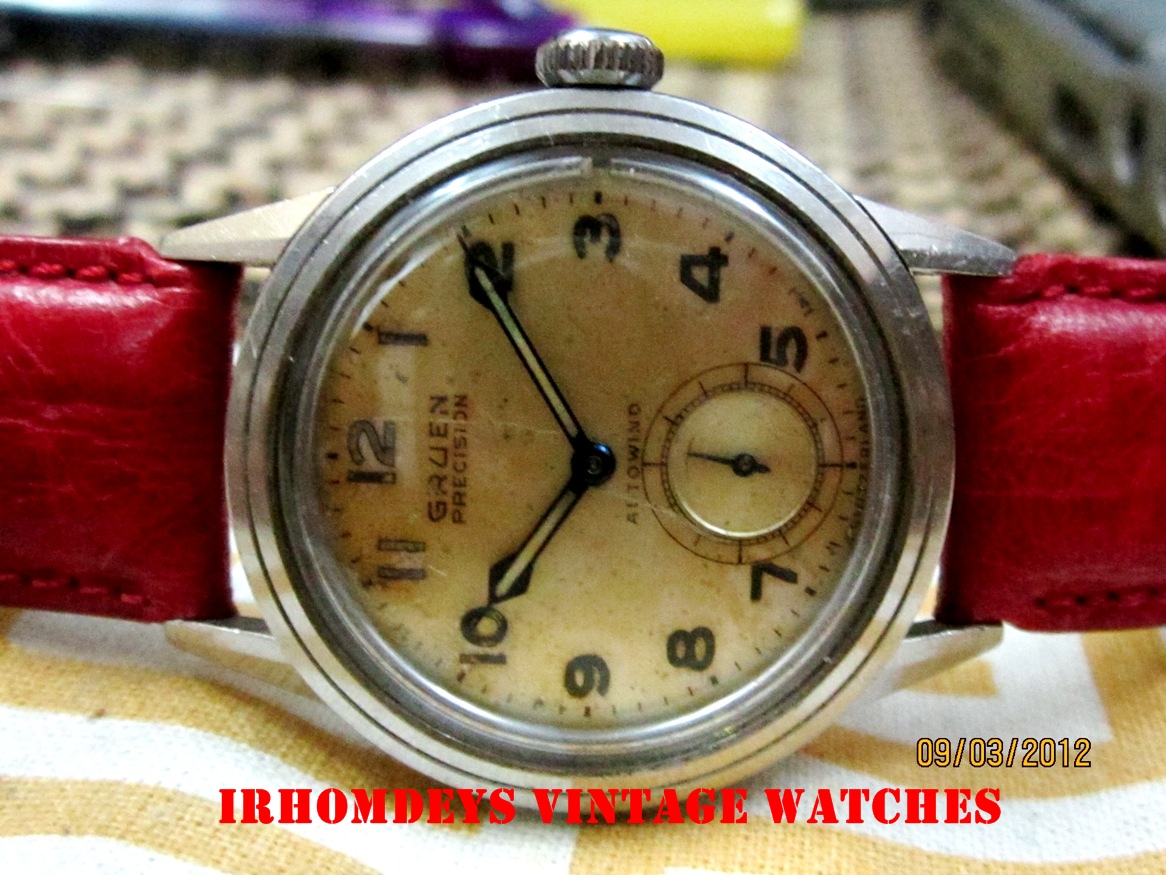
RARE CLLECTION - GRUEN PRECISION VERI-THIN GUILDITE AUTOWIND BUMPER MILITARY GENTS WRISTWATCH


BRAND/JENAMA: VINTAGE GRUEN PRECISION VERI-THIN GUILDITE BUMPER AUTOWIND MILITARY GENTS WRISTWATCH

MADE IN/BUATAN: SWISS

CIRCA/TAHUN: 1950's

MODEL: MILITARY

CRYSTAL/CERMIN: ACRYLIC

MOVEMENT/ENJIN: SWISS GRUEN PRECISION 17 JEWELS BUMPER AUTOMATIC WINDING MOVEMENT (AUTO MECHANISM IS FAULTY, CAN BE WOUND MANUALLY

DIAL COLOR: SILVER TONE WITH FAIRLY DISTRIBUTED PATINA

FUNCTION/FUNGSI: HOUR, MINUTES AND SUB-SECOND AT 6:00

HANDS/JARUM: BLUE METAL

MARKERS/TANDA WAKTU: BLACK ARABIC

CASING : GSOLID STAINLESS STEEL

LUGS: 12mm

MEASUREMENT/UKURAN: 37mm DIAMETER INCLUDING CROWN and 41mm LUG TO LUG

DITANDA/ENGARVED BACK CASING: GRUEN

CROWN: ORIGINAL SS CROWN

STRAP/TALI: NEW GENUINE MAROON LEATHER

SIZE STRAP/SAIZ TALI: 8.5"

WORKING CONDITION, KEEPING TIME, DISCONTINUED MODEL & RAREST AND HARD TO FIND OF THIS RAREST GRUEN MODEL.

PRICE/HARGA: RM950 (NEGOTIABLE/BOLEH DIRUNDING)


BRIEF HISTORY OF GRUEN WATCHES


The first Gruen watches are of very high quality and are beautifully made. Both 18 and 16 size versions were manufactured, each in both open face and hunter styles, and in 18- and 21-jewel versions. The earliest D. Gruen & Son serial numbers started around 62000. The Gruens dealt directly with individual jewelry stores; there were no wholesalers or jobbers involved in the distribution of their watches.

In 1898 George Gruen joined the firm as treasurer and financial officer. The company incorporated and its name changed to D. Gruen, Sons & Company.

In 1903 Gruen introduces its "VeriThin" line of watches.

In 1908 Gruen introduced both men's and women's wristwatches. These proved popular only with women. Gruen was one of a very few companies to take wristwatches seriously this early, seeing their potential in spite of disappointing early sales to male customers.

Gruen made both wrist and pocket watches for the military during World War I. Most had silver cases, which would tarnish but would not corrode under adverse conditions. To satisfy U.S. military regulations, these watches all have luminous dial markings and hands.

1911 Dietrich Gruen dies suddenly. Fred Gruen takes control of the company.

In 1913 the company purchased Nanny Goat Hill, a pasture just outside of Cincinnati, and renamed it Time Hill. Work began on a new building designed by architect Guy C. Burroughs at a construction cost estimated at $50,000 USD. The company moved to the new location in 1917.

1921: Gruen introduces The Cartouche wrist watch calling it "The logical wrist watch shape".

1922: Gruen introduces "The Pentagon" pocket watch. "the Croix de Guerre of American achievement"

Up until 1922 there had actually been three Gruen companies: D. Gruen, Sons & Company; The Gruen National Watch Case Company of Cincinnati; and The Gruen Watch Manufacturing Company of Biel, Switzerland. In 1922 all three businesses were merged to form the Gruen Watch Company, with Fred as President.

In 1924, Gruen released a special pocket watch in an edition of 600 to commemorate their 50th anniversary. The watch cost $500 at the time.

In 1925, Gruen introduced the men's Quadron. These were rectangular watches containing very high-quality 15-j or 17-j tonneau-shaped movements.

In 1928 Gruen releases The Techni-Quadron. The famous Techni-Quadron "doctor's watches" are so-called because the large seconds dial was handy for timing a patient's pulse.

In 1935 Fred Gruen, now 63 years old, became Chairman of the Board and Benjamin S. Katz was brought in as President of the Gruen Watch Company. In 1935, Gruen was about $1.8 million USD (roughly $36 million USD today) in debt; nervous stockholders and investors were behind the change. Fred would retire in 1940, but continued to sit on the board for the rest of his life.

In 1935 Gruen introduces the most famous Gruen wristwatch- "The Curvex". These watches are one of the greatest examples of 1930s streamlined design.

1937: Gruen introduces "The Ristside" or "driver's" watches.

In 1938, continuing the success of their VeriThin pocket watches, Gruen also launched a series of Veri-Thin wristwatches. Contemporary Curvex and Veri-Thin movements often are closely related, and can share many parts. By the 1940s, most Gruen wristwatches were either Veri-Thin or Curvex models.

Although Gruen did not manufacture watches for the U.S. military, they offered the public a collection of eight military-style watches, to be used as personal watches.

In 1949, the company introduced their first watches made entirely in the U.S., a line of 21-jewel men's models called the "Gruen 21". The movements are marked "Cincinnati" or "US" instead of the usual "Switzerland."

Fred Gruen retired in 1940 and died in 1945, and his brother George died in 1952. In 1953 the Gruen family sold their interest in the company. The same year, Gruen president Benjamin Katz was forced into retirement after a scandal, and in 1954 the company bought out his shares for $2 million USD. In 1953, the Gruen Watch Company had its highest sales in its entire history. The Myth about Gruen, Rolex and Aegler - The True History

One of the most deeply-held myths about Gruen is that Gruen and Rolex at one time manufactured movements for each other's watches. Both firms did use some of the same movements—the best known examples are the Gruen Techi-Quadron and its twin, the Rolex Prince. In reality, these movements were manufactured by a third company, Aegler, who was a very close neighbor to the Gruen Precision Factory. The Aegler factory in Biel. Aegler made movements for Rolex (which had no manufacturing capability at the time), and this building is the main Rolex factory today. Aegler was partly owned by Gruen.

Gruen and Rolex were Aegler's biggest customers, and were both large shareholders as well—the full company name at one time was, Aegler, Societe Anonyme, Fabrique des Montres Rolex & Gruen Guild A. Gruen and Rolex both occasionally showed pictures of the huge Aegler factory in their advertising, making the implication that this was a Gruen- or Rolex-owned facility, although ownership at the time was divided among Gruen, Rolex and Aegler itself. Gruen sold their Aegler shares in the 1930s, after they moved all production to the Precision Factory. After this time, Aegler became increasingly tied to Rolex through the sale of stock. Today, the main Rolex building in Biel is the old Aegler factory, and though it is now owned by Rolex, it is still run by the Aegler family.

This article taken from Complete Price Guide to Watches, American Wriswatches, Rolex Wristwatches: Best of Time and Gruen Master Book

RARE CLLECTION - GRUEN PRECISION VERI-THIN GUILDITE AUTOWIND BUMPER MILITARY GENTS WRISTWATCH (SOLD)


BRAND/JENAMA: VINTAGE GRUEN PRECISION VERI-THIN GUILDITE BUMPER AUTOWIND MILITARY GENTS WRISTWATCH
MADE IN/BUATAN: SWISS
CIRCA/TAHUN: 1950's
MODEL: MILITARY
CRYSTAL/CERMIN: ACRYLIC
MOVEMENT/ENJIN: SWISS GRUEN PRECISION 17 JEWELS BUMPER AUTOMATIC WINDING MOVEMENT (AUTO MECHANISM IS FAULTY, CAN BE WOUND MANUALLY
DIAL COLOR: SILVER TONE WITH FAIRLY DISTRIBUTED PATINA, A TINY SCRATCH FROM 12:00 TO THE CENTRE OF THE DIAL (LOOK AT THE PHOTO)
FUNCTION/FUNGSI: HOUR, MINUTES AND SUB-SECOND AT 6:00
HANDS/JARUM: BLUE METAL
MARKERS/TANDA WAKTU: BLACK ARABIC
CASING : SOLID STAINLESS STEEL
LUGS: 12mm
MEASUREMENT/UKURAN: 37mm DIAMETER INCLUDING CROWN and 41mm LUG TO LUG
DITANDA/ENGARVED BACK CASING: GRUEN
CROWN: ORIGINAL SS CROWN
STRAP/TALI: NEW GENUINE MAROON LEATHER
SIZE STRAP/SAIZ TALI: 8.5"
WORKING CONDITION, KEEPING TIME, DISCONTINUED MODEL & RAREST AND HARD TO FIND OF THIS RAREST GRUEN MODEL.
PRICE/HARGA:  (SOLD TO THOMAS SALAKI, NEW JERSEY, USA)

BRIEF HISTORY OF GRUEN WATCHES

The first Gruen watches are of very high quality and are beautifully made. Both 18 and 16 size versions were manufactured, each in both open face and hunter styles, and in 18- and 21-jewel versions. The earliest D. Gruen & Son serial numbers started around 62000. The Gruens dealt directly with individual jewelry stores; there were no wholesalers or jobbers involved in the distribution of their watches.

In 1898 George Gruen joined the firm as treasurer and financial officer. The company incorporated and its name changed to D. Gruen, Sons & Company.

In 1903 Gruen introduces its "VeriThin" line of watches.

In 1908 Gruen introduced both men's and women's wristwatches. These proved popular only with women. Gruen was one of a very few companies to take wristwatches seriously this early, seeing their potential in spite of disappointing early sales to male customers.

Gruen made both wrist and pocket watches for the military during World War I. Most had silver cases, which would tarnish but would not corrode under adverse conditions. To satisfy U.S. military regulations, these watches all have luminous dial markings and hands.

1911 Dietrich Gruen dies suddenly. Fred Gruen takes control of the company.

In 1913 the company purchased Nanny Goat Hill, a pasture just outside of Cincinnati, and renamed it Time Hill. Work began on a new building designed by architect Guy C. Burroughs at a construction cost estimated at $50,000 USD. The company moved to the new location in 1917.

1921: Gruen introduces The Cartouche wrist watch calling it "The logical wrist watch shape".

1922: Gruen introduces "The Pentagon" pocket watch. "the Croix de Guerre of American achievement"

Up until 1922 there had actually been three Gruen companies: D. Gruen, Sons & Company; The Gruen National Watch Case Company of Cincinnati; and The Gruen Watch Manufacturing Company of Biel, Switzerland. In 1922 all three businesses were merged to form the Gruen Watch Company, with Fred as President.

In 1924, Gruen released a special pocket watch in an edition of 600 to commemorate their 50th anniversary. The watch cost $500 at the time.

In 1925, Gruen introduced the men's Quadron. These were rectangular watches containing very high-quality 15-j or 17-j tonneau-shaped movements.

In 1928 Gruen releases The Techni-Quadron. The famous Techni-Quadron "doctor's watches" are so-called because the large seconds dial was handy for timing a patient's pulse.

In 1935 Fred Gruen, now 63 years old, became Chairman of the Board and Benjamin S. Katz was brought in as President of the Gruen Watch Company. In 1935, Gruen was about $1.8 million USD (roughly $36 million USD today) in debt; nervous stockholders and investors were behind the change. Fred would retire in 1940, but continued to sit on the board for the rest of his life.

In 1935 Gruen introduces the most famous Gruen wristwatch- "The Curvex". These watches are one of the greatest examples of 1930s streamlined design.

1937: Gruen introduces "The Ristside" or "driver's" watches.

In 1938, continuing the success of their VeriThin pocket watches, Gruen also launched a series of Veri-Thin wristwatches. Contemporary Curvex and Veri-Thin movements often are closely related, and can share many parts. By the 1940s, most Gruen wristwatches were either Veri-Thin or Curvex models.

Although Gruen did not manufacture watches for the U.S. military, they offered the public a collection of eight military-style watches, to be used as personal watches.

In 1949, the company introduced their first watches made entirely in the U.S., a line of 21-jewel men's models called the "Gruen 21". The movements are marked "Cincinnati" or "US" instead of the usual "Switzerland."

Fred Gruen retired in 1940 and died in 1945, and his brother George died in 1952. In 1953 the Gruen family sold their interest in the company. The same year, Gruen president Benjamin Katz was forced into retirement after a scandal, and in 1954 the company bought out his shares for $2 million USD.

In 1953, the Gruen Watch Company had its highest sales in its entire history.The Myth about Gruen, Rolex and Aegler - The True History

One of the most deeply-held myths about Gruen is that Gruen and Rolex at one time manufactured movements for each other's watches. Both firms did use some of the same movements—the best known examples are the Gruen Techi-Quadron and its twin, the Rolex Prince. In reality, these movements were manufactured by a third company, Aegler, who was a very close neighbor to the Gruen Precision Factory. The Aegler factory in Biel. Aegler made movements for Rolex (which had no manufacturing capability at the time), and this building is the main Rolex factory today. Aegler was partly owned by Gruen.
Gruen and Rolex were Aegler's biggest customers, and were both large shareholders as well—the full company name at one time was, Aegler, Societe Anonyme, Fabrique des Montres Rolex & Gruen Guild A. Gruen and Rolex both occasionally showed pictures of the huge Aegler factory in their advertising, making the implication that this was a Gruen- or Rolex-owned facility, although ownership at the time was divided among Gruen, Rolex and Aegler itself. Gruen sold their Aegler shares in the 1930s, after they moved all production to the Precision Factory. After this time, Aegler became increasingly tied to Rolex through the sale of stock. Today, the main Rolex building in Biel is the old Aegler factory, and though it is now owned by Rolex, it is still run by the Aegler family.

This article taken from Complete Price Guide to Watches, American Wriswatches, Rolex Wristwatches: Best of Time and Gruen Master Book

RARE CLLECTION - GRUEN PRECISION VERI-THIN GUILDITE AUTOWIND BUMPER MILITARY GENTS WRISTWATCH


BRAND/JENAMA: VINTAGE GRUEN PRECISION VERI-THIN GUILDITE BUMPER AUTOWIND MILITARY GENTS WRISTWATCH
MADE IN/BUATAN: SWISS
CIRCA/TAHUN: 1952 based on style no. 825 stamped on the caseback
MODEL: MILITARY
CRYSTAL/CERMIN: ACRYLIC
MOVEMENT/ENJIN: SWISS GRUEN PRECISION 17 JEWELS BUMPER AUTOMATIC WINDING MOVEMENT (AUTO MECHANISM IS FAULTY, CAN BE WOUND MANUALLY
DIAL COLOR: SILVER TONE
FUNCTION/FUNGSI: HOUR, MINUTES AND SUB-SECOND AT 6:00
HANDS/JARUM: BLUE METAL
MARKERS/TANDA WAKTU: BLACK ARABIC
CASING : GSOLID STAINLESS STEEL
LUGS: 12mm
MEASUREMENT/UKURAN: 37mm DIAMETER INCLUDING CROWN and 41mm LUG TO LUG
DITANDA/ENGARVED BACK CASING: GRUEN
CROWN: ORIGINAL SS CROWN
STRAP/TALI: NEW GENUINE BROWN LEATHER/ KULIT ASLI WARNA COKLAT BARU
SIZE STRAP/SAIZ TALI: 8.5"
WORKING CONDITION, KEEPING TIME, DISCONTINUED MODEL & RAREST AND HARD TO FIND. SEARCH IN THE NET AND NO OTHER SIMILAR TO THIS WATCH. WONDER HOW MANY LEFT TROUGH OUT THE CONTINENT FOR A GOOD WORKING CONDITION OF THIS RAREST GRUEN MODEL
PRICE/HARGA: RM900 (NOT FOR SALE- ITEM DAMAGED)

BRIEF HISTORY OF GRUEN WATCHES

The first Gruen watches are of very high quality and are beautifully made. Both 18 and 16 size versions were manufactured, each in both open face and hunter styles, and in 18- and 21-jewel versions. The earliest D. Gruen & Son serial numbers started around 62000. The Gruens dealt directly with individual jewelry stores; there were no wholesalers or jobbers involved in the distribution of their watches.

In 1898 George Gruen joined the firm as treasurer and financial officer. The company incorporated and its name changed to D. Gruen, Sons & Company.

In 1903 Gruen introduces its "VeriThin" line of watches.

In 1908 Gruen introduced both men's and women's wristwatches. These proved popular only with women. Gruen was one of a very few companies to take wristwatches seriously this early, seeing their potential in spite of disappointing early sales to male customers.

Gruen made both wrist and pocket watches for the military during World War I. Most had silver cases, which would tarnish but would not corrode under adverse conditions. To satisfy U.S. military regulations, these watches all have luminous dial markings and hands.

1911 Dietrich Gruen dies suddenly. Fred Gruen takes control of the company.

In 1913 the company purchased Nanny Goat Hill, a pasture just outside of Cincinnati, and renamed it Time Hill. Work began on a new building designed by architect Guy C. Burroughs at a construction cost estimated at $50,000 USD. The company moved to the new location in 1917.

1921: Gruen introduces The Cartouche wrist watch calling it "The logical wrist watch shape".

1922: Gruen introduces "The Pentagon" pocket watch. "the Croix de Guerre of American achievement"

Up until 1922 there had actually been three Gruen companies: D. Gruen, Sons & Company; The Gruen National Watch Case Company of Cincinnati; and The Gruen Watch Manufacturing Company of Biel, Switzerland. In 1922 all three businesses were merged to form the Gruen Watch Company, with Fred as President.

In 1924, Gruen released a special pocket watch in an edition of 600 to commemorate their 50th anniversary. The watch cost $500 at the time.

In 1925, Gruen introduced the men's Quadron. These were rectangular watches containing very high-quality 15-j or 17-j tonneau-shaped movements.

In 1928 Gruen releases The Techni-Quadron. The famous Techni-Quadron "doctor's watches" are so-called because the large seconds dial was handy for timing a patient's pulse.

In 1935 Fred Gruen, now 63 years old, became Chairman of the Board and Benjamin S. Katz was brought in as President of the Gruen Watch Company. In 1935, Gruen was about $1.8 million USD (roughly $36 million USD today) in debt; nervous stockholders and investors were behind the change. Fred would retire in 1940, but continued to sit on the board for the rest of his life.

In 1935 Gruen introduces the most famous Gruen wristwatch- "The Curvex". These watches are one of the greatest examples of 1930s streamlined design.

1937: Gruen introduces "The Ristside" or "driver's" watches.

In 1938, continuing the success of their VeriThin pocket watches, Gruen also launched a series of Veri-Thin wristwatches. Contemporary Curvex and Veri-Thin movements often are closely related, and can share many parts. By the 1940s, most Gruen wristwatches were either Veri-Thin or Curvex models.

Although Gruen did not manufacture watches for the U.S. military, they offered the public a collection of eight military-style watches, to be used as personal watches.

In 1949, the company introduced their first watches made entirely in the U.S., a line of 21-jewel men's models called the "Gruen 21". The movements are marked "Cincinnati" or "US" instead of the usual "Switzerland."

Fred Gruen retired in 1940 and died in 1945, and his brother George died in 1952. In 1953 the Gruen family sold their interest in the company. The same year, Gruen president Benjamin Katz was forced into retirement after a scandal, and in 1954 the company bought out his shares for $2 million USD.

In 1953, the Gruen Watch Company had its highest sales in its entire history. The Myth about Gruen, Rolex and Aegler - The True History


One of the most deeply-held myths about Gruen is that Gruen and Rolex at one time manufactured movements for each other's watches. Both firms did use some of the same movements—the best known examples are the Gruen Techi-Quadron and its twin, the Rolex Prince. In reality, these movements were manufactured by a third company, Aegler, who was a very close neighbor to the Gruen Precision Factory. Gruen and Rolex were Aegler's biggest customers, and were both large shareholders as well—the full company name at one time was, Aegler, Societe Anonyme, Fabrique des Montres Rolex & Gruen Guild A. Gruen and Rolex both occasionally showed pictures of the huge Aegler factory in their advertising, making the implication that this was a Gruen- or Rolex-owned facility, although ownership at the time was divided among Gruen, Rolex and Aegler itself. Gruen sold their Aegler shares in the 1930s, after they moved all production to the Precision Factory. After this time, Aegler became increasingly tied to Rolex through the sale of stock. Today, the main Rolex building in Biel is the old Aegler factory, and though it is now owned by Rolex, it is still run by the Aegler family.

This article taken from Complete Price Guide to Watches, American Wriswatches, Rolex Wristwatches: Best of Time and Gruen Master Book