Showing posts with label RETRO. Show all posts

Saturday, February 9, 2013

RARE NEW OLD STOCK VINTAGE TENOR DORLY HEXAGON GENT WRISTWATCH


VERY RARE COLLECTION - AUTHENTIC NEW OLD STOCK VINTAGE TENOR DORLY  HEXAGON RETRO GENTS WRISTWATCH

MADE IN/BUATAN: SWISS
CIRCA/TAHUN: 1970's
MODEL: TENOR DORL YHEXAGON
CRYSTAL/CERMIN: ACCRYLIC
MOVEMENT/ENJIN: SWISS AUTOMATIC 21J MOVEMENT CAL.1393
DIAL COLOR: TWO TONE BROWN/YELLOW
FUNCTION/FUNGSI: HOUR, MINUTES AND DATE
HANDS/JARUM: LUMINOUS SS HANDS
MARKERS/TANDA WAKTU: NRAISED SS BATON MARKE
CASING : WHITE GOLD PLATED ON BASE METAL
BEZEL: WHITE GOLD PLATED ON BASE METAL
LUGS: 18mm 
MEASUREMENT/UKURAN: 35mm DIAMETER EXCLUDING CROWN and 45mm LUG TO LUG
DITANDA/ENGARVED BACK CASING: -
CROWN: ORIGINAL  CROWN 
STRAP/TALI: ORIGINAL SS BRACELET BAND 
SIZE STRAP/SAIZ TALI: FULL LENGHT 8.5"
CONDITION: WORKING AND KEEPING TIME, EXCELLENT CONDITION
MY PRICE/HARGA :  RM750 (NEGOTIABLE)
LISTING RM750 SOLD RM

Tenor Dolly Watch is one of the coolest designs featuring a robust Tenor-Dorly 1393 calibre. The TD1393 movement is more complicated than an average automatic direct read from the 1970's but the various designs available prove that it must have been pretty popular among watch producers. It was sold under different brands such as Tenor-Dorly, TD, Waltham, Technos, Sempertalis, Dynasty or even the top-shelf Universal Geneve. Gunmetal or blackchrome versions are uncommon and have been very likely custom modified.

Saturday, January 12, 2013

LIKE NEW AUTHENTIC VINTAGE SWISS JOWISA JUMP HOUR RETRO GENTS WRISTWATCH


VERY RARE COLLECTION - AUTHENTIC VINTAGE  SWISS JOWISA RETRO GENTS WRISTWATCH

MADE IN/BUATAN: SWISS
CIRCA/TAHUN: 1970's
MODEL: JUMP HOUR
CRYSTAL/CERMIN: ACRYLIC
MOVEMENT/ENJIN: SWISS JOWISA MANUAL WINDING 17J MOVEMENT 
DIAL COLOR: BLUE
FUNCTION/FUNGSI: HOUR, MINUTES AND DATE
HANDS/JARUM: WHITE SECOND HAND 
MARKERS/TANDA WAKTU: NONE
CASING : CHROME PLATED ON BASE METAL
BEZEL: CHROME PLATED
LUGS: 18mm 
MEASUREMENT/UKURAN: 39mm DIAMETER EXCLUDING CROWN and 41mm LUG TO LUG
DITANDA/ENGARVED BACK CASING: -
CROWN: ORIGINAL  CROWN 
STRAP/TALI: MICKEY BLACK RUBBER BAND 
SIZE STRAP/SAIZ TALI: FULL LENGHT 8.5"
CONDITION: WORKING AND KEEPING TIME, EXCELLENT CONDITION
MY PRICE/HARGA :  RM650 (NEGOTIABLE)
LISTING RM650 SOLD RM00

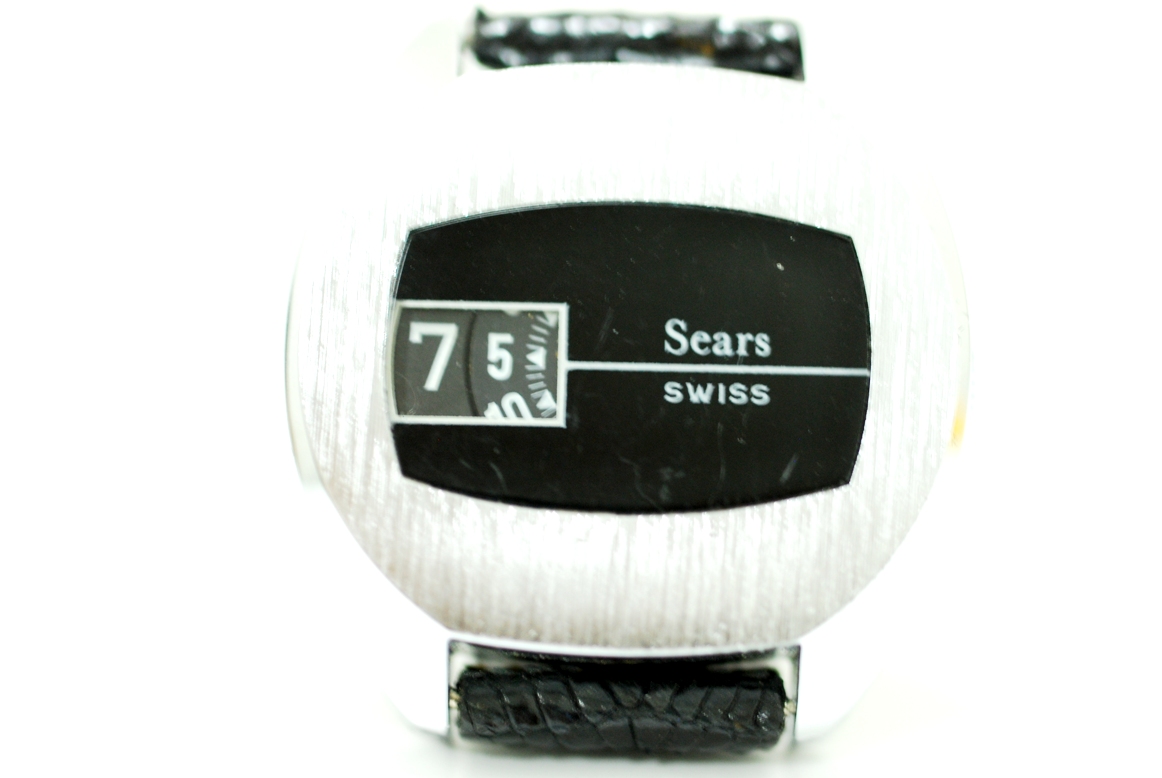
AUTHENTIC VINTAGE SEARS RETRO JUMP HOUR GENTS WRISTWATCH


VERY RARE COLLECTION - AUTHENTIC VINTAGE  SEARS JUMP HOUR RETRO GENTS WRISTWATCH

MADE IN/BUATAN: USA
CIRCA/TAHUN: 1970's
MODEL: JUMP HOUR
CRYSTAL/CERMIN: ACRYLIC
MOVEMENT/ENJIN: SEARS MANUAL WINDING MOVEMENT 
DIAL COLOR: BLACK
FUNCTION/FUNGSI: HOUR, MINUTES
HANDS/JARUM: NONE 
MARKERS/TANDA WAKTU: NONE
CASING : CHROME PLATED ON BASE METAL
BEZEL: CHROME PLATED
LUGS: 18mm 
MEASUREMENT/UKURAN: 37mm DIAMETER EXCLUDING CROWN and 41mm LUG TO LUG
DITANDA/ENGARVED BACK CASING: -
CROWN: ORIGINAL  CROWN 
STRAP/TALI: GENUINE BLACK LEATHER BAND 
SIZE STRAP/SAIZ TALI: FULL LENGHT 8.5"
CONDITION: WORKING AND KEEPING TIME, EXCELLENT CONDITION
MY PRICE/HARGA :  RM350 (NEGOTIABLE)

One day in 1886, a Chicago jewelry company shipped some gold-filled watches to an unsuspecting jeweler in a Minnesota hamlet. Thus started a chain of events that led to the founding of Sears. Richard Sears was an agent of the Minneapolis and St. Louis railway station in North Redwood, Minnesota. Sears job as station agent left him plenty of spare time, so he sold lumber and coal to local residents on the side to make extra money. Later, when he received a shipment of watches - unwanted by a neighboring Redwood Falls jeweler - he was ready. Sears purchased them himself, sold the watches at a nice profit to other station agents up and down the line, and then ordered more for resale.

Richard Sears was an agent of the Minneapolis and St. Louis railway station in North Redwood, Minnesota. Sears job as station agent left him plenty of spare time, so he sold lumber and coal to local residents on the side to make extra money. Later, when he received a shipment of watches - unwanted by a neighboring Redwood Falls jeweler - he was ready. Sears purchased them himself, sold the watches at a nice profit to other station agents up and down the line, and then ordered more for resale.

In 1969, Sears announced plans to build a new headquarters building in downtown Chicago. The 110-story Sears Tower became the world's tallest building at 1,454 feet when it was opened in 1973. The staggering amount of materials needed to construct the building included 76,000 tons of steel, 2 million cubic feet of concrete, 16,000 tinted windows, 1,500 miles of electrical wiring and 80 miles of elevator cable.

In 1980, Sears, Roebuck and Co. announced the formation of a corporate office and plans for major restructuring. This resulted in renaming the retail business the Sears Merchandise Group and the insurance business Allstate Insurance Group in early 1981. When Sears acquired the Dean Witter Reynolds Organization, Inc. and Coldwell Banker & Company later that year, it formed the Dean Witter Financial Services Group and the Coldwell Banker Real Estate Group. The following year, Sears formed a world trading company. It became Sears World Trade, whose activities were reduced and transferred to the Sears Merchandise Group in 1986.

The financial services strategy worked. The corporation --plus the Discover Card introduced in 1985--grew into the 1990s, with revenues reaching $59 billion in 1992. That year Sears announced it would again reshape the company to give it greater strength and marketing focus and to give its shareholders a better return on investment. As part of this restructuring, the Sears Merchandise Group, reorganized around its apparel, home and automotive businesses, closed many of its under-performing retail locations including some mall-based stores. Its unprofitable general catalog operations also were closed in 1993, leaving a smaller -- but successful -- direct-response business.

In early 1993, Sears also completed an initial public offering (IPO) of 20 percent of its Dean Witter organization, then called Dean Witter. In the second largest stock dividend distribution in U.S. history, Sears spunoff its remaining shares of Dean Witter to Sears shareholders. Later in the year, Sears established another financial milestone through the IPO of 20 percent of Allstate's stock. At the time, it was the largest IPO in U.S. history. The remaining Allstate shares were distributed to shareholder in 1995. As the result of these actions, shareholders of Sears then owned shares in three separate and non-affiliated companies: Sears, Roebuck and Co., Allstate and Dean Witter Discover & Co. (now Morgan Stanley Dean Witter & Co.). In addition, Sears sold the Coldwell Banker Residential Services, the Sears Mortgage Banking Group and the Homart Development Company. Total proceeds from these transactions, about $4 billion, were used to reduce overall corporate debt. With its diversified companies divested, Sears, Roebuck and Co. had returned to its retailing roots.

In 1997, Sears sold its majority interest in Sears, Roebuck de Mexico. A major expansion of Sears.com in 1999 heralded a new era of enhancing the customer experience through Web-based technology. With Sears.com, the company began serving as a single national "clicks and bricks" resource for researching, buying, delivering, installing, maintaining and repairing the top brands of home-related products - major appliances, home electronics, heating and cooling systems, lawn and garden equipment, jewelry and watches, recreation/games, power tools, repair parts and select apparel items.

Sears Today
At the close of its 2000 fiscal year, Sears operated 863 mall-based retail stores, most with co-located Sears Auto Centers, and an additional 1,200 retail locations including hardware, outlet, tire and battery stores as well as independently owned stores, primarily in smaller and rural markets.
The company's services operations include product installation and repair services; service contracts; selected installed home improvements; and direct response. Direct response includes direct response marketing, clubs and services memberships; and merchandise through specialty catalogs.

Sears, Roebuck and Co. also is the majority owner of Sears Canada Inc., one of Canada's largest retailers. Sears Canada operates 125 full-line stores, 176 specialty stores, and 1,550 independently owned catalog agents and hometown stores.

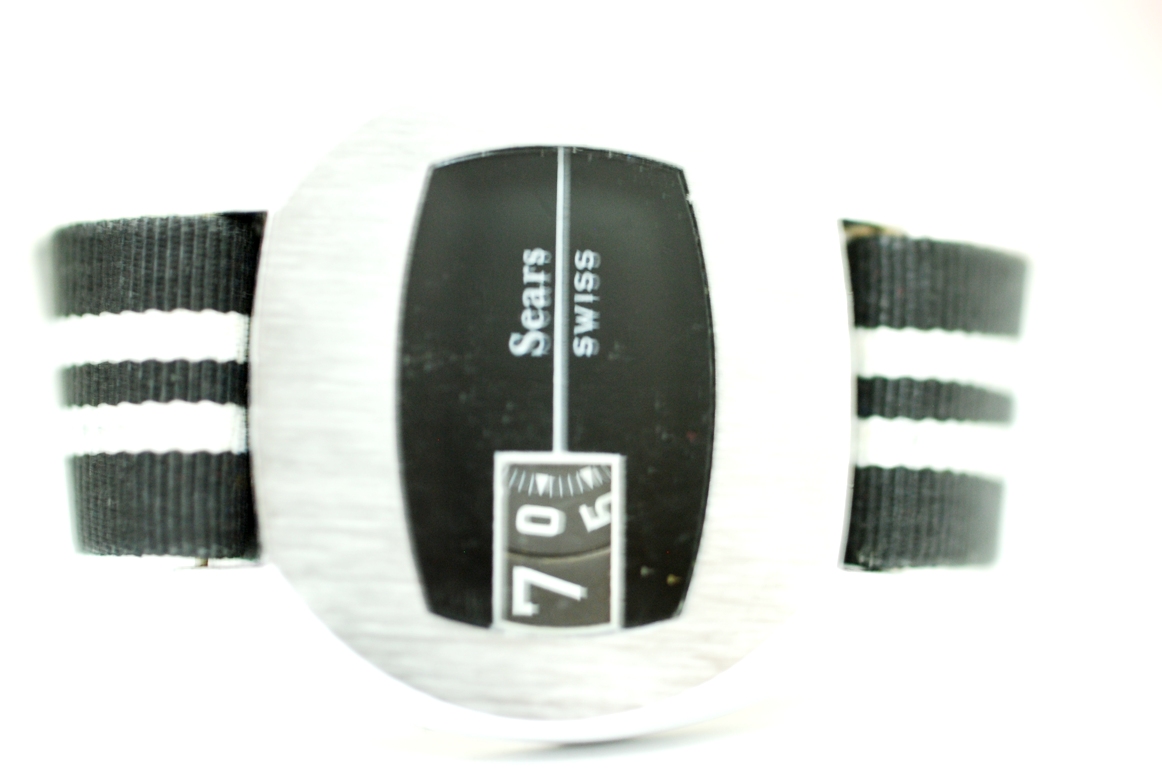
AUTHENTIC VINTAGE SEARS RETRO JUMP HOUR GENTS WRISTWATCH


VERY RARE COLLECTION - AUTHENTIC VINTAGE  SEARS JUMP HOUR RETRO GENTS WRISTWATCH

MADE IN/BUATAN: USA
CIRCA/TAHUN: 1970's
MODEL: JUMP HOUR
CRYSTAL/CERMIN: ACRYLIC
MOVEMENT/ENJIN: SEARS MANUAL WINDING MOVEMENT 
DIAL COLOR: BLACK
FUNCTION/FUNGSI: HOUR, MINUTES
HANDS/JARUM: NONE 
MARKERS/TANDA WAKTU: NONE
CASING : CHROME PLATED ON BASE METAL
BEZEL: CHROME PLATED
LUGS: 18mm 
MEASUREMENT/UKURAN: 37mm DIAMETER EXCLUDING CROWN and 41mm LUG TO LUG
DITANDA/ENGARVED BACK CASING: -
CROWN: ORIGINAL  CROWN 
STRAP/TALI: NEW BLACK/WHITE TEXTILE MILITARY BAND 
SIZE STRAP/SAIZ TALI: FULL LENGHT 8.5"
CONDITION: WORKING AND KEEPING TIME, EXCELLENT CONDITION
MY PRICE/HARGA :  RM350 (NEGOTIABLE)

One day in 1886, a Chicago jewelry company shipped some gold-filled watches to an unsuspecting jeweler in a Minnesota hamlet. Thus started a chain of events that led to the founding of Sears. Richard Sears was an agent of the Minneapolis and St. Louis railway station in North Redwood, Minnesota. Sears job as station agent left him plenty of spare time, so he sold lumber and coal to local residents on the side to make extra money. Later, when he received a shipment of watches - unwanted by a neighboring Redwood Falls jeweler - he was ready. Sears purchased them himself, sold the watches at a nice profit to other station agents up and down the line, and then ordered more for resale.

Richard Sears was an agent of the Minneapolis and St. Louis railway station in North Redwood, Minnesota. Sears job as station agent left him plenty of spare time, so he sold lumber and coal to local residents on the side to make extra money. Later, when he received a shipment of watches - unwanted by a neighboring Redwood Falls jeweler - he was ready. Sears purchased them himself, sold the watches at a nice profit to other station agents up and down the line, and then ordered more for resale.

In 1969, Sears announced plans to build a new headquarters building in downtown Chicago. The 110-story Sears Tower became the world's tallest building at 1,454 feet when it was opened in 1973. The staggering amount of materials needed to construct the building included 76,000 tons of steel, 2 million cubic feet of concrete, 16,000 tinted windows, 1,500 miles of electrical wiring and 80 miles of elevator cable.

In 1980, Sears, Roebuck and Co. announced the formation of a corporate office and plans for major restructuring. This resulted in renaming the retail business the Sears Merchandise Group and the insurance business Allstate Insurance Group in early 1981. When Sears acquired the Dean Witter Reynolds Organization, Inc. and Coldwell Banker & Company later that year, it formed the Dean Witter Financial Services Group and the Coldwell Banker Real Estate Group. The following year, Sears formed a world trading company. It became Sears World Trade, whose activities were reduced and transferred to the Sears Merchandise Group in 1986.

The financial services strategy worked. The corporation --plus the Discover Card introduced in 1985--grew into the 1990s, with revenues reaching $59 billion in 1992. That year Sears announced it would again reshape the company to give it greater strength and marketing focus and to give its shareholders a better return on investment. As part of this restructuring, the Sears Merchandise Group, reorganized around its apparel, home and automotive businesses, closed many of its under-performing retail locations including some mall-based stores. Its unprofitable general catalog operations also were closed in 1993, leaving a smaller -- but successful -- direct-response business.

In early 1993, Sears also completed an initial public offering (IPO) of 20 percent of its Dean Witter organization, then called Dean Witter. In the second largest stock dividend distribution in U.S. history, Sears spunoff its remaining shares of Dean Witter to Sears shareholders. Later in the year, Sears established another financial milestone through the IPO of 20 percent of Allstate's stock. At the time, it was the largest IPO in U.S. history. The remaining Allstate shares were distributed to shareholder in 1995. As the result of these actions, shareholders of Sears then owned shares in three separate and non-affiliated companies: Sears, Roebuck and Co., Allstate and Dean Witter Discover & Co. (now Morgan Stanley Dean Witter & Co.). In addition, Sears sold the Coldwell Banker Residential Services, the Sears Mortgage Banking Group and the Homart Development Company. Total proceeds from these transactions, about $4 billion, were used to reduce overall corporate debt. With its diversified companies divested, Sears, Roebuck and Co. had returned to its retailing roots.

In 1997, Sears sold its majority interest in Sears, Roebuck de Mexico. A major expansion of Sears.com in 1999 heralded a new era of enhancing the customer experience through Web-based technology. With Sears.com, the company began serving as a single national "clicks and bricks" resource for researching, buying, delivering, installing, maintaining and repairing the top brands of home-related products - major appliances, home electronics, heating and cooling systems, lawn and garden equipment, jewelry and watches, recreation/games, power tools, repair parts and select apparel items.

Sears Today
At the close of its 2000 fiscal year, Sears operated 863 mall-based retail stores, most with co-located Sears Auto Centers, and an additional 1,200 retail locations including hardware, outlet, tire and battery stores as well as independently owned stores, primarily in smaller and rural markets.
The company's services operations include product installation and repair services; service contracts; selected installed home improvements; and direct response. Direct response includes direct response marketing, clubs and services memberships; and merchandise through specialty catalogs.

Sears, Roebuck and Co. also is the majority owner of Sears Canada Inc., one of Canada's largest retailers. Sears Canada operates 125 full-line stores, 176 specialty stores, and 1,550 independently owned catalog agents and hometown stores.

AUTHENTIC VINTAGE SEARS RETRO JUMP HOUR GENTS WRISTWATCH


VERY RARE COLLECTION - AUTHENTIC VINTAGE  SEARS JUMP HOUR RETRO GENTS WRISTWATCH

MADE IN/BUATAN: USA
CIRCA/TAHUN: 1970's
MODEL: JUMP HOUR
CRYSTAL/CERMIN: ACRYLIC
MOVEMENT/ENJIN: SEARS MANUAL WINDING MOVEMENT 
DIAL COLOR: GOLD
FUNCTION/FUNGSI: HOUR, MINUTES
HANDS/JARUM: NONE 
MARKERS/TANDA WAKTU: NONE
CASING : GOLD PLATED ON BASE METAL
BEZEL: GOLD PLATED
LUGS: 18mm 
MEASUREMENT/UKURAN: 37mm DIAMETER EXCLUDING CROWN and 39mm LUG TO LUG
DITANDA/ENGARVED BACK CASING: -
CROWN: ORIGINAL  CROWN 
STRAP/TALI: GENUINE LIZARD PRINT BLACK LEATHER BAND 
SIZE STRAP/SAIZ TALI: FULL LENGHT 8.5"
CONDITION: WORKING AND KEEPING TIME, EXCELLENT CONDITION
MY PRICE/HARGA :  RM350 (NEGOTIABLE)

One day in 1886, a Chicago jewelry company shipped some gold-filled watches to an unsuspecting jeweler in a Minnesota hamlet. Thus started a chain of events that led to the founding of Sears. Richard Sears was an agent of the Minneapolis and St. Louis railway station in North Redwood, Minnesota. Sears job as station agent left him plenty of spare time, so he sold lumber and coal to local residents on the side to make extra money. Later, when he received a shipment of watches - unwanted by a neighboring Redwood Falls jeweler - he was ready. Sears purchased them himself, sold the watches at a nice profit to other station agents up and down the line, and then ordered more for resale.

Richard Sears was an agent of the Minneapolis and St. Louis railway station in North Redwood, Minnesota. Sears job as station agent left him plenty of spare time, so he sold lumber and coal to local residents on the side to make extra money. Later, when he received a shipment of watches - unwanted by a neighboring Redwood Falls jeweler - he was ready. Sears purchased them himself, sold the watches at a nice profit to other station agents up and down the line, and then ordered more for resale.

In 1969, Sears announced plans to build a new headquarters building in downtown Chicago. The 110-story Sears Tower became the world's tallest building at 1,454 feet when it was opened in 1973. The staggering amount of materials needed to construct the building included 76,000 tons of steel, 2 million cubic feet of concrete, 16,000 tinted windows, 1,500 miles of electrical wiring and 80 miles of elevator cable.

In 1980, Sears, Roebuck and Co. announced the formation of a corporate office and plans for major restructuring. This resulted in renaming the retail business the Sears Merchandise Group and the insurance business Allstate Insurance Group in early 1981. When Sears acquired the Dean Witter Reynolds Organization, Inc. and Coldwell Banker & Company later that year, it formed the Dean Witter Financial Services Group and the Coldwell Banker Real Estate Group. The following year, Sears formed a world trading company. It became Sears World Trade, whose activities were reduced and transferred to the Sears Merchandise Group in 1986.

The financial services strategy worked. The corporation --plus the Discover Card introduced in 1985--grew into the 1990s, with revenues reaching $59 billion in 1992. That year Sears announced it would again reshape the company to give it greater strength and marketing focus and to give its shareholders a better return on investment. As part of this restructuring, the Sears Merchandise Group, reorganized around its apparel, home and automotive businesses, closed many of its under-performing retail locations including some mall-based stores. Its unprofitable general catalog operations also were closed in 1993, leaving a smaller -- but successful -- direct-response business.

In early 1993, Sears also completed an initial public offering (IPO) of 20 percent of its Dean Witter organization, then called Dean Witter. In the second largest stock dividend distribution in U.S. history, Sears spunoff its remaining shares of Dean Witter to Sears shareholders. Later in the year, Sears established another financial milestone through the IPO of 20 percent of Allstate's stock. At the time, it was the largest IPO in U.S. history. The remaining Allstate shares were distributed to shareholder in 1995. As the result of these actions, shareholders of Sears then owned shares in three separate and non-affiliated companies: Sears, Roebuck and Co., Allstate and Dean Witter Discover & Co. (now Morgan Stanley Dean Witter & Co.). In addition, Sears sold the Coldwell Banker Residential Services, the Sears Mortgage Banking Group and the Homart Development Company. Total proceeds from these transactions, about $4 billion, were used to reduce overall corporate debt. With its diversified companies divested, Sears, Roebuck and Co. had returned to its retailing roots.

In 1997, Sears sold its majority interest in Sears, Roebuck de Mexico. A major expansion of Sears.com in 1999 heralded a new era of enhancing the customer experience through Web-based technology. With Sears.com, the company began serving as a single national "clicks and bricks" resource for researching, buying, delivering, installing, maintaining and repairing the top brands of home-related products - major appliances, home electronics, heating and cooling systems, lawn and garden equipment, jewelry and watches, recreation/games, power tools, repair parts and select apparel items.

Sears Today
At the close of its 2000 fiscal year, Sears operated 863 mall-based retail stores, most with co-located Sears Auto Centers, and an additional 1,200 retail locations including hardware, outlet, tire and battery stores as well as independently owned stores, primarily in smaller and rural markets.
The company's services operations include product installation and repair services; service contracts; selected installed home improvements; and direct response. Direct response includes direct response marketing, clubs and services memberships; and merchandise through specialty catalogs.

Sears, Roebuck and Co. also is the majority owner of Sears Canada Inc., one of Canada's largest retailers. Sears Canada operates 125 full-line stores, 176 specialty stores, and 1,550 independently owned catalog agents and hometown stores.

Tuesday, November 27, 2012

AUTHENTIC VINTAGE ORIGINAL GLASHUTTE SPEZICHRON HI BEAT 28,800 GENTS WRISTWATCH


BRAND/JENAMA : GLASHUTTE 
MODEL : RETRO
 MOVEMENT/ENJIN :SUPERB SPEZICRON HI BEAT 22800 GLASHUTTE GUB 22 RUBIES AUTOMATIC MOVEMENT CAL.11-27
ORIGIN/BUATAN : GERMANY
NO. SIRI/SERIAL NO. : 067719
CIRCA/TAHUN : 1980's
CASING/KEMASAN : STAINLESS STEEL
FUNCTION/FUNGSI : HOUR, MINUTES, SECOND, NON QUICK DATE
DIAL: TWO TONE DARK/LIGHT BROWN
CROWN: UNSIGNED SS CROWN
BEZEL: -
MARKINGS/TANDA JENAMA : DIAL, CASEBACK, MOVEMENT
BAND/TALI :
 NEW GENUINE DARK BROWN LEATHER BAND FIT 8" WRIST
HIDDEN LUGS SIZE: 20mm
BAND WIDTH: 20mm
LENS/CERMIN : ACCRYLIC CRYSTAL
MEASUREMENT/UKURAN : 42mm WITH CROWN X 44mm LUG TO LUG
WATER RESISTANT: NOT STATED
CONDITION/KONDISI : EXCELLENT WORKING CONDITIONAND KEEPING TIME
PRICE/HARGA: RM2150 (NEGOTIABLE)
MARKET VALUE FOR THIS PREOWNED TIME PIECE IS RM2800
LISTING: RM990  SOLD:RM700
Brief History of Glashutte Watches
Glashutte Original was created in 1845, when the German master watchmakers, Ferdiand Al Lange, Julius Assmann, Ludwig Strasser, Johannes Durrstein, Adolf Schneider, Strasser and Rohde, Ernst Kassiske settled in the region of Glasshutte. These master watchmakers were awarded various gold model at the world exhibition and international competitions, thus creating the foundation and reputation of watching making industry of Glashutte. In 1878, Moritz Grossmann founded the German School of Watchmaking, hence building groundwork for more skillful watchmakers in the region of Glashutte and transforming the region into a reputed symbol of watchmaking excellence.
In the beginning of World War II, the watch manufactories in Glasutte was still in the production of military watches for the Navy and Air Force. Later, in the last day of War World II, Glashutte was bombed from the sky and the factories were badly destroyed. The reminding unaffected factories merged and found the VEB Glashutter Uhrenbetriebe under the rule of East German state.

HISTORY OF GLASHUTTER UHRENBETRIEB (GUB)

Compares the pictures of Glashuette Original movements in older catalogues with those printed in the recent ones, the different movement designations are immediately evident: The older watches are equipped with the movement cal. 10-30, whereas the newer ones have the cal. 39. However, aside from the drastically improved optical finish, the two movements seem to be the same: the same wheels and the same screws seem to be located in the same places on both movements. So where are the differences that justify that new designation, or is this just a try to cheat, to pretend a new movement where there is none?

When the communist German Democratic Republic found its end as a souvereign state, the state-owned “Glashuetter Uhrenbetrieb” (GuB) was busy developing a new selfwinding movement. Solid it should be, and efficient. Before the works could be finished, the company was sold to the French movement manufacturer France Ebauches SA. This company tried to save itself from bankruptcy by means of German know-how and the cheap labour in Eastern Germany. The new selfwinding movement should compete with the Swiss movements produced by ETA, and was therefore developed specifically with a high momentum and maximum universality in mind. Before the short-time owner of the Glashuette watch manufactory had to develop a new movement, they found already a good movement in Glashuette: In 1978, the V.E.B. ("Volkseigener Betrieb" = People's owned company) Glashuetter Uhrenbetriebe (GUB) brought out their last completely new construction, the cal. 11-26, dubbed Spezichron.

This Spezichron was modernized in several steps under control of first the France Ebauches, then the Treuhand-Anstalt, and finally of Heinz W. Pfeifer, until it found its way as cal. 10-30 into the new watches of Glashuette Original. Under control of the Treuhandanstalt, which, from 1990 to 1994, took over the former East German state-owned companies and sought to bring them into the private sector, the movement cal. 10-30 was completed and used in a new and very cheap line of watches after 1993.

The Spezichron cal. 11-27 movement was the successor of the popular "Spezimatic", which was produced from 1964 until 1980. Compared to the Spezimatic, the new Spezichron was smaller and faster: 28,800 A/h, while the Spezimatic only had 18,000. With that movement, the East German GUB could compete with the common movements of Swiss origins. The Spezichron was solid and accurate. Additionally, a version with weekday display was made; it was designated cal. 11-27.

Yet there were plans for more complications, which could not be based on the trusted 10-30 movement; a new development was necessary. However, it was neither economically feasible nor desirable to have completely new cases and dials produced for the new base movement. Therefore, the starting point of the effort was the condition, that the new movement had the same dimensions, as well as the location of important parts, such as the winding stem, must be the same as in the old 10-30. Additionally, the planned new complication modules should have enough space on the movement’s front.
All elements of the 10-30 movement, which were tried and reliable, were taken over into the new construction, above all the complete escapement was transferred. Even these parts were refined, however, with the addition of a swan neck adjustement, for example. The result of the development was the new cal. 39 movement, which from the outside, looked like the old 10-30. Yet of the originally 130 parts, only 17 remained unchanged. The new movement had more jewels, a better adjustment, and, above all, a better ability to wear additional complication modules.

With the 10-30, every module had to be autonomous; that means, that each module had to consist of an upper an a lower baseplate, so that the final movement had four plate layers. The new cal. 39 movement was constructed in a way that its upper baseplate could serve as the lower base of the module, resulting in a “sandwich” of only three plate layers. This saves space which can be used for more complicated modules.
Finally, the optical qualities of the new movement were drastically improved: skeletonized rotor, finely grinded wheels, angled plates and teeth, the decoration work entirely done by hand. In spite of the still solid base of a movement designed to compete with the ETA-workhorses, the Glashuette Original cal. 39 without doubt is one of the finest selfwinding movements on the market.

The cal. 26 movement found in the watches of UNION/Glashuette, is based on that cal. 39 movement, but is changed in two essential ways: It consists of 12 parts less than its GO counterpart (mainly in the fine adjustement area), and its decoration is mostly machine-made. This saves a lot of money and enables UNION, to offer fine inhouse movements in well-made, competitively priced watches.

This movement was the successor of the popular "Spezimatic", which was produced from 1964 until 1980. Compared to the Spezimatic, the new Spezichron was smaller and faster: 28,800 A/h, while the Spezimatic only had 18,000. With that movement, the East German GUB could compete with the common movements of Swiss origins. The Spezichron was solid and accurate. Additionally, a version with weekday display was made; it was designated cal. 11-27.

A year later, in 1994, the company was bought by Heinz W. Pfeifer, and immediately the cal. 10-30 was thoroughly revised in order to equip high-class watches. More than 60 changes were made, until the movement, which internally was designated cal. 10-30/2, was used for the then new “Klassik”-line. However, the movement’s potential for refinement was exhausted. It was used in all self-winding Glashuette Original watches, including the chronographs, which added a chrono module to the base movement.
Yet there were plans for more complications, which could not be based on the trusted 10-30 movement; a new development was necessary. However, it was neither economically feasible nor desirable to have completely new cases and dials produced for the new base movement. Therefore, the starting point of the effort was the condition, that the new movement had the same dimensions, as well as the location of important parts, such as the winding stem, must be the same as in the old 10-30. Additionally, the planned new complication modules should have enough space on the movement’s front.

Thursday, November 22, 2012

AUTHENTIC VINTAGE ORIGINAL GLASHUTTE GuB SPEZICHRON HI BEAT 28800 GENTS WRISTWATCH


BRAND/JENAMA : ORIGINAL GLASHUTTE GuB SPEZICRON GENTS WRISTWATCH
MODEL : SPEZICRON
 MOVEMENT/ENJIN :SUPERB SPEZICRON HI BEAT 22800 GLASHUTTE GUB 22 RUBIES AUTOMATIC MOVEMENT CAL.11-27
ORIGIN/BUATAN : GERMANY
NO. SIRI/SERIAL NO. : 471260
CIRCA/TAHUN : 1980's
CASING/KEMASAN : STAINLESS STEEL
FUNCTION/FUNGSI : HOUR, MINUTES, SECOND, NON QUICK DATE
DIAL: BLACK
CROWN: UNSIGNED SS CROWN
BEZEL: -
MARKINGS/TANDA JENAMA : DIAL, CASEBACK, MOVEMENT
BAND/TALI :
 NEW GENUINE DARK BROWN LEATHER BAND FIT 8" WRIST
HIDDEN LUGS SIZE: 20mm
BAND WIDTH: 20mm
LENS/CERMIN : ACCRYLIC CRYSTAL
MEASUREMENT/UKURAN : 35mm W/O CROWN X 43mm LUG TO LUG
WATER RESISTANT: NOT STATED
CONDITION/KONDISI : EXCELLENT WORKING CONDITIONAND KEEPING TIME
PRICE/HARGA: RM2650 (NEGOTIABLE)
MARKET VALUE FOR THIS PREOWNED TIME PIECE IS RM3500
LISTING: RM1450  SOLD:RM
ISTING: RM SOLD:

Brief History of Glashutte Watches
Glashutte Original was created in 1845, when the German master watchmakers, Ferdiand Al Lange, Julius Assmann, Ludwig Strasser, Johannes Durrstein, Adolf Schneider, Strasser and Rohde, Ernst Kassiske settled in the region of Glasshutte. These master watchmakers were awarded various gold model at the world exhibition and international competitions, thus creating the foundation and reputation of watching making industry of Glashutte. In 1878, Moritz Grossmann founded the German School of Watchmaking, hence building groundwork for more skillful watchmakers in the region of Glashutte and transforming the region into a reputed symbol of watchmaking excellence.
In the beginning of World War II, the watch manufactories in Glasutte was still in the production of military watches for the Navy and Air Force. Later, in the last day of War World II, Glashutte was bombed from the sky and the factories were badly destroyed. The reminding unaffected factories merged and found the VEB Glashutter Uhrenbetriebe under the rule of East German state.

HISTORY OF GLASHUTTER UHRENBETRIEB (GUB)

Compares the pictures of Glashuette Original movements in older catalogues with those printed in the recent ones, the different movement designations are immediately evident: The older watches are equipped with the movement cal. 10-30, whereas the newer ones have the cal. 39. However, aside from the drastically improved optical finish, the two movements seem to be the same: the same wheels and the same screws seem to be located in the same places on both movements. So where are the differences that justify that new designation, or is this just a try to cheat, to pretend a new movement where there is none?
When the communist German Democratic Republic found its end as a souvereign state, the state-owned “Glashuetter Uhrenbetrieb” (GuB) was busy developing a new selfwinding movement. Solid it should be, and efficient. Before the works could be finished, the company was sold to the French movement manufacturer France Ebauches SA. This company tried to save itself from bankruptcy by means of German know-how and the cheap labour in Eastern Germany. The new selfwinding movement should compete with the Swiss movements produced by ETA, and was therefore developed specifically with a high momentum and maximum universality in mind. Before the short-time owner of the Glashuette watch manufactory had to develop a new movement, they found already a good movement in Glashuette: In 1978, the V.E.B. ("Volkseigener Betrieb" = People's owned company) Glashuetter Uhrenbetriebe (GUB) brought out their last completely new construction, the cal. 11-26, dubbed Spezichron.
This Spezichron was modernized in several steps under control of first the France Ebauches, then the Treuhand-Anstalt, and finally of Heinz W. Pfeifer, until it found its way as cal. 10-30 into the new watches of Glashuette Original. Under control of the Treuhandanstalt, which, from 1990 to 1994, took over the former East German state-owned companies and sought to bring them into the private sector, the movement cal. 10-30 was completed and used in a new and very cheap line of watches after 1993.
The Spezichron cal. 11-27 movement was the successor of the popular "Spezimatic", which was produced from 1964 until 1980. Compared to the Spezimatic, the new Spezichron was smaller and faster: 28,800 A/h, while the Spezimatic only had 18,000. With that movement, the East German GUB could compete with the common movements of Swiss origins. The Spezichron was solid and accurate. Additionally, a version with weekday display was made; it was designated cal. 11-27.
Yet there were plans for more complications, which could not be based on the trusted 10-30 movement; a new development was necessary. However, it was neither economically feasible nor desirable to have completely new cases and dials produced for the new base movement. Therefore, the starting point of the effort was the condition, that the new movement had the same dimensions, as well as the location of important parts, such as the winding stem, must be the same as in the old 10-30. Additionally, the planned new complication modules should have enough space on the movement’s front.
All elements of the 10-30 movement, which were tried and reliable, were taken over into the new construction, above all the complete escapement was transferred. Even these parts were refined, however, with the addition of a swan neck adjustement, for example. The result of the development was the new cal. 39 movement, which from the outside, looked like the old 10-30. Yet of the originally 130 parts, only 17 remained unchanged. The new movement had more jewels, a better adjustment, and, above all, a better ability to wear additional complication modules.
With the 10-30, every module had to be autonomous; that means, that each module had to consist of an upper an a lower baseplate, so that the final movement had four plate layers. The new cal. 39 movement was constructed in a way that its upper baseplate could serve as the lower base of the module, resulting in a “sandwich” of only three plate layers. This saves space which can be used for more complicated modules.
Finally, the optical qualities of the new movement were drastically improved: skeletonized rotor, finely grinded wheels, angled plates and teeth, the decoration work entirely done by hand. In spite of the still solid base of a movement designed to compete with the ETA-workhorses, the Glashuette Original cal. 39 without doubt is one of the finest selfwinding movements on the market.
The cal. 26 movement found in the watches of UNION/Glashuette, is based on that cal. 39 movement, but is changed in two essential ways: It consists of 12 parts less than its GO counterpart (mainly in the fine adjustement area), and its decoration is mostly machine-made. This saves a lot of money and enables UNION, to offer fine inhouse movements in well-made, competitively priced watches.
This movement was the successor of the popular "Spezimatic", which was produced from 1964 until 1980. Compared to the Spezimatic, the new Spezichron was smaller and faster: 28,800 A/h, while the Spezimatic only had 18,000. With that movement, the East German GUB could compete with the common movements of Swiss origins. The Spezichron was solid and accurate. Additionally, a version with weekday display was made; it was designated cal. 11-27.

A year later, in 1994, the company was bought by Heinz W. Pfeifer, and immediately the cal. 10-30 was thoroughly revised in order to equip high-class watches. More than 60 changes were made, until the movement, which internally was designated cal. 10-30/2, was used for the then new “Klassik”-line. However, the movement’s potential for refinement was exhausted. It was used in all self-winding Glashuette Original watches, including the chronographs, which added a chrono module to the base movement.
Yet there were plans for more complications, which could not be based on the trusted 10-30 movement; a new development was necessary. However, it was neither economically feasible nor desirable to have completely new cases and dials produced for the new base movement. Therefore, the starting point of the effort was the condition, that the new movement had the same dimensions, as well as the location of important parts, such as the winding stem, must be the same as in the old 10-30. Additionally, the planned new complication modules should have enough space on the movement’s front.