Saturday, February 18, 2012

RARE VINTAGE COLLECTILE CHUNKY RETRO GLASHUTTE GENTS WATCH

BRAND/JENAMA : GuB GLASHUTTE SPEZIMATIC
MODEL : SPEZIMATIC
MOVEMENT/ENJIN :SUPERB 26 RUBIES GLASHUTTE GUB AUTOMATIC MOVEMENT
ORIGIN/BUATAN : GERMANY NO. SIRI/SERIAL NO. : 340861
CIRCA/TAHUN : 1970's
CASING/KEMASAN : GOLD PLATED & STAINLESS STEEL BACK (PLATED FLAKING IN CERTAIN PART OF CASING - SEE PHOTO)
FUNCTION/FUNGSI : HOUR, MINUTES, SECOND, NON QUICK DATE DIAL: CREAMY YELLOW - RETRO CROWN: UNSIGNED GOLD TONE BEZEL: -
MARKINGS/TANDA JENAMA : DIAL, CASEBACK, MOVEMENT BAND/TALI : NEW GENUINE BLACK LEATHER MILITARY BAND FIT 8" WRIST HIDDEN LUGS SIZE: 20mm BAND WIDTH: 20mm
LENS/CERMIN : ACCRYLIC CRYSTAL
MEASUREMENT/UKURAN : 44mm WITH CROWN X 37mm LUG TO LUG WATER RESISTANT: NOT STATED
CONDITION/KONDISI : EXCELLENT WORKING CONDITIONAND KEEPING TIME
PRICE/HARGA: RM2500 (NEGOTIABLE)
MARKET VALUE FOR THIS PREOWNED TIME PIECE IS RM3,800 LISTING: RM SOLD: 
Brief History of Glashutte Watches

Glashutte Original was created in 1845, when the German master watchmakers, Ferdiand Al Lange, Julius Assmann, Ludwig Strasser, Johannes Durrstein, Adolf Schneider, Strasser and Rohde, Ernst Kassiske settled in the region of Glasshutte. These master watchmakers were awarded various gold model at the world exhibition and international competitions, thus creating the foundation and reputation of watching making industry of Glashutte. In 1878, Moritz Grossmann founded the German School of Watchmaking, hence building groundwork for more skillful watchmakers in the region of Glashutte and transforming the region into a reputed symbol of watchmaking excellence.

In the beginning of World War II, the watch manufactories in Glasutte was still in the production of military watches for the Navy and Air Force. Later, in the last day of War World II, Glashutte was bombed from the sky and the factories were badly destroyed. The reminding unaffected factories merged and found the VEB Glashutter Uhrenbetriebe under the rule of East German state.


Wednesday, February 15, 2012

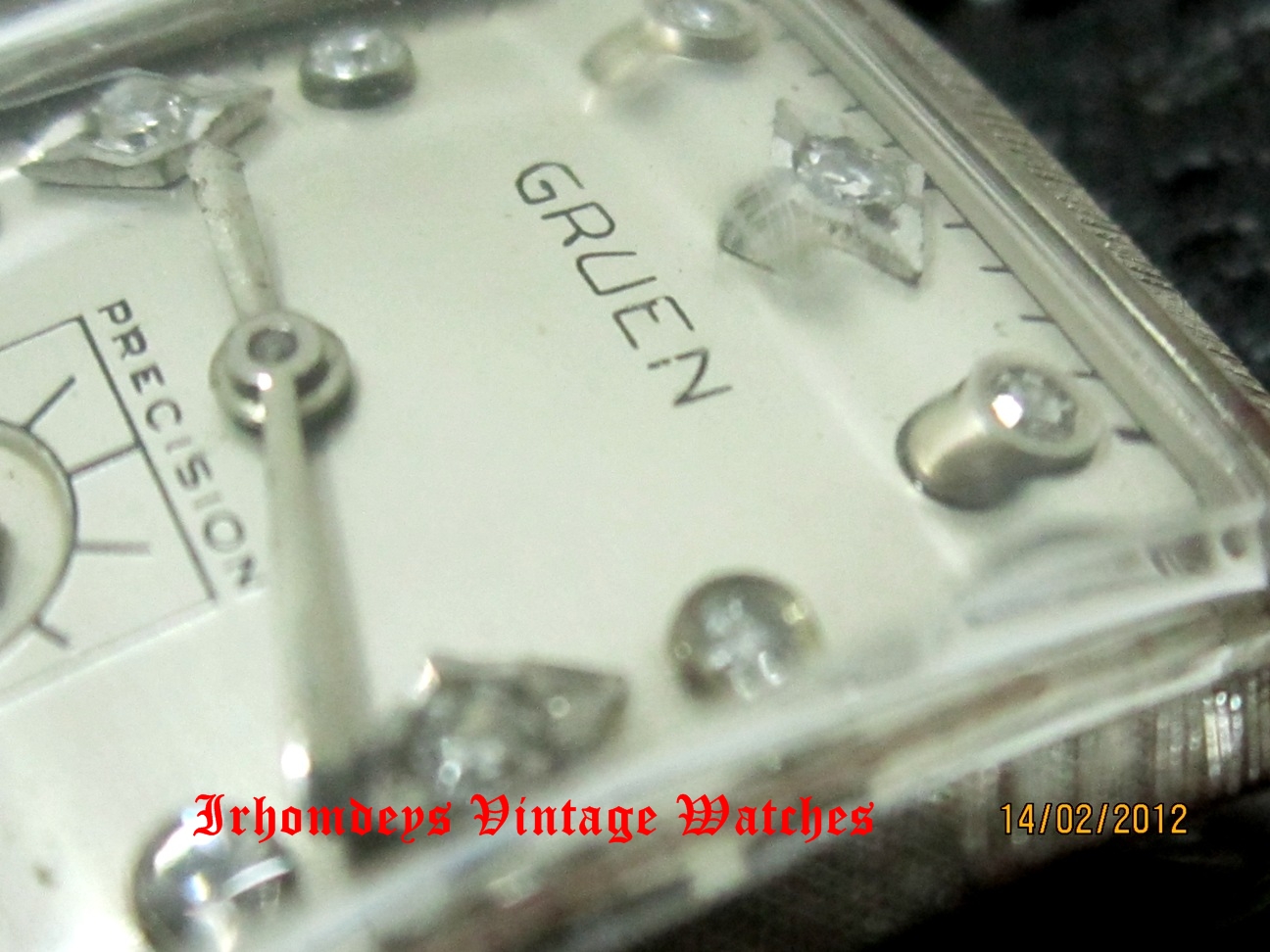
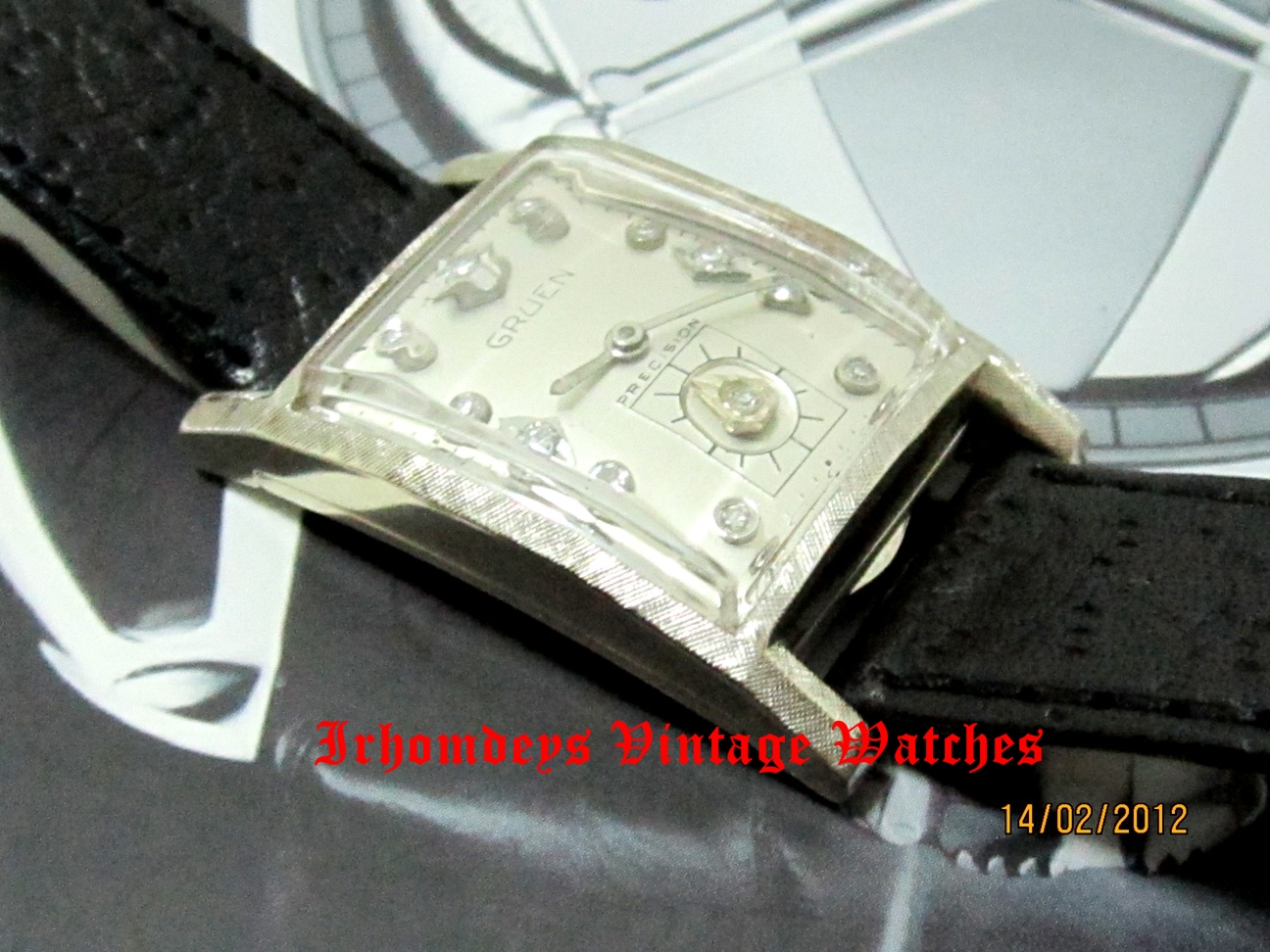
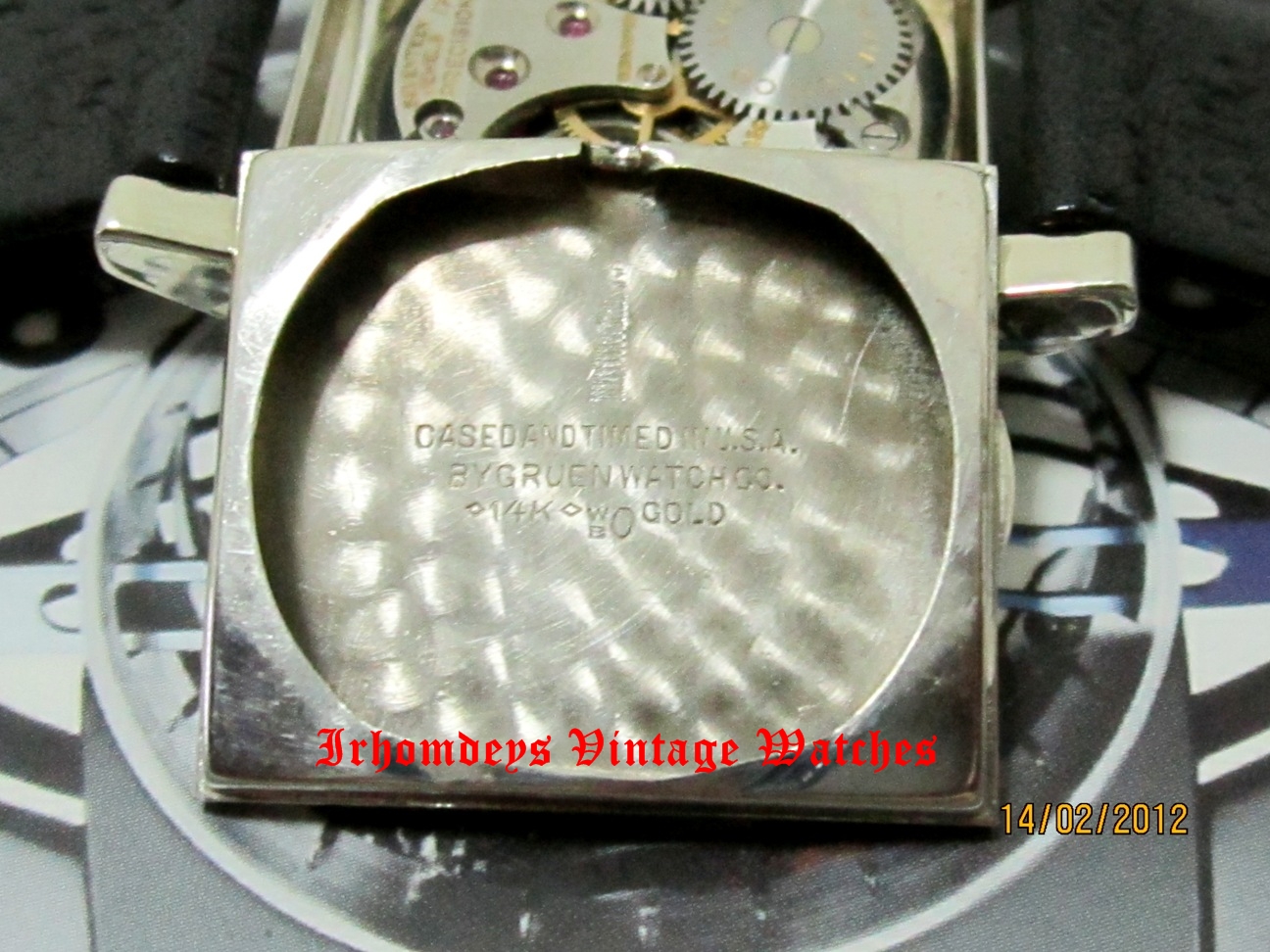
EXTREMELY RARE SOLID 14K WHITE GOLD DIAMONDS DIAL GRUEN PRECISION CURVEX ARTDECO GENTS WRISTWATCH


BRAND/JENAMA: EXTREMELY RARE SOLID 14K WHITE GOLD DIAMONDS DIAL GRUEN PRECISION CURVEX ARTDECO GENTS WRISTWATCH
MADE IN/BUATAN: SWISS
CIRCA/TAHUN: 1920's
MODEL: ARTDECO
CRYSTAL/CERMIN: ACRYLIC
MOVEMENT/ENJIN: SWISS AGLEAR GRUEN GUILD 15 JEWELS MANUAL WINDING MOVEMENT CAL. 3132
DIAL COLOR: SOLID 14K WHITE GOLD
FUNCTION/FUNGSI: HOUR, MINUTE AND SUB SECOND DIAL AT 6:00 WITH ROTATING GENUINE DIAMOND
HANDS/JARUM: BLUE METAL
MARKERS/TANDA WAKTU: 12 PCS GENUINE 0.08 CARAT ROUND DIAMONDS (TOTAL 0.96 CARAT VVS)
CASING : 14K SOLID WHITE GOLD
LUGS: 16mm UNIQUE DESIGN HARD TO FIND
CROWN: 14K SOLID WHITE GOLDDITANDA/ENGARVED BACK CASING: GRUEN
STRAP/TALI: BLACK LEATHER BAND
SIZE STRAP/SAIZ TALI: 8.5"
WORKING CONDITION, KEEPING TIME, DISCONTINUED MODEL & HARD TO FIND
PRICE/HARGA: PERSONAL COLLECTION BUT WILLING TO LET GO FOR USD1,990

Gruen Watch Company
On June 12, 1874 Dietrich Gruen applied for a patent on an improved safety pinion, which was granted on December 22. He was 27 years old.

In 1876 he formed the Columbus Watch Manufacturing Company in the basement of a downtown Columbus, Ohio bank building.

In his Columbus workshop, Dietrich modified, finished and cased raw movements that were imported from Switzerland. These new watches included his patented safety pinion. Dietrich introduced 16-size watches as an alternative to the heavy and thick 18-size and larger watches that were prevalent at the time. He also introduced the first stemwind watches sold in the U.S. market.

As the company grew, they moved to two floors in a commerical building a few blocks away.

In 1882, in collaboration with a number of new partners, the company was reorganized as the Columbus Watch Company and moved to a newly-constructed factory building located on Thurman Street, in the 'German Village' section of Columbus. Dietrich was President of the new corporation.

By 1888 production was about 45 watches per day; the company would grow to 300 employees and output to 150 watches per day. Although the company continued to issue stemwind watches, they also manufactured keywind movements for some of their less-expensive models.

After a series of disagreements with the other partners, Dietrich Gruen and his son Fred left the Columbus Watch Company in 1894, shortly before the business went bankrupt. Dietrich had lost his share of the company to the investors, and was faced with the prospect of staying on as a salaried employee at the company that he had founded. He chose to leave rather than bear this indignity. After the departure of the Gruens the firm was reorganized, refinanced and renamed "The New Columbus Watch Company."

The New Columbus Watch Company survived until 1903. The contents of the factory, including all the tooling and stocks of movements, were eventually purchased by the Studebaker family, moved to Indiana (along with many key employees) and used to start the South Bend Watch Company. Some early South Bend watches were sold with signed Columbus movements in them.

In 1894, Fred Gruen and Dietrich Gruen decided to try to start a new watch company. Using money borrowed from friends and relatives, Dietrich and Fred formed the partnership "D. Gruen and Son.".

These first Gruen watches are of very high quality and are beautifully made. Both 18 and 16 size versions were manufactured, each in both open face and hunter styles, and in 18- and 21-jewel versions. The earliest D. Gruen & Son serial numbers started around 62000. The Gruens dealt directly with individual jewelry stores; there were no wholesalers or jobbers involved in the distribution of their watches.

In 1898 George Gruen joined the firm as treasurer and financial officer. The company incorporated and its name changed to D. Gruen, Sons & Company.

In 1903 Gruen introduces its "VeriThin" line of watches.

In 1908 Gruen introduced both men's and women's wristwatches. These proved popular only with women. Gruen was one of a very few companies to take wristwatches seriously this early, seeing their potential in spite of disappointing early sales to male customers.

Gruen made both wrist and pocket watches for the military during World War I. Most had silver cases, which would tarnish but would not corrode under adverse conditions. To satisfy U.S. military regulations, these watches all have luminous dial markings and hands.

1911 Dietrich Gruen dies suddenly. Fred Gruen takes control of the company.

In 1913 the company purchased Nanny Goat Hill, a pasture just outside of Cincinnati, and renamed it Time Hill. Work began on a new building designed by architect Guy C. Burroughs at a construction cost estimated at $50,000 USD. The company moved to the new location in 1917.

1921: Gruen introduces The Cartouche wrist watch calling it "The logical wrist watch shape".

1922: Gruen introduces "The Pentagon" pocket watch. "the Croix de Guerre of American achievement"

Up until 1922 there had actually been three Gruen companies: D. Gruen, Sons & Company; The Gruen National Watch Case Company of Cincinnati; and The Gruen Watch Manufacturing Company of Biel, Switzerland. In 1922 all three businesses were merged to form the Gruen Watch Company, with Fred as President.

In 1924, Gruen released a special pocket watch in an edition of 600 to commemorate their 50th anniversary. The watch cost $500 at the time.

In 1925, Gruen introduced the men's Quadron. These were rectangular watches containing very high-quality 15-j or 17-j tonneau-shaped movements.

In 1928 Gruen releases The Techni-Quadron. The famous Techni-Quadron "doctor's watches" are so-called because the large seconds dial was handy for timing a patient's pulse.

In 1935 Fred Gruen, now 63 years old, became Chairman of the Board and Benjamin S. Katz was brought in as President of the Gruen Watch Company. In 1935, Gruen was about $1.8 million USD (roughly $36 million USD today) in debt; nervous stockholders and investors were behind the change. Fred would retire in 1940, but continued to sit on the board for the rest of his life.

In 1935 Gruen introduces the most famous Gruen wristwatch- "The Curvex". These watches are one of the greatest examples of 1930s streamlined design.

1937: Gruen introduces "The Ristside" or "driver's" watches.

In 1938, continuing the success of their VeriThin pocket watches, Gruen also launched a series of Veri-Thin wristwatches. Contemporary Curvex and Veri-Thin movements often are closely related, and can share many parts. By the 1940s, most Gruen wristwatches were either Veri-Thin or Curvex models.

Although Gruen did not manufacture watches for the U.S. military, they offered the public a collection of eight military-style watches, to be used as personal watches.

In 1949, the company introduced their first watches made entirely in the U.S., a line of 21-jewel men's models called the "Gruen 21". The movements are marked "Cincinnati" or "US" instead of the usual "Switzerland."

Fred Gruen retired in 1940 and died in 1945, and his brother George died in 1952. In 1953 the Gruen family sold their interest in the company. The same year, Gruen president Benjamin Katz was forced into retirement after a scandal, and in 1954 the company bought out his shares for $2 million USD.

In 1953, the Gruen Watch Company had its highest sales in its entire history.
Gruen, Rolex and Aegler

One of the most deeply-held myths about Gruen is that Gruen and Rolex at one time manufactured movements for each other's watches. Both firms did use some of the same movements—the best known examples are the Gruen Techi-Quadron and its twin, the Rolex Prince. In reality, these movements were manufactured by a third company, Aegler, who was a very close neighbor to the Gruen Precision Factory.

Above: The Aegler factory in Biel. Aegler made movements for Rolex (which had no manufacturing capability at the time), and this building is the main Rolex factory today. Aegler was partly owned by Gruen.
Gruen and Rolex were Aegler's biggest customers, and were both large shareholders as well—the full company name at one time was, Aegler, Societe Anonyme, Fabrique des Montres Rolex & Gruen Guild A. Gruen and Rolex both occasionally showed pictures of the huge Aegler factory in their advertising, making the implication that this was a Gruen- or Rolex-owned facility, although ownership at the time was divided among Gruen, Rolex and Aegler itself. Gruen sold their Aegler shares in the 1930s, after they moved all production to the Precision Factory. After this time, Aegler became increasingly tied to Rolex through the sale of stock. Today, the main Rolex building in Biel is the old Aegler factory, and though it is now owned by Rolex, it is still run by the Aegler family.

This article taken from Complete Price Guide to Watches, American Wriswatches, Rolex Wristwatches: Best of Time and Gruen Master Book

Tuesday, February 7, 2012

RARE COLLECTION - AUTHENTIC LONGINES ADMIRAL CHRONOMETER CERTIFIED GENTS WRISTWATCH (SOLD)


BRAND/JENAMA: AUTHENTIC VINTAGE LUXURIOUS LONGINES ADMIRAL CHRONOMETER CERTIFIED GENTS WRISTWATCH

MADE IN/BUATAN: LONGINES SWISS

CIRCA/TAHUN: 1970's

MODEL: ADMIRAL CHRONOMETER S/N 52248759

CRYSTAL/CERMIN: ACCRYLIC CRYSTAL

MOVEMENT/ENJIN: LONGINES 25 JEWELS AUTOMATIC WINDING MOVEMENT CAL. 8651

DIAL COLOR: SALMON PIE PAN STYLE DIAL

FUNCTION/FUNGSI: HOUR, MINUTE, SWIPE SECOND AND QUICK SET DATE AT 3:00

HANDS/JARUM: GOLD TONE

MARKERS/TANDA WAKTU: BLACK BATON MARKERS

CASING : SOLID STAINLESS STEEL

HIDDEN LUGS: 19mm

MEASUREMENT/UKURAN: 35mm DIAMETER EXCLUDING CROWN and 41mm LUG TO LUG

DITANDA/ENGARVED BACK CASING:

CROWN: ORIGINAL LONGINES GP CROWN

STRAP/TALI: GENUINE LEATHER BAND

SIZE STRAP/SAIZ TALI: 8.5"

EXCELLENT CONDITION, WORKING, KEEPING TIME

PRICE/HARGA : SOLD TO KL LOKE


BRIEF HISTORY OF LONGINES AND WITTNAUER WATCHES
Longines Watch Company was started in 1832 by Auguste Agassiz. Agassiz opened a workshop in St Imier, Switzerland. He operated what today would be called a "Home Business". Workers would work on watches out of thier own homes, whigh Agassiz would later sell.


Sometime between the years of 1854 and 1866 Agassiz handed down over the operation of the watchmaking business to his nephew Ernest Francillon. Realizing the lack of consistant quality coming from the manufacture of watches in so many locations, Francillon soon built a factory in Les Longines near St. Imier and consolidated all of the areas watchmaking under one roof. The Longines name was born.

The company began producing chronographs in 1879. They later produced aviator watches and cockpit instruments.

The company registered its "Winged Hourglass" trademark in May of 1890.

In 1912 the company produced the first automatic timekeeping device. From that day Longines has long been associated with time-keeping at major sporting events.

In the 1950's Longines purchased the Wittnauer watch company and marketed a number of very similar lines of watches in the US under both brand names.

In my opinion, Longines Wittnauer is one of the finest watches a collector can find. The classic designs are fantastic. The accuracy and reliability is amazing, and the parts are readily available. One of my favorites.

BEAUTIFUL AUTHENTIC VINTAGE LONGINES GENTS DRESS WRISTWATCH


BRAND/JENAMA: AUTHENTIC VINTAGE LONGINES GENTS DRESS WRISTWATCH

MADE IN/BUATAN: LONGINES SWISS

CIRCA/TAHUN: 1970's

MODEL: DRESS

CRYSTAL/CERMIN: SAPPHIRE CRYSTAL

MOVEMENT/ENJIN: LONGINES 21 JEWELS AUTOMATIC WINDING MOVEMENT CAL. CW8 BASED ON ETA CAL.2892-2

DIAL COLOR: SILVER

FUNCTION/FUNGSI: HOUR, MINUTE, SWIPE SECOND AND QUICK SET DATE AT 3:00

HANDS/JARUM: DAUPHANE

MARKERS/TANDA WAKTU: BLACK ROMAN MARKERS

CASING : SOLID STAINLESS STEEL

HIDDEN LUGS: 19mm

MEASUREMENT/UKURAN: 35mm DIAMETER EXCLUDING CROWN and 41mm LUG TO LUG

DITANDA/ENGARVED BACK CASING:

CROWN: ORIGINAL LONGINES STAINLESS STEEL

STRAP/TALI: GENUINE LEATHER BAND

SIZE STRAP/SAIZ TALI: 8.5"

EXCELLENT CONDITION, WORKING, KEEPING TIME

PRICE/HARGA : SOLD>


BRIEF HISTORY OF LONGINES AND WITTNAUER WATCHES

Longines Watch Company was started in 1832 by Auguste Agassiz. Agassiz opened a workshop in St Imier, Switzerland. He operated what today would be called a "Home Business". Workers would work on watches out of thier own homes, whigh Agassiz would later sell.


Sometime between the years of 1854 and 1866 Agassiz handed down over the operation of the watchmaking business to his nephew Ernest Francillon. Realizing the lack of consistant quality coming from the manufacture of watches in so many locations, Francillon soon built a factory in Les Longines near St. Imier and consolidated all of the areas watchmaking under one roof. The Longines name was born.

The company began producing chronographs in 1879. They later produced aviator watches and cockpit instruments.

The company registered its "Winged Hourglass" trademark in May of 1890.

In 1912 the company produced the first automatic timekeeping device. From that day Longines has long been associated with time-keeping at major sporting events.

In the 1950's Longines purchased the Wittnauer watch company and marketed a number of very similar lines of watches in the US under both brand names.

In my opinion, Longines Wittnauer is one of the finest watches a collector can find. The classic designs are fantastic. The accuracy and reliability is amazing, and the parts are readily available. One of my favorites.

AUTHENTIC VINTAGE LONGINES GENTS DRESSWRISTWATCH


BRAND/JENAMA: AUTHENTIC VINTAGE LONGINES GENTS DRESS WRISTWATCH

MADE IN/BUATAN: LONGINES SWISS

CIRCA/TAHUN: 1980's

MODEL: DRESS

CRYSTAL/CERMIN: SAPPHIRE CRYSTAL

MOVEMENT/ENJIN: LONGINES 23 JEWELS AUTOMATIC WINDING MOVEMENT CAL. L 619.3

DIAL COLOR: SILVER

FUNCTION/FUNGSI: HOUR, MINUTE, SWIPE SECOND AND QUICK SET DATE AT 3:00

HANDS/JARUM: BLACK METAL

MARKERS/TANDA WAKTU: BLACK ROMAN MARKERS

CASING : SOLID STAINLESS STEEL

HIDDEN LUGS: 19mm

MEASUREMENT/UKURAN: 35mm DIAMETER EXCLUDING CROWN and 41mm LUG TO LUG

DITANDA/ENGARVED BACK CASING:

CROWN: ORIGINAL LONGINES STAINLESS STEEL

STRAP/TALI: GENUINE LONGINES SS BEAD BRACELET

SIZE STRAP/SAIZ TALI: 8"

EXCELLENT CONDITION, WORKING, KEEPING TIME

PRICE/HARGA :SOLD<>span>


BRIEF HISTORY OF LONGINES AND WITTNAUER WATCHES

Longines Watch Company was started in 1832 by Auguste Agassiz. Agassiz opened a workshop in St Imier, Switzerland. He operated what today would be called a "Home Business". Workers would work on watches out of thier own homes, whigh Agassiz would later sell.


Sometime between the years of 1854 and 1866 Agassiz handed down over the operation of the watchmaking business to his nephew Ernest Francillon. Realizing the lack of consistant quality coming from the manufacture of watches in so many locations, Francillon soon built a factory in Les Longines near St. Imier and consolidated all of the areas watchmaking under one roof. The Longines name was born.

The company began producing chronographs in 1879. They later produced aviator watches and cockpit instruments.

The company registered its "Winged Hourglass" trademark in May of 1890.

In 1912 the company produced the first automatic timekeeping device. From that day Longines has long been associated with time-keeping at major sporting events.

In the 1950's Longines purchased the Wittnauer watch company and marketed a number of very similar lines of watches in the US under both brand names.

In my opinion, Longines Wittnauer is one of the finest watches a collector can find. The classic designs are fantastic. The accuracy and reliability is amazing, and the parts are readily available. One of my favorites.