Since Sumerian time, human being has invented the devices to measure and keep track of time. Clock and watches further developed in modern days. Antique and vintage mechanical watches and clocks produced in Switzerland, Germany,Japan and USA were high precision device that were sought after by many collector for their complications, rarity and high in value....
1960'S Lecoultre Atmos Swiss Clock 528-6. Really nice clock and looks so shiny and beautiful! Serial Number 171402 puts it early 1960's. Finish is bright and clear with only a few minor scuffs or spots that are mostly noticeable at close inspection. There is a teeny tiny rough spot on the upper back side corner that I only noticed upon up close and personal inspection. It is very hard to detect and nobody would even see it, but I had to mention it. Since I have been testing it ON 10.12.2010, it has been working and keeping proper time.
The ATMOS as manufactured by Jaeger LeCoultre, the makers of world famous Reverso wrist watches, is a time piece that for generations has represented the wonders of science, technology and remarkable Swiss craftsmanship. Possessing one signifies belonging to an exclusive group of world leaders, famous celebrities, business professionals, and, put more simply, people with exquisite taste.
ATMOS - The breathtaking clock that lives on air!
People often search for the one special item that will make their home or office stand out, without seeming to be too pretentious or requiring the spending of a fortune. How many absurd pieces of junk have found their way into fine homes based upon some trendy concept of art deco or post modernism? The Atmos is a counterweight to all of that. It is the answer to that endless quest. It is a marvel of technology that also will shine of refinement and grace.
Jean Lebet, the head engineer in the ATMOS division in the LeCoultre factory in Switzerland recalls in his book, "I subsequently discovered that everyone who comes to know it is captivated by its charm! Some are taken by the serene movement of its balance, others by the equilibrium of its shape, others again by the technical challenge that it has required and finally there are those who love it for reasons that escape logical analysis. You cannot explain charm and some people even say that it can be dangerous to try to explain the inexplicable!" (from Lebet, "Living On Air, History Of The Atmos Clock", (c) 1997)
The story of the ATMOS is a fascinating one. Centuries ago the great Leonardo Da Vinci demonstrated the physical impossibility of constructing a perpetual motion device. However, scientists and artisans of many nationalities have always tried continually to do so anyway. In 1928 a French engineer named Jean-Leon Reutter constructed a clock driven quite literally by the air. This device captured the imagination of many of his contemporary clock makers. After extensive development, Jaeger LeCoultre, a famous watch and clock maker in its own right, perfected and patented the perpetual motion Atmos clock and began marketing it world wide.
The technological concept is a remarkable one. Inside a sealed capsule, a mixture of gas and liquid expands as the temperature rises and contracts as it falls, moving the capsule back and forth like a tiny unseen accordion. This motion is used to constantly wind the mainspring thus enabling the clock to run and keep perfect time. A small temperature variation of just one degree is sufficient for over two day's operation. Such variation occurs naturally in normal room temperature and thus without any additional sources of energy, the Atmos clock will continue to run, if left untouched, "forever".
The Atmos is the ultimate environmentally friendly device, there are no batteries to throw away, no electrical consumption of any kind to consider. But this is no quartz clock, the Atmos is a precision device of the first order. To convert the small amount of energy that comes from the air, everything inside the Atmos is made to be virtually frictionless and runs as smoothly and as quietly as is humanly possible. The power consumed by a 15 watt light bulb could run over 60 million Atmos clocks simultaneously!
The parts inside the Atmos are also virtually wear free, thus an Atmos can expect an operational service life of over 600 years, although with today's air pollution, an overhaul and cleaning is recommended every 20 years or so. The Atmos will be the heirloom that you will treasure in your lifetime and leave to future generations for their own enjoyment and appreciation.
In these days of mass production, every Atmos is still made in Switzerland entirely by hand. A single Atmos clock takes a month to produce and then undergoes another 5 weeks of trial and adjustment before leaving the factory in the Vallée De Joux located in the Swiss Jura Mountains. Atmos is thus a rare, hard to find item.
Admirers of advanced technology are not the only ones who get their money's worth. Connoisseurs of elegant forms, precious materials and traditional craftsmanship do so as well. For decades the Government of Switzerland has been presenting its distinguished guests with this masterpiece of Swiss artistry, it is the pride and joy of the Swiss clock making industry. The Atmos has had the honor of being associated with great statesmen, royalty and other renowned people including President John F. Kennedy, Sir Winston Churchill, General Charles De Gaulle, President Ronald Reagan, Pope John Paul II, King Hussein of Jordan and many others.
MOVEMENT/PERGERAKAN : ORIENT 21 JEWELS AUTOMATIC MOVEMENT DIAL: TWO TONE BLACK/RED RING WITH QUICKSET DAYDATE AT 3:00 HANDS: SILVER TONE LUMINOUS BEZEL: DIVER BI DIRECTIONAL 24 SLIDE RULE WITH RED BATON MARKERS
MARKINGS/TANDA JENAMA : DIAL AND CASEBACK
BAND/TALI : GENUINE BLACK LEATHER BAND CROWN: UNSIGNED ORIGINAL CROWN LUGS SIZE: 20mm BAND WIDTH: 20mm
LENS/CERMIN : MINERAL
MEASUREMENT/UKURAN : 46mm X 50mm LUG TO LUG WATER RESISTANT: 200 METERS
CONDITION/KONDISI : GOOD, WORKING AND KEEPING TIME PRICE/HARGA: SOLD TO SAIFUL FROM MALACCA LISTING RM570.00 SOLD RM385 BRIEF HISTORY OF ORIENT WATCHES
Orient Watch was founded in Tokyo by Shogoro Yoshida, more than a century ago in 1901. And though the world was a very different place back then, everyone still needed to know what time it was – much like today’s world.
In those early watch making days, Orient Watch had some competition in the watch industry at home. Seiko and Citizen were big names in the watch making industry, and for many years Orient was ranked number three when it came to watch companies.
From the early beginnings, Orient Watch has been focused on making the best mechanical watches that money can buy. The history of Orient Watch is interesting because Orient Watch is a company that started out with a good idea, and never once veered onto a different course. The long years have helped Orient Watch to produce high-quality, long-lasting watches that anyone can afford.
In 1985 Orient and Seiko established a joint factory. Orient produces a range of automatic and quartz watches ranging in price from reasonably inexpensive (about 50USD / 50Euro) to very expensive (7000USD). Orient Star and Orient Star Royal are the middle and high-end brands, with the Royal Orient being their flagship line." - quoted from Orient Watch Company, Wikipedia
Today, Orient Watch is known all over the globe. With manufacturing facilities in Singapore, Brazil, and Japan, Orient Watch today offers more styles and types of watches than ever. Today, Orient Watch offers watches in many designs including quartz, light powered, and of course mechanical.
Mitsuo Mimura, President of Orient Watch in 2006 quoted in Orient Watch website “In the Japanese market, we supply high-quality watches, such as "Orient Star Royal," our prestigious mechanical watch series, which our customers want to carry with them for many years. In overseas markets, our strategy is to develop new outlets for our products mainly in countries and areas with high potential economic growth, and increase our sales of budget-price watches."
For more than a hundred years, Orient Watch has been a well-known and respected name in the watch making industry. Today, many other companies try to reach the success and the high standards that Orient Watch has set. When it comes to mechanical watches, Orient Watch is the first name in the business. For high quality at an affordable price, Orient Watch is one of the better choices in watches. But don’t just take my word for it. Let the history of Orient Watch speak for itself.
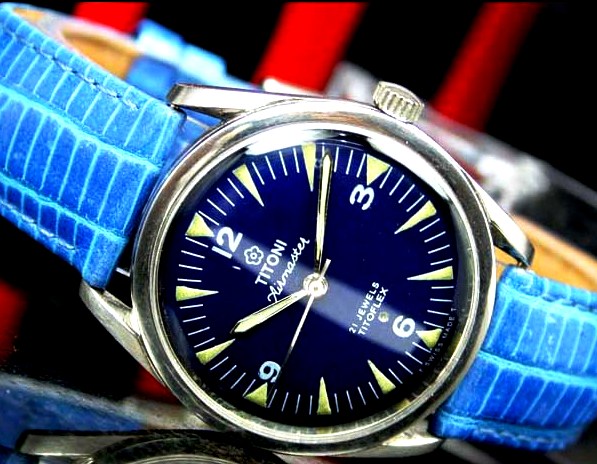
MOVEMENT/ENJIN:RARE HIGH GRADE ETA 21 JEWELS SWISS TITONI TITIFLEX MANUAL WINDING MOVEMENT CAL. 1900/01
DIAL COLOR: BLUE MILITARY RAIL DIAL
FUNCTION/FUNGSI: HOUR, MINUTES AND SWIPESECONDS
HANDS/JARUM: SILVER TONE HANDS
MARKERS/TANDA WAKTU: RAIL MARKER
CASING : SOLID STAINLESS STEEL/ KELULI SEPENUHNYA
BEZEL: STAINLESS STEEL
LUGS: 18mm
MEASUREMENT/UKURAN: 37mm DIAMETER INCLUDING CROWN and 39mm LUG TO LUG
DITANDA/ENGARVED BACK CASING: -
CROWN: NON SIGNED ORIGINAL SS CROWN
STRAP/TALI:GENUINE BLUE CROCO DESIGN LEATHER BANDS
SIZE STRAP/SAIZ TALI: 8.5" FULL LENGHT
CONDITION:WORKING AND KEEPING TIME, EXCELLENT CONDITION
MY PRICE/HARGA :(SOLD TO MR JACOB FROM KAJANG)
BRIEF HISTORY OF TITONI WRISTWATCH
In the year 1851, the watch-making industry was introduced to the small city of Grenchen Switzerland. Many famous watch companies were founded here and have helped make Grenchen an important part of today's Swiss watch business.
Titoni was founded by Fritz Schluep in 1919 in Grenchen and the company is still in the hands of the Schluep family. Titoni is one of the few remaining independent watch enterprises and has made a significant contribution to the history of watchmaking.
Today, the Titoni Company is in its third generation of family ownership. New to the US market, Titoni has concentrated on the far east and near east markets for over 50 years.
While many watch brands have focused over the last twenty-five years on quartz watches, Titoni has continued in the niche it has always occupied: watches equipped with self-winding mechanical movements. All Titoni watch components have to fulfill rigorous quality standards. The components for automatic movements, such as jeweled lever escapements, main springs, jewel shock absorbers, etc., are individually selected. This is claimed to assure better quality in contrast to other watch companies who buy complete movements. The assembly and integration of movements, as well as finishing and final control of the complete watches are handled at the Titoni factory in Switzerland.
Standard Titoni features include sapphire crystals, water resistance from 30 meters up to 200 meter, solid bracelets, buckles with two push-pieces and the stones on the dials are individually set, not glued. The modern Titoni factory makes use of manufacturing technology including extensive automation.
165 Fee
USD3,995 (RM12,000) SOLD TO MR AZUAN FROM DENGKIL
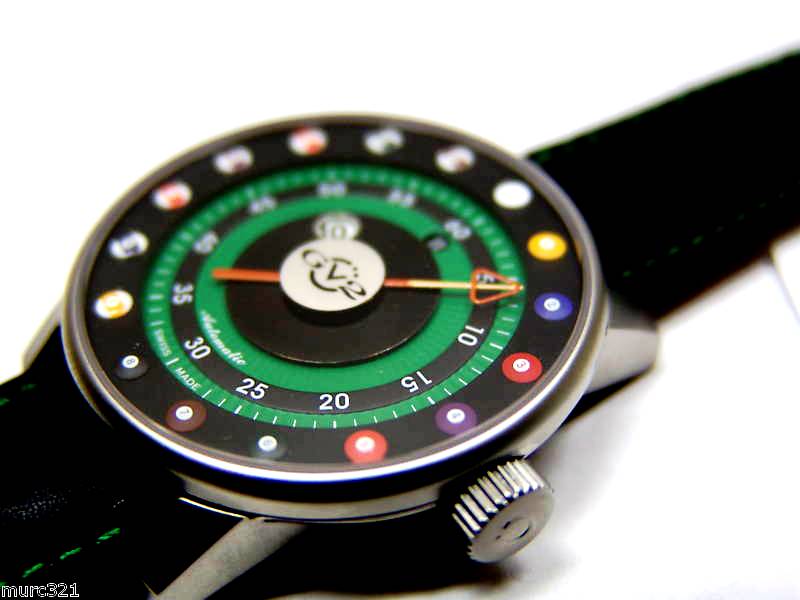
Gevril Legacy The Gevril watch company was begun by Jacques Gevril in the mid-1700s in La Chaux-de-Fonds, Switzerland's center of watch-making for centuries. He was a sought-after master of horology, and he created his first chronometer in 1743 and his first repetition dial in 1744. Most notably, he was called upon by the King of Spain in 1758 to produce a personal timepiece, which went over so well that Gevril was appointed as Royal Swiss Watchmaker to the Spanish Crown.The Gevril family tradition of watchmaking was passed onto Jacques's son, Moyse Gevril, and in 1784 he achieved the status of Master Clockmaker. During the 1800s, the Gevril family expanded their art to include enameling as well as the creation of dials for their watches. Gevril timepieces are displayed in museums across Europe--most notably the Museum Geneve and the Rolex Museum (where a Gevril pocket watch is displayed in the collection personally selected by the Wilsdorf family, the founder of Rolex). The company was purchased by Samuel Friedmann in 2000, who believed the Gevril name represented an ideal combination of history and future potential. Today's signature Avenue of Americas line is based on a case design from the 1920, which was discovered after going through Gevril's raft of historical documents and design books. It has a retro look, but is updated with a bevelled dial with raised, hand-painted numbers and straight chrono pushers for a contemporary feel. Creating a Gevril timepiece is exhaustive, and Gevril expends years into the design and manufacture of its rare and enduring timepiece collections. It manufactures only limited edition collections, with 6,000 Gevril watches created each year and each line limited to 500 (stainless steel) or 100 (gold) pieces. The company also sources only the best materials and accoutrements, including 316L stainless steel, natural mother-of-pearl dials, Wesselton diamonds calibrated by CNC machines and Louisiana crocodile skin.
RARE COLLECTION - AUTHENTIC VINTAGE ETERNA GENTS MILITARY WRISTWATCH
MADE IN/BUATAN: SWISS
CIRCA/TAHUN: 1950's
MODEL: MILITARY
CRYSTAL/CERMIN: ACCRYLIC
MOVEMENT/ENJIN:THE HIGH GRADE 17 JEWELS SWISS ETERNA MANUAL WINDING MOVEMENT
DIAL COLOR: BLACK MILITARY DIAL
FUNCTION/FUNGSI: HOUR, MINUTES AND SWIPESECONDS
HANDS/JARUM: SILVER TONE HANDS
MARKERS/TANDA WAKTU: LUMINOUS ARABIC MILITARY MARKER
CASING : SOLID STAINLESS STEEL/ KELULI SEPENUHNYA
BEZEL: STAINLESS STEEL
LUGS: 20mm
MEASUREMENT/UKURAN: 35mm DIAMETER INCLUDING CROWN and 39mm LUG TO LUG
DITANDA/ENGARVED BACK CASING: -
CROWN: ORIGINAL SS CROWN
STRAP/TALI:GENUINE GREEN MILITARY TEXTILE BANDS
SIZE STRAP/SAIZ TALI: 8.5" FULL LENGHT
CONDITION:WORKING AND KEEPING TIME, EXCELLENT CONDITION
MY PRICE/HARGA :RM600.00 SOLD(SOLD TO MR LOKE FROM SUBANG)
BRIEF HISTORY OF ETERNA WATCHES
Having been pioneers in the field of watch making the Eterna company has a tradition in the field dating back to 1856. The Eterna Watches made their first break through by creating the ball bearing mounted rotor for self winding movements which also has five tiny spheres which symbolize the eternal brand. It also boasts of having undisputed standards in making automatic wristwatches. Eterna watches hold records for creating many worlds first such as the very first alarm wrist watch, the smallest self winding movement with a gold rotor, the thinnest quartz wrist watch of all times with a mere width of 0.98 mm, the smallest quartz movements for ladies wristwatches and so on. Due to these achievements and accomplishments the name Eterna has been transformed into a genuine legend through decades.
Eterna watch company was started by a doctor, Dr. Joseph Girard and a school teacher Urs Schild on the seventh of November, 1856 in Jura, Switzerland. Later on discouraged by the stiff competition and bleak prospects Joseph Girard quit in 1866. The Eternal watch collection boasts of a collection which has set up a revolutionary milestone in the history of watch making. It consists of the Eternal perfection series of the 1948, the Eternal elegance series of the 1935, along with the Grand Eternal challenge series the Kontiki and the Eternal Platinum series. The basic features of the 1948 models were the introduction of the chronometer, date, alarm and the moon phase chronograph. The Kontiki collection includes chronometer with a patented gasket system with water resistance down to a depth of 200 mts, along with GMT features and robust chronograph which accurately functions even under extreme stress.
CRYSTAL/CERMIN: ACRYLIC WITH MINOR SCRATCHES HARDLY VISIBLE
MOVEMENT/ENJIN: WYLER ETA 2829 24JEWELS AUTO MOVEMENT (CANNOT SHOW THE MOVEMENT - OPEN THROUGH CRYSTAL)
DIAL COLOR: TEXTURED TWO TONE METALLIC DARK GREEN
FUNCTION/FUNGSI: QUICKSET DAYDATE
HANDS/JARUM: LUMINOUS GOLD TONE
MARKERS/TANDA WAKTU: GOLD TONE BATON/ BATON OREN
CASING : STAINLESS STEEL CASE/ DURACLAD BASE METAL RING
HIDDEN LUGS: 18mm
MEASUREMENT/UKURAN: 35mm DIAMETER W/O CROWN and 41mm LUG TO LUG
DITANDA/ENGARVED BACK CASING: WYLER LIFEGUARD~STAINLESS STEEL CASE~S/N 112040
CROWN: SCREW LOCK SS
STRAP/TALI:GENUINE BLACK LEATHER BAND
SIZE STRAP/SAIZ TALI: 8.5"
EXCELLENT CONDITION, WORKING, KEEPING TIME, DISCONTINUED MODEL & VERY RARE AND VERY HARD TO FIND
PRIC: RM1350.00 NEGOTIABLE
BRIEF HISTORY OF WYLER WATCHES
Paul Wyler was born on 15th June 1896 and established the Wyler Watch company in Basel on 28th March 1924 in Basel. Among Wyler’s biggest customers was Innocente Binda, an Italian entrepreneur whose family business has grown into one of today’s big watchmaking groups, the Binda Group. Based in Milan, Italy, the Binda Group is the parent company of Wyler Genève.
Throughout its history, the Wyler watch company has upheld a commitment to producing innovative, yet reliable and sturdy timepieces in continuation of its founder’s original mission.
Incaflex The unbreakable Incaflex balance wheel was one of Paul Wyler’s most significant innovations and was incorporated in the 2007 Wyler Genève chronograph as a link with the brand’s heritage.
The design is as simple as it is brilliant: the balance wheel, made out of a single piece of metal, had two flexible symmetrical half-spiral arms that joined at the wheel’s axis and acted as shock absorbers.
Wyler’s dedication to improving the quality and accuracy of his timepieces earned him nine patents for balances with flexible arms, two and three-piece watch cases and other innovations.
Performing to extremes Italy’s 1934 World Cup football team were among the first to discover the benefits of Wyler Incaflex timepieces, as the watches added a sporty finishing touch to the official attire for their campaign. It was a proud moment for Paul Wyler to see his watches worn by the team that raised the first-ever World Cup trophy won by their country.
In order to clearly demonstrate the benefits of Wyler’s revolution for such a small but crucial component in a watch, a simple demonstration was organised in 1956. In an early form of publicity stunt, two Wyler Incaflex timepieces were dropped 300 metres (almost 1000 feet) from the top of the Eiffel Tower. The notary public chronicling this audacious event confirmed that both timepieces were in excellent working order even after their harsh landing. This was a clear indication that the Wyler Incaflex balance wheel represented a major breakthrough in the watch industry.
AUTHENTIC VINTAGE ROLEX OYSTER PERPETUAL DATE GENTS WRISTWATCH
BRAND/JENAMA : ROLEX MADE IN/BUATAN : ROLEX MONTRES SA, SWITZERLANDMODEL NO : MODEL 1501SERIAL NO : 914652 MOVEMENT : ROLEX 26 JEWELS AUTOMATIC MOVEMENT CAL. 1570CIRCA/TAHUN BUATAN : 1953FUNCTION/FUNGSI : LUXURIOUS CASUAL WATCHCRYSTAL : accrylic CRYSTAL WITH ENLARGED LENS FOR DATE AT 3:00DIAL : ROLEX DATE WINDOW : YES AT 3:00, NON QUICKSET DAY WINDOW : NO CHRONOGRAPH : NO MARKERS/TANDA WAKTU : GOLD TONE BATON MARKERSHANDS/JARUM WAKTU : LUMINOUS GOLD TONE HANDSCASING : SOLID STAINLESS STEEL SIZE : 33mm EXCLUDING CROWN and 41.5mm LUG TO LUG BEZEL : STAINLESS STEEL BEZEL CROWN : ORIGINAL SS 1 STEPS SCREW DOWN ROLEX CROWN STRAPS/TALI: AFTER MARKET LEATHER BANDLUGS SIZE: 22mm CONDITION/KONDISI: EXCELLENT WORKING CONDITION, KEEPING TIME AND RECENTLY SERVICEDCOMMENTS: BEAUTIFUL MINT CONDITION. RETAILED PRE-OWNED FOR RM12,000 PRICE/HARGA: (TRADED WITH PATRICK FROM MUAR)
BRIEF HISTORY OF ROLEX AND TUDOR WATCHES
The Rolex brand was created by a visionary named Hans Wilsdorf, who was born in Bavaria in the year 1881. Just before the turn of the century young Hans moved to Geneva, and at the age of nineteen discovered the industry of watchmaking. At that time the wristwatch was considered vulgar and uncouth; gentlemen of the day carried pocketwatches. Wristwatches were worn only by women, and the tiny delicate movements were unreliable and imprecise. Leading watchmakers were convinced that the challenges involved in creating an accurate timekeeping device in such a small package were insurmountable. Hans Wilsdorf disagreed. He saw much room for improvement in an industry dominated by traditional thinking.
In 1905 Wilsdorf relocated to London and founded Wilsdorf & Davis in association with his brother-in-law Alfred, a company which manufactured watch cases and distributed wristwatches. Wilsdorf always maintained a very high standard for the quality of his products, so he was continually seeking ways to improve the design of his cases and movements. In cooperation with the firm of Aegler in Bienne, Switzerland, he developed and improved the small-caliber lever escapement movement, and was confident enough to stake a loan of five times the total capital of Wilsdorf & Davis in the first order. From then on, Wilsdorf made and sold watches; his own cases with movements imported from Switzerland. After the turn of the century as wristwatches started to enter the mainstream (as soldiers wore watches on their wrists and the general perception changed from the earlier notion that wristwatches were strictly feminine), Wilsdorf quickly saw how he could take advantage of their emerging popularity by offering a variety of case designs: formal, sporty, casual, etc. He also realized the importance of brand recognition. Until then the custom had been for the retailer�s name to appear on both the dial and the movement, but Wilsdorf wanted to distinguish his watches from those of his competitors, which he considered inferior since they did not submit their products to the exacting tests which he insisted be performed on all of his own. Hence in 1908 he coined the name Rolex, which would henceforth appear on all parts of the watch, including dial, movement, case, and bracelet. No one knows for sure where he got the name; there are many theories on the subject. But everyone agrees that Rolex is a name anyone in Europe or the world at large could easily pronounce, and is short enough to fit comfortably on the dial of any wristwatch.
History was first made by Rolex in 1910 when a movement was sent to the School of Horology at Bienne, and was awarded a chronometer bulletin. This was the first time a wristwatch had ever received the chronometer rating, and suddenly Hans Wilsdorf's brand earned the respect of horologists the world over. Four years later a Rolex movement was awarded a Class A Certificate by the Royal Observatory at Kew, again the first small caliber watch movement to receive the award. Thereupon Wilsdorf decided that all Rolex timepieces should be submitted to similar tests carried out by impartial institutes. No Rolex watch would ever again be sold without its Official Timing Certificate. After World War I, Wilsdorf moved his operation to Geneva to avoid the exorbitant import taxes in England, and renamed his company Montres Rolex S.A., and later simply Rolex S.A. The Aegler company of Bienne provided watch movements to many companies, but only Rolex demanded that each and every movement undergo a weeklong battery of meticulous tests before they would be accepted. Any irregularity whatsoever meant the movement was returned to the workshops. It was due to these stringent methods of quality control that Rolex was able to achieve such high standards in accuracy and make such advancements in the world of horology.
Wilsdorf had long ago realized that for a watch to be accurate over the long term, its case would need not only to withstand the attack of dust and water, but would need to be self winding to protect the mainspring from stress caused by overwinding. The first problem was overcome in 1926 with the creation of the Rolex "Oyster", in which the winding crown was screwed down onto the case using a twin lock system. This brilliant watch was totally protected from the environment since the case was air tight as well as waterproof. In a well publicized event the following year, the Oyster was celebrated after being worn on the wrist by Mercedes Gleitze when she swam the English Channel. The watch made world headlines for keeping perfect time after being immersed in salt water for 15 hours. The Oyster was displayed in jewelry shop windows inside aquariums; keeping time while fish swam through the bracelet.
The first self-winding movement was invented by Abram-Louis Perrelet in the mid 1800's, and later perfected by Abram-Louis Breguet, but was never widely adopted because the mechanism was too delicate for daily use. In 1923 a British watchmaker named John Harwood patented a self-winding watch movement based on a "hammer winding system", which had a semi-circular weight that pivoted at the center of the movement and swung through a 300 degree arc. The swinging weight was actuated by the movement of the wearer. Wilsdorf discarded this system as too impractical. For one thing, Harwood's watch was unable to be set except by turning the bezel, and it used an unreliable friction plate to prevent overwinding. According to Wilsdorf, a truly self-winding watch should be completely automatic, silent, able to revolve in both directions, smooth in action and completely free of buffer springs. These obstacles were surmounted in 1931 when Emile Borer, the technical head of Rolex, invented the "Rotor", whose winding mass could turn both clockwise and counter-clockwise and pivot freely on its axis. The new movement was dubbed the Rolex Oyster Perpetual, and immediately became the world standard, imitated by every watchmaker since.
History of the Rolex Watch Company
For almost a century, Rolex has grown to become one of the most renowned companies in the history of watchmaking. This sterling reputation is the result of sheer hard work by the people associated with Rolex in creating their state-of-the-art watches. Today, beyond just being one of the top luxury watch brands, Rolex is known for manufacturing highly accurate wristwatches. Every Rolex watch stands out in the crowd for their unparalleled performance as well as appearance. Let us take a look at the history of Rolex and its distinctive evolution into one of the top watch brands in the world.
The Founders of Rolex
The company that eventually would become Rolex was founded by an intriguing European combination of a German national and a British native, bringing the best of two diverse cultures into play. Hans Wilhelm Wilsdorf and Alfred James Davis founded Wilsdorf and Davis Ltd in 1905.
Born on March 22,1881. Wilsdorf’s job as a correspondence writer with the watch exporter Cuno Korten of Geneva, Switzerland gave him direct exposure to the international watch industry.
He became focused intensely on Horology--the study of creating timepieces. His initial work was so successful he was able to make three watches that passed rigorous accuracy testing. After such initial success, he decided to start his own watch company. His English partner Alfred Davis would later marry his younger sister, turning the business into a family affair. Wilsdorf and Davis Ltd was registered as "Rolex" in Switzerland in 1908 and later in London in 1912. The name "Rolex" was chosen because it was clear, easy to spell, and easy to pronounce in multiple languages. On Nov 15, 1915 Wilsdorf and Davis Ltd officially was renamed "The Rolex Watch Company Ltd." The company's name was later modified to Montres Rolex, SA and finally became the company we know today as Rolex, SA.
Rolex in Its Early Years
In its early years, Wilsdorf and Davis concentrated on selling only two types of watches: pocket watches (designed for men because wristwatches were considered feminine at that time) and travel clocks (also known as portfolio or purse watches). Travel clocks were very popular then, particularly in English markets. Rolex covered these watches in exotic leather cases. Some early features of these models included the following:
They were made of silver with porcelain dials.
They had plain faces (dials) in order to allow their retailers to paint their brand names on them. Today, if you find a valuable antique model of that time, you most likely will see a plain dial as the painted names tended to erode after years of cleaning.
Changes in watch configurations, including the placement of the company's hallmark "W & D" (Wilsdorf & Davis Ltd) not only inside the case back, but also on the movement.
The utilization of Rebberg movements, which were imported from Herman Aegler's firm in Bienne, Switzerland. Wilsdorf preferred these movements for their accuracy and affordable price.
Wilsdorf did not want to restrict himself and his company, however, to only pocket and travel watches. Instead, he took a significant step forward and began to manufacture wristwatches for men. This decision was in response to the Boer War in South Africa when soldiers began to wear small pocket watches on their wrists. Since it was too hot for them to wear jackets carrying a pocket watch, the soldiers wore the watches attached with a leather strap. By strapping the watches around their wrists, they could free their hands.
In 1910, a major milestone in the successful evolution of Rolex was achieved when Rolex received the world’s first wristwatch chronometer rating for its movement from the Aegler's company. After being awarded the "Class A" Certificate of Precision from the famous Kew Observatory in England in 1914, Rolex decided to accept movements from Aegler only after they successfully had passed Rolex’s own series of rigorous tests. This decision began a new qualitative standard of accurate and reliable watches in the industry. People started to recognize the brand "W & D" and notice its focus on true quality.
Rolex During World War I
With the break-out of World War I, soldiers needed highly reliable and accurate wristwatches. As in the Boer War, pocket watches were uncomfortable and even dangerous to use in combat situations. Ironically, this conflict opened a new door to future growth prospects for Rolex as Wilsdorf had established the company in the arena of manufacturing men’s wristwatches. More and more, men looked for such watches, a trend started by their war idols. World War I, however, also led directly to some serious problems for Rolex. In 1915, the British Government imposed a duty of 33% on all imported watches, clocks, and parts. This tax was quickly followed by a ban on all imported gold and silver. Such economic challenges compelled Wilsdorf to shift the base of Rolex from London to Bienne, and finally to Geneva in 1919.
1915 witnessed another major development in the history of Rolex when Wilsdorf and Davis gave nearly 15% of their company’s equity to Herman Aegler. With this exchange, Aegler became the sole supplier of movements to Rolex. The third member of the partnership was another watch company named Gruen. According to the partnership, Gruen would sell its watches only to the US while Rolex concentrated on Europe, Asia, and the markets of the British Empire. By 1916, the name "Rolex" began to appear on the case backs. If you are lucky enough, you may catch hold of some early models that bore double names: both "Rolex" and the name of the local retailer.
Rolex
Rolex created clout for itself throughout the 1920s and 1930s by setting records related to an impressive variety of aspects of watchmaking. This trend of setting the bar for quality and precision continued into the Second World War. The company received numerous awards and certificates from the four renowned observatories: Kew, Geneva, Neuchatel, and Besancon. A series of events significant to the evolution of Rolex took place between the two World Wars. Let us have a quick look at this series of significant events in the evolution of Rolex:
The famous Rolex logo, the Crown or Coronet, was trademarked in 1925. This logo, however, only made its appearance on the watches in 1939.
The name "Rolex" began to appear on the dial for the first time in 1926. This new development was supported by a strong advertising campaign to popularize the logo and increase brand recognition.
Rolex changed the design from 3 piece Hunter style hinged case comprising the case body, back and bezel to a two piece case in approximately 1920. As soon as Rolex moved its base to Geneva, Wilsdorf began using cases made by the Swiss craftsman Francis Baumgartner. This case featured a hermetic seal, making it nearly waterproof. The main problem with this case design, however, was the whole watch was enclosed inside the outer sealed case. Such a design made it difficult for the wearer to wind the watch.
Rolex achieved a major success when Wilsdorf bought the patent for a new moisture-proof winding stem and button from inventors Paul Perregaux and Georges Peret. This acquisition allowed Rolex to market the world’s first waterproof case, which was given the name "Oyster" in 1926. To advertise the Oyster waterproof watch, Rolex strapped one to the wrist of Mercedes Gleitze, the first woman to swim across the English Channel. The Rolex watch was worn in her second endeavor to cross the English Channel in 1927. This marketing coup provided a huge impetus to the success story of Rolex. It became a famous brand of wristwatch known for creating a wonder watch, the first of its kind. As more and more improvements were introduced in the Rolex Oyster Watch, powerful advertising campaigns were undertaken. In addition, when the Rolex Oyster Watch was waterproofed up to a level of 100 feet under water, its popularity and renown skyrocketed.
In 1928, Rolex rolled out a new model "The Prince," which has been and still is today one of the most successful Rolex wristwatches for men. “The Prince” became very popular for its rectangular case and separate dials for hour/minute and seconds. Its price tag made it the preferred choice of the elite.
Rolex demonstrated another significant development in 1928 when it launched a new series of balances. These precise instruments could be adjusted in 6 positions and at all temperatures. They were made available in three classes, named the "Prima," "Extra Prima," and "Ultra Prima."
In 1931, Rolex created the first Auto-Rotor movement using an Aegler movement (subsidiary seconds Hunter 8-3/4'''). A major innovation, this revolutionary invention led to the introduction of the first successful self-winding perpetual wristwatch in 1932. A long-desired dream of Wilsdorf, this ground-breaking concept was made a reality by the designer Emile Borer, the technical head of Rolex at the time and Herman Aegler's brother-in-law. This precisely-crafted watch sported a perpetual motion as its winding mass could freely turn both clockwise and counter-clockwise and pivot a full 360 degrees on its staff in the center of the movement. Another feature of this model was its accuracy in time-keeping. The large semi-circular shaped Auto Rotor was fitted into a thicker case, which made this model popularly known as the "Bubbleback."
In 1935, Rolex added yet another chapter to its success story when it introduced a new streamlined balance wheel called the "Super Balance" to improve the design of its Auto Rotor.
By the end of the 1930s, Rolex established itself as the number one watchmaker. In fact, it received class certificates from all four major observatories (Kew, Geneva, Neuchatel, and Besancon) in 1934. Virtually every Rolex watch was successful in receiving chronometer certificates.
In the midst of this early success, Rolex sustained a blow that came in the form of a devaluation of the English pound and other European currencies. This had a detrimental impact on its European sales and led directly to the company’s search for new prospective markets for Rolex products in areas such as Latin America and the Far East.
In 1935, Rolex acquired the exclusive rights to all Aegler's movements when their third partner, Gruen, ended its partnership with them. This strategic move allowed Rolex to itself focus on the United States as a new and open market for its watches.
Rolex added another feather to its cap in 1937 by producing its first chronograph wristwatch. This chronograph performed the job of a stop watch with the help of a separate second hand which could be started, stopped, and reset to zero. The push buttons on the side (in earlier models there was a single button) were used to perform this function. Rolex sourced the movement used in its chronograph models from the company Valjoux.
By the late 1930s, Rolex had developed many subsidiary lines and brands which were not as expensive as the Rolex models. In spite of their high quality, such lower end brands did not produce satisfactory results. This ultimately led to Rolex’s decision to discontinue these cheaper brands.
With the onset of the Second World War, wristwatches for soldiers (Allied forces) featuring the California Dial were in great demand when the War Production Board prohibited American companies to manufacture civilian watches in 1942. Rolex specifically benefited from this move, as it had previously patented in 1941 a version of the California Dial featuring Roman numerals across the top half of the watch and Arabic numerals along the bottom. During war time, Rolex Oyster Perpetuals became popular particularly among the British Pilots in the Royal Air Force. To these pilots, wearing a Rolex represented a symbol of their success and excellence.
During the Second World War, Wilsdorf came up with a unique and compassionate idea. He decided to give every British prisoner of war who lost his Rolex to his captors a replacement--which did not have to be paid for until the end of the war. This move proved to be an effective marketing tool, displaying the class of the Rolex company to both the British government and the common soldier.
At the end of the second world war in 1945, Wilsdorf created a trust called the Hans Wilsdorf Foundation to run the company in his absence, making the Rolex company secure from being sold or taken over by an unfriendly aggressor in the future. This was a prompt action on his part in response to the sudden death of both his wife and long-time partner Hermann Aegler in 1944.
Rolex - From 1945 to the Present
By the end of the Second World War, Rolex had already established itself as the manufacturer of one of the most reliable and accurate wristwatches in the world. In addition, Rolex proved its exceptional expertise in creating jeweled movements. It now started concentrating more on exceeding its limits and came up with a series of special watches (Tool Watch Models) that had never before been built. Some of the major achievements of Rolex that set definitive benchmarks and made it the "King" in watchmaking and the luxury goods industry included the following:
On November 24, 1945 Rolex rolled out a new model, "Datejust," that remains a definitive symbol of the luxury watch. It was the first model of its kind that displayed the numbered date through a tiny aperture at the three o'clock position. To this very day, it is one of the most popular and expensive Rolex models. Since it was launched on the forty year Jubilee anniversary of Rolex, the exquisite bracelet that it flaunted was named the "Jubilee." Today, if you buy a brand new Rolex Datejust, you will find the cyclops lens (that looks like a glass bubble) over the date display. This was added in 1954 in order to make the date easier to see by magnifying it 2 ½ times.
The year 1945 saw another new model called the "Tudor," a less expensive Rolex. This new watch line had the distinctive Tudor rose logo. In the 1960s, the logo was changed into a "shield."
On May 29, 1953 Rolex continued its innovative marketing by strapping a prototype of its watch "Explorer" to the wrist of Sherpa Tenzing Norgay, a member of the British Himalayas expedition team. The watch performed to perfection even in the brutal cold and high altitudes of Mt. Everest. Such extreme performance provided a living example of supreme engineering which allowed the watch to withstand such harsh weather conditions. The same year also saw the introduction of two new Rolex models — the Milgauss and the Turn-O-Graph. Today, all modern sport models are the improved versions of the Rolex Turn-O-Graph. The Rolex Milgauss was designed as a professional watch for those who work around electromagnetic fields, which would negatively affect the majority of normal wristwatches.
In 1953 Rolex successfully tested a new and improved waterproof watch called the "Deep Sea Special" to a depth of 10,336 feet. This event coincided with the world record-setting dive of Piccard’s famed bathyscaphe FNRS-2. This milestone led to the introduction of the first diver's watch, the Rolex Oyster Perpetual "Submariner." It was waterproof to a depth of 600 feet. This unique professional watch was worn by the leading stars of the James Bond movies, creating a craze for them amongst the masses and, in fact, coming to be popularly known as the "James Bond." The sporty look of the watch made it a big hit even amongst those who were not serious divers. In other words, wearing a “Submariner” became a modern symbol of cool.
Focusing on the air instead of the water, another unique model in the professional line of Rolex was the GMT-Master--which was launched in 1954. Meant primarily for aviators, this model allowed the pilot to read the time in any two zones simultaneously. Such an innovation was made possible with the help of a special 24-hour hand and bezel. However, when astronauts wore this watch in space with zero gravity, they had to wind the watches manually after every 48 hours, as the auto winding mechanism would not work in zero gravity.
In 1956, Rolex launched a new watch called the "Day Date," which would become one of the flagship models of Rolex. It displayed both the date and the day. It became popularly known, however, as the "President" wristwatch when one such model was given to President Dwight D. Eisenhower. The “Day Date” model was the first watch to receive the official recognition of the certification "Superlative Chronometer Officially Certified" on its dial due to its incomparable accuracy in performance.
In 1960, Rolex launched another exceptional watch, the “Cosmograph Daytona,” which became a very popular model in its own right. The “Cosmograph Daytona” featured a tachymeter scale engraved on the bezel unlike the chronograph models where it is found on the dial. When Paul Newman wore one of these models in his racing film "Winning," it created a craze in popularity.
On July 6, 1960 Hans Wilhelm Wilsdorf passed away at the age of 79. His legacy was handed over to the Hans Wilsdorf Foundation, which made Andre J. Heiniger responsible for running the operations of Rolex. In the same year, another significant event was the founding of the Centre Electronic Horologer (C.E.H.). With the prestigious watch making companies (including Rolex) as its members, C.E.H. moved to develop a quartz wristwatch movement.
C.E.H. found success when it came out with its first movement, the Beta 21, at the Basel Fair in 1970. Rolex did not take part in the introduction, however, because it wanted to create a watch that was more accurate and also effectively met its high qualitative standards. After a few months, Rolex launched its own quartz model the “Quartz Date," which became an instant hit. For the first time it utilized the synthetic sapphire crystal, which subsequently was introduced to the rest of the line by the early 1980s. The “Quartz Date” did not, however, feature an Oyster case. The success of this model was short lived, and Rolex had to discontinue its production in 1972. After five years, Rolex made a comeback with the introduction of a new and improved version of Oysterquartz movement. This introduction eventually led to two new Rolex models: the “Oysterquartz Datejust” and the “Oysterquartz Day Date.” Both of these models were equipped with the Oyster's screw-down case back and sported a new slimmer angular case. Unfortunately for Rolex, this effort was also met with negligible success. These electro-mechanical watches simply could not compete with the accuracy of the mechanical models of Rolex. In addition, the heavy inflow of Rolex counterfeit watches featuring quartz movement and the use of quartz watches as promotional items degraded their image in the eyes of the public. Although Rolex still manufactures these two models, they account for only 2% of its overall production.
In 1971, a new outstanding tool watch called the "Sea-Dweller" was launched as a definite improvement over the Rolex Submariner model. Its unique feature was its one-way gas escape valve which protected the watch from internal pressures created during an ascent. The initial Sea-Dweller models were depth rated to 2000 feet. Later, in 1978, the “Sea-Dweller” was upgraded to 4000 feet. To put it bluntly, wherever you happened to be in the entire world, there was now a Rolex to meet your needs no matter how extreme or intense the environment.
The year 1971 was a special year as it witnessed the introduction of yet another tool watch. The ”Explorer II” was designed specifically for cave explorers. It featured crown guards, a new fixed and engraved 24-hour bezel, and a special 24-hour hand which would help to distinguish AM from PM.
The remarkable hacking feature was widely introduced to all Rolex models around 1972. This feature allows the wearer to synchronize time easily with some other source as the second hand comes to a dead stop when the winding crown is pulled out fully to set the time.
By 1977, Rolex movements were rated at 28,800 beats per hour (BPH) from 19,800 BPH during the 1960s and 18,000 BPH during the late 1950s. Never satisfied, Rolex watchmakers continue to set the bar for both precision and qualitative standards.
Rolex introduced an important feature called the "Quick Set" feature in the late 1970s. It was fitted to all the date models by 1983. This new feature made it easy to set the date rapidly via the winding stem/crown without the hour hand having to pass the midnight position.
By the early 1980s, the first uni-directional rotating bezel was introduced on the Submariner models.
Introduced in the early 1990s, the feature "Double Quick Set" allows you to set both the date and the day quickly via the winding stem/crown.
In 1992, Rolex launched a new "Yacht-Master" wristwatch, the first model in the Professional line that was made available in smaller sizes. Today, this model is extremely popular and is made available in a variety of metals, including 18k yellow gold, all stainless steel, two-tone (yellow gold and stainless steel), and even Rolesium (stainless steel and platinum).
Even to this very day, with the world watch market flooded with cheaper quartz watches and second-rate imitations, Rolex continues to manufacture its highly accurate, chronometer certified mechanical watches. In fact, with the beginning of the 21st century, it has created an institute called the "Watch Technicum" in the small town of Lititz, Pennsylvania where 12 students are trained every year in the art of mechanical watch repair. The supreme engineering of Rolex in making quality watches places it among the top 100 companies in the world. Today, it is the single largest luxury watch brand! Producing about 2000 watches per day, it has been ranked #71 on the 2007 annual list of the top 100 global companies by Business Week magazine and at the top slot amongst all watch companies. Rolex has continuously improved the functionality and look of different Rolex models under all of the three major categories: Oyster Perpetual, Professional, and Cellini. In the future, you may hope to come across even better versions of the current models and be able to lay your eyes on altogether new models offering never-before-seen features. It is rightly said that tradition meets innovation at Rolex. Perhaps no other company in the world has such a tradition and consistent legacy of both innovation and high qualitative standards. Without question, Rolex is the place where luxury and precision are one.