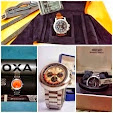
SESIAPA BERMINAT BOLEHLAH TANYA SPESIFIKASI DAN BUAT TAWARAN HARGA
Wednesday, July 15, 2009
Tuesday, July 14, 2009
ROLEX OYSTERDATE PRECISION MOTHER OF PEARL DIAL MEN'S WRISTWATCH (SOLD)
AUTHENTIC VINTAGE ROLEX OYSTERDATE PRECISION MOP MEN'S WRISTWATCH CIRCA 1966 (BASE ON SERIAL NUMBER STAMPED BETWEEN THE LUGS)
SOLID STAINLESS STEEL FLUTTED BEZEL
ACCRYLIC CRYSTAL NO CRACK OR SCRATCHES
NON QUICK DATE FUNCTION
ROLEX 17 JEWEL MANUAL WINDING MOVEMENT
LUMINESCENT SILVER TONE HANDS
MOP DIAL WITH LUMINOUS ROMAN MARKER
THE REAR CASE SCREWS IN PROPERLY AND STATES ORIGINAL OYSTER CASE BY ROLEX
THE REVERSE SIDE OF THE SCREW CASE STATES MONTRES ROLEX SA, STAINLESS STEEL, GENEVA SWITZERLAND, 74000, CRS
STEEL CASE MEASURES APPROXIMATELY 35mm EXCLUDING THE CROWN AND 44mm LUG TO LUG
HALLMARKED ORIGINAL ROLEX CROWN
GENUINE ROLEX PRESIDENT BRACELET BAND FITS 8.5" WRIST
DISCONTINUED ROLEX MODEL... RARE!
EXCELLENT CONDITION, KEEPING GOODTIME AND RECENTLY SERVICED
SOLD TO TUAN HASROL AFFANDI FROM PERAK
Sunday, July 12, 2009
HIGHLY COLLECTIBLE HARD TO FIND OMEGA SPEEDMASTER CHRONOGRAPH MOON WATCH (SOLD)
WANT OT KNOW ABOUT THIS WATCH - PLEASE READ THE HISTORY OF OMEGA WATCH IN THIS BLOG WHICH SHOWED EXACTLY THE SAME MODEL IN THIS PREVIEW. PRICE LISTED IN THAT SITE WHICH I COPIED FROM IS USD3,500.00 (RM12,500). NEW WATCH PRICED RM16,000
PLEASE VIEW THE LAUNCHING OF OMEGA SPEEDMASTER MOON WATCH ON JULY 13, 2009 AT http://www.omegawatches.com/minisites/speedmaster/generic/minisite.html
Vintage Omega Speedmaster circa 1978
This vintage Omega Speedmaster watch, model 145.022-78 dates to 1978 based on its model number and serial number of 39.9 million.
One look tells you this is a very clean example of this durable and collectible model, which was used primarily as a pilots tool watch. Overall the condition can be described as crisp given the very black colour and contrast of the bezel and the light patina of the original hands against the original black dial. This is some spotted drop out of the original tritium in the hands. Many of these watches have had the dial replaced due to fading or discoloration and now have the newer Luminova luminous dials, this watch however is still fitted with the original tritium markers. Collectors are now paying a premium for the tritium dials when in clean condition.
The original Omega bezel is in fantastic condition. The watch is fitted with a ORIGINAL full-sized genuine Omega 1171-1 bracelet, which is the correct Omega bracelet for this model according to the Omega catalogue.
The Omega calibre 861 movement was just serviced by my watchmaker and functions flawlessly.
The Omega Speedmaster became a legend for being the first watch worn on the moon and is flight qualified for every NASA manned space mission.
The watch measures 40mm wide by 47mm long.SOLD TO TUAN OSMAN FROM PETALING JAYA
HISTORY OF GAB GLASHUTTE BY A. LANGE & SOHNE


PRICE RANGE FOR NEW GLASUTTE ORIGINAL IS BETWEEN USD3,000 - USD20,000A. Lange & Sohne is a very old German watch manufacturer located in Glashutte, which is around 25 km south of Dresden, in the state of Saxony (not to be confused with two other states, Lower Saxony and Saxony-Anhalt).
SHORT BRIEF ON GLASHUTTE HISTORYGlashutte Original was created in 1845, when the German master watchmakers, Ferdiand Al Lange, Julius Assmann, Ludwig Strasser, Johannes Durrstein, Adolf Schneider, Strasser and Rohde, Ernst Kassiske settled in the region of Glasshutte. These master watchmakers were awarded various gold model at the world exhibition and international competitions, thus creating the foundation and reputation of watching making industry of Glashutte. In 1878, Moritz Grossmann founded the German School of Watchmaking, hence building groundwork for more skillful watchmakers in the region of Glashutte and transforming the region into a reputed symbol of watchmaking excellence.
In the beginning of World War II, the watch manufactories in Glasutte was still in the production of military watches for the Navy and Air Force. Later, in the last day of War World II, Glashutte was bombed from the sky and the factories were badly destroyed. The reminding unaffected factories merged and found the VEB Glashutter Uhrenbetriebe under the rule of East German state.
After the reunification of Germany in 1990, The VEB Glashutte was transformed into the Glashutter Uhrenbetrieb GmbH. The skillful master watchmakers remained. The company, then, was transformed to a global enterprise from the state-owned company. Today, the new name of the company is Glasshutte Original, but it is still carrying the old tradition of Glashutte watchmaking for more than 150 years.
Characters of Glashutte Original.
Glashutte Original timepieces are still carrying the old tradition of German watchmaking. The unusual three-quarter plate, the seductive German silver as the raw material for the components of the movements, the beautiful gold chatons holding for jewels, the gorgeous swan-neck regulators, and the exalted idea of manufacturing all of the components exclusively in the factory, without outsourcer assistance. With the old traditional craftsmanship and modern machines, Glashutte Original, without a doubt, is created which incorporates all the best German virtues.
VINTAGE PHENIX MEN'S WRISTWATCH (SOLD)
COLLECTIBLE VINTAGE SWISS PHENIX MEN'S DRESS WRISTWATCH CIRCA 1950's
METALLIC CHAMPAGNE DIAL WITH LOTS OF PATINA
2nd SUB SECOND AT 3:00
CRYSTAL IS CLEAN WITH NO CRACK OR SCRATCHES
THE 17 JEWEL PHENIX MANUAL WINDING MOVEMENT
GOLD TONE DAPHNE HANDS
RAISED GOLD TONE ARABIC AND DOT MARKERS
LARGE GOLD PLATED SQUARE CASE WITH ENGRAVED ART DECO MEASURES APPROXIMATELY 43mm EXCLUDING THE CROWN AND 45mm LUG TO LUG
UNSIGNED CROWN
GOLD PLATED FLEXI SCRATCH BAND FITS 8.5" WRIST
DISCONTINUED MODEL... RARE FIND!
EXCELLENT CONDITION, KEEPING TIME AND RECENTLY SERVICED
SOLD TO RAYMOND FROM KL
Saturday, July 11, 2009
HOW TO FIX FALLEN MARKER AND EMBLEM
BENTUK DFIAL SETELAH MARKER DAN EMBLEM DIPERBETULKAN
HURUF G DARI EMBLEM GARUDA DIMASUKKAN KE LUBANG ASAL SECARA MENEGAK
STEP 3: GLUED THE FALLEN MARKER AND PUSHED IT TO IT'S ORIGINAL POSITION
AMBIL MARKER DAN GLUEKAN DIA, LEPAS TU MASUKKAN KE LUBANG ASALNYA
BUKAKAN PENUTUP BELAKANG
PROJEK INI DIBUAT SEBAIK SAYA MENERIMA JAM GARUDA DARI KOLEKSI ZULEKHAN JAMLAMA, SAYA SUKA JAM INI SEBAB MENGGUNAKAN ENJIN RONDA-MATIC YANG BIASA DIGUNAKAN DALAM JAM-JAM SWISS SEPERTI DALIL. THANK YOU ZULEKHAN.
ASALNYA STICK MARKER DI 8:00 DAN HURUG G, EMBELM GARUDA SENGET SEDIKIT. PROJEK INI MENGAMBIL MASA TAK SAMPAI 10 MINIT. PERHATIKAN GAMBAR-GAMBARNYE.... SELAMAT MENCUBA
THE HISTORY OF ELGIN WATCHES


The National Watch Company of Chicago, Illinois was incorporated on August 27, 1864 with a capital of $100,000. The incorporators were Philo Carpenter, Howard Z. Culver, Benjamin W. Raymond, George M. Wheeler, Thomas S. Dickerson, Edward H. Williams and W. Robbins.In September of 1864 a visit was made by some company representatives to the Waltham Watch Co. and seven of their key people where lured away to work for the newly formed company and they were nicknamed the Seven Stars. The bait used was a $5,000 a year salary for 5 years, a $5,000 bonus and one acre of land on the company's, soon to be acquired, 35 acre site (some things never seem to change). Since turn about is fair play, Elgin lost several of the Seven Stars to the Illinois Watch Co. a few years later in 1869.
The Seven Stars were all machinists first and watchmakers second. One of these men was Charles S. Moseley and he became the factory's first superintendent. He had been in the watch business since 1852.
The Elgin businessmen had been informed that if they wanted the company to be located in Elgin they would have to donate 35 acres of land. The towns people would also have to put up $25,000 (keep in mind that the war was on and all the young men where gone). The requested location for the company was on a farm with absentee owners. The owners refused to sell unless the entire farm property of 71 acres was purchased at a price of $3,550. Four local businessmen purchased the land and donated the 35 acres. The company was re-organized on April 25, 1865 with a capitol of $500,000.
The first officers were:
Benjamin W. Raymond, President Philo Carpenter, Vice President Thomas S. Dickerson, Treasurer George M. Wheeler, Secretary
The first movement was delivered from the factory April 1, 1867 and was named in honor of Benjamin W. Raymond. It was an 18 size, key wind, and full plate, with quick train and straight-line escapement arranged to set on the face and was adjusted to temperature. At that time watches took six months to complete and the B. W. Raymond model sold for $117 at a time when pork chops sold for three cents a pound (several years ago this watch was bought at auction by the city of Elgin for $15,000).
On July 16, 1867, a new watch was made and it was named the H. Z. Culver. The slow train was then adopted on all the new movements brought out and they appeared on the market as follows; J. T. Ryerson, October 14, 1867; H. H. Taylor, November 20, 1867; G.W. Wheeler, November 26, 1867 and Matthew Laflin, January 2, 1868. (Laflin and Ryerson both sat on the Elgin's board of directors and Laflin's family did so for more than 70 years.)
On May 20, 1869 the first "Lady Elgin" made its appearance and was the first of a series of 10 size movements and it was also key wind. This was followed on August 24, 1870 by the Francis Rubie, which was adjusted to temperature, on September 8, 1871 by the Gail Borden (of Elsie fame) and on December 20, 1871 by the Dexter Street.
Elgin and most other watch companies sold their movements to wholesaler's who then sold them to the jewelry shops. The customer would pick out the case of his choice, add the dial and then the jeweler would put them together. Only about 10% of the cases sold were solid gold.
The first stem wind movement was placed on the market June 28, 1873. It was a B. W. Raymond movement made over, and was followed shortly by the Culver, Taylor, Wheeler, Laflin and Ogden movements.
On May 12, 1874 during a special stockholder's meeting held in Chicago, the name of the company was changed to "The Elgin National Watch Company. This was thought to be advisable because the movements manufactured by the company were universally known as and called "Elgin Watches" or the "Watch from Elgin".
Seven new grades of 10 size, six grades of 12 size and five grades of 14 size, three quarter plate, key wind movements, were made by the company between September 29, 1875 and December 29, 1876. Most of these new patterns were made for the foreign markets, which demanded movements differing in some respects from those made for home consumption.
The company placed its first nickel movement upon the market, August 15, 1877. A new line of 8 size, stem wind watches were introduced on June 11, 1878, and in the fall of 1878 four grades of 16 size, three quarter plate, stem wind movements began production. These were interchangeable and could be used in hunting or open face cases and were considered quite a novelty at that time. These are called convertible models in today's market and sell at a premium.
In 1888 the factory was producing about 7,500 movements per week, about one fifth of which were key wind and one tenth of the movements were nickel. The factory had 2,300 employees at this time and they were split 50/50 between men and women but not so their pay. The women earned about $6 per week while some of the men earned as much as $3 per day and this was for a 6-day workweek.)
During World War I the United States Army had the Elgin factory train more than 350 men to make the precision repairs required in the battlefields.
It was during the Second World War that all civilian work was stopped and Elgin made military watches, chronometers for the U.S. Navy, fuses for artillery shells, altimeters and instruments for aircraft and sapphire bearings used in the aiming of cannon. The Elgin Company was awarded ten Army-Navy "E" awards, for full filling contracts ahead of schedule.
The Elgin Company diversified after World War II making decorator clocks, transistor radios, wedding rings, but the heart's beat was the Elgin watch. That heart beat had been getting slower every year and Elgin ceased to depend on the watch factory as its main enterprise. The clock tower of the National Street plant was torn down October 7, 1966.
The world's largest watch manufacturing complex was located in several buildings from its inception in 1864 until the last Elgin movement made in the United States was completed in Elgin, South Carolina, in 1968.
Plant No. 1, the Main Plant, was located on National Street in Elgin, Illinois. The original building, opened in 1866, was expanded over the years. In 1925 it contained 583,343 square feet of floor space, the equivalent of 13.4 acres. This area was reduced to 454,800 square feet by 1947. The company sold it in 1965, and it was razed in 1965-66.
An observatory at 312 Watch Street, Elgin, Illinois, was constructed in 1909-10 to time watches by the stars. It was turned over to School District U46 in 1960.
The Elgin Watchmakers College, 267 South Grove Avenue, Elgin, was opened in 1921. The doors closed in 1960. The building was razed in 1985.
Plant No. 2 was located at 366 Bluff City Boulevard in Elgin, Illinois. Opened in 1925, it was acquired by the Elgin National Watch Company in 1940. In 1947 it had 64,930 square feet. No. 2 was closed in 1949 and re-opened in 1951. It was sold by Elgin National Industries in 1972, but a small watch repair operation continued to occupy it.
Plant No. 3 at 932 Benton Street, Aurora, Illinois. It was acquired for jewel production in 1942 and closed in 1950. In 1947 it contained 30,370 square feet.
The Lincoln, Nebraska, plant was purchased in 1945. It had 218,100 square feet in 1947. The operation was closed in 1958, and the building was sold to the University of Nebraska.
The Elgin, South Carolina, plant-a new building with 72,000 square feet of production space-was opened in 1963. It closed in 1968.
A leased plant at 1565 Fleetwood Drive, Elgin, Illinois, was occupied beginning in 1964 when operations were transferred from the obsolete Main Plant. Watch production was now centered in South Carolina, and this was the site of the casing, fitting, shipping, service, and trade material departments as well as offices. It was closed up about 1970.
From its inception, the company maintained its general offices in Chicago, Illinois. These were transferred to the Main Plant in Elgin in 1932 and 1940.