Monday, February 11, 2013

VINTAGE ARTDECO TANQ BRUNVIL BY E. BLANCPAIN GENTS WRISTWATCH


BRAND/JENAMA: BRUNVIL
MADE IN/BUATAN: SWISS BY BRUNVIL - E. BLANCPAIN & Fils Villeret
CIRCA/TAHUN: 1920's
MODEL: ARTDECO
CRYSTAL/CERMIN: ACRYLIC 
MOVEMENT/ENJIN: BRUNVIL 15 JEWELS MANUAL MOVEMENT Cal.23
DIAL COLOR: CREAM
FUNCTION/FUNGSI: HOUR, MINUTE AND SUB SECOND AT 6:00
HANDS/JARUM: BREGUET  HANDS 
MARKERS/TANDA WAKTU: GOLDTONE  ARABIC 
CASING : SOLID STAINLESS STEEL
LUGS: 17mm 
MEASUREMENT/UKURAN: 30mm DIAMETER EXCLUDING CROWN and 34mm LUG TO LUG
DITANDA/ENGARVED BACK CASING:
CROWN: ORIGINAL
STRAP/TALI: BLACK LEATHER BAND 
SIZE STRAP/SAIZ TALI: 8.5"
EXCELLENT CONDITION, WORKING, KEEPING TIME, DISCONTINUED MODEL & VERY RARE AND VERY HARD TO FIND
PRICE/HARGA: RM1,300 (NEGOTIABLE)

BLANCPAIN - A TRADITION OF INNOVATION SINCE 1735


Use the words "tradition" and "innovation" to describe Blancpain's philosophy is not an oxymoron. Quite the contrary, both are closely related to the heart of the history of the brand. 
True to an ancient tradition, Blancpain celebrates and perpetuates the proven traditional methods of mechanical watchmaking. Far from the production lines, each Blancpain watch is assembled from start to finish by the same watchmaker. 
HISTORY OF BLANCPAIN AND BRUNVIL WATCHES BY E. BLANCPAIN & FILS VILLERET

This story begins in the heart of the Swiss Jura mountains, in the valley of St. Imier. The valley lies between the Chasseral Mountains and those that form the border to France. We are in the year 1650. Imérion Beynon, known as "Blancpan", the ancestor of the Blancpain watch dynasty is born in the village of Villeret. Villeret already is no longer a simple farm village. The Suze River which winds along the valley before it throws itself into the gorges of the Taubenloch (pigeon hole), produces enough energy to power flour mills, sawmills and mechanical workshops.

In the 17th century, when the name “Blancpain” makes its first appearance in the person of d’Imer Blancpain, most of the trades present in the valley of Saint-Imier are represented in the village. Villeret has blacksmith farriers, nail makers and locksmiths. Imer Blancpain becomes ashopkeeper and lawyer.

In 1692, the lock- and gunsmith Daniel Jean Richard, son of a blacksmith, establishes himself in the city of Locle as a master watchmaker. Other excellent watchmakers are already present in La Neuveville (ancient name for Neuchâtel), on the borders of Lake Biel, where political conditions are particularly favorable for this trade.Their reputation rapidly reaches Villeret and as of the beginning of the 18th century, families send their most apt sons to learn this craft in La Neuveville.
Under the impetus of the two watchmakers, the farmers start to install workshops in their farmhouses and produce or finish watch parts during the long winter months, when the valley is cut off from the rest of the world. This complementary activity rapidly takes hold when the farmers realize that it is far more lucrative than another activity they engage in: iron smelting in their domestic forges.

The Blancpain family chronicles inform us that Jehan-Jacques Blancpain, baptized on March 11, 1693, great-great grandson of Imer Blancpain, is the first Blancpain to become a watchmaker. He establishes himself officially in 1735 but probably was already working in this profession previously. It is even possible that he was one of the two watchmakers mentioned in the 1725 census. In 1760, the son of the other watchmaker, Adam Bourquin, opens the first watch shop in Villeret called “Chez le Secrétaire” (At the Secretary's Place).
Despite the difficult times, Blancpain continues to manufacture and sell watches throughout Europe. In 1815, due to the excellent state of the business, a fundamental change is made: Frédéric-Louis Blancpain, a former officer of the Emperor’s army and one of the five sons of David-Louis Blancpain, transforms the purely artisan watch production into the first small scale industrial production of watches in a factory that bears the Blancpain name. By then Blancpain is making its own raw movements and is thus an integrated “manufacture”. Over the years, more and better machine tools enable Blancpain to develop its production and steadily improve product quality.
The year 1815 is considered the founding year of the Blancpain Watch Company. Over the years the name of the Company changes several times:
  • 1830 Emile Blancpain
  • 1857 E. Blancpain et fils
  • 1889 E. Blancpain fils
  • 1928 Blancpain, Fabrique d’horlogerie à Villeret.
The trademarks registered by Blancpain with the Office fédéral de la propriété intellectuelle (Swiss Patent Office) are numerous and diverse. However, the name Blancpain itself only is to be found on a small proportion of the watches the Company actually produces.
On February 24, 1888, Blancpain registers its brand with the courts in Leipzig.
Often the watches produced by Blancpain only carry the name of the retailer or one of the many other trademarks registered by the firm, hereafter some examples:

Date of registration
Brand
Specialization
August 16, 1889
Leonine
April 8, 1890
Lion’s Watch
February 10, 1893
Lion’s (Standard)
Pocket Watches
October 1, 1894
La Précieuse
Pocket Watches (Watch cases, cuvette (bassin), movements, dials, boxes)
January 24, 1896
Lux
Pocket Watches
January 14, 1897
EBFW
June 14, 1899
Masel
Pocket Watches
March 24, 1900
Truena
Pocket Watches
June 30, 1902
L’Etoile d’Or
Pocket Watches
June 30, 1902
L’Etoile Rouge
Pocket Watches
August 11, 1903
Cabane’s Watch
Pocket Watches
March 17, 1916
Lux
Watches
Mai 16, 1922
Blancpain
Watches of all sorts and sizes
October 14, 1926
Bonvil
Watches of all sorts
Idem
Blanvil
“
Idem
Brunvil
“
Idem
Dixvil
“
September 2, 1926
Jar Proof
Watches of all sorts and sizes

They finally decide on the Vallée de Joux, in the Jura mountain range of western Switzerland, a center for fine watchmaking since the mid-1700s, and still today the birthplace of 90% of all high-end complicated mechanical movements.
Here, in the village of Le Brassus, stands a fine old Piguet family house, "haunted" by the very soul of watchmaking... Just the place for Blancpain’s new home. It will now turn out watches made in the most genuinely traditional manner, similar in spirit to those that Jehan-Jacques Blancpain and his descendants fashioned more than two centuries ago only 100 kilometres away.

AUTHENTIC VINTAGE GLASHUTTE TANQ DRESS GENTS WATCH


BRAND/JENAMA : GLASHUTTE 
MODEL : DRESS
MOVEMENT/ENJIN :SUPERB 17 RUBIES GLASHUTTE GUB MANUAL WINDING MOVEMENT CAL.19-20
ORIGIN/BUATAN : GERMANY
NO. SIRI/SERIAL NO. : -
CIRCA/TAHUN : 1970's
CASING/KEMASAN : GOLD PLATED & STAINLESS STEEL BACK 
FUNCTION/FUNGSI : HOUR & MINUTES
DIAL: BLACK with WHITE ARABIC MARKER AND WHITE HANDS
CROWN: UNSIGNED GOLD TONE
BEZEL: -
MARKINGS/TANDA JENAMA : DIAL, CASEBACK, MOVEMENT
BAND/TALI :
 NEW GENUINE BLACK LEATHER BAND FIT 8" WRIST 
LUGS SIZE: 20mm
BAND WIDTH: 20mm
LENS/CERMIN : ACCRYLIC CRYSTAL
MEASUREMENT/UKURAN : 33mm w/o CROWN X 39mm LUG TO LUG
WATER RESISTANT: NOT STATED
CONDITION/KONDISI : EXCELLENT WORKING CONDITIONAND KEEPING TIME
PRICE/HARGA: RM850 (NEGOTIABLE)
MARKET VALUE FOR THIS PREOWNED TIME PIECE IS RM1500
LISTING: RM990  SOLD:RM700

Brief History of Glashutte Watches

Glashutte Original was created in 1845, when the German master watchmakers, Ferdiand Al Lange, Julius Assmann, Ludwig Strasser, Johannes Durrstein, Adolf Schneider, Strasser and Rohde, Ernst Kassiske settled in the region of Glasshutte. These master watchmakers were awarded various gold model at the world exhibition and international competitions, thus creating the foundation and reputation of watching making industry of Glashutte. In 1878, Moritz Grossmann founded the German School of Watchmaking, hence building groundwork for more skillful watchmakers in the region of Glashutte and transforming the region into a reputed symbol of watchmaking excellence.
In the beginning of World War II, the watch manufactories in Glasutte was still in the production of military watches for the Navy and Air Force. Later, in the last day of War World II, Glashutte was bombed from the sky and the factories were badly destroyed. The reminding unaffected factories merged and found the VEB Glashutter Uhrenbetriebe under the rule of East German state.

AUTHENTIC VINTAGE GLASHUTTE TANQ DRESS GENTS WATCH


BRAND/JENAMA : GLASHUTTE 
MODEL : DRESS
MOVEMENT/ENJIN :SUPERB 17 RUBIES GLASHUTTE GUB MANUAL WINDING MOVEMENT CAL.19-20
ORIGIN/BUATAN : GERMANY
NO. SIRI/SERIAL NO. : -
CIRCA/TAHUN : 1970's
CASING/KEMASAN : GOLD PLATED & STAINLESS STEEL BACK 
FUNCTION/FUNGSI : HOUR & MINUTES
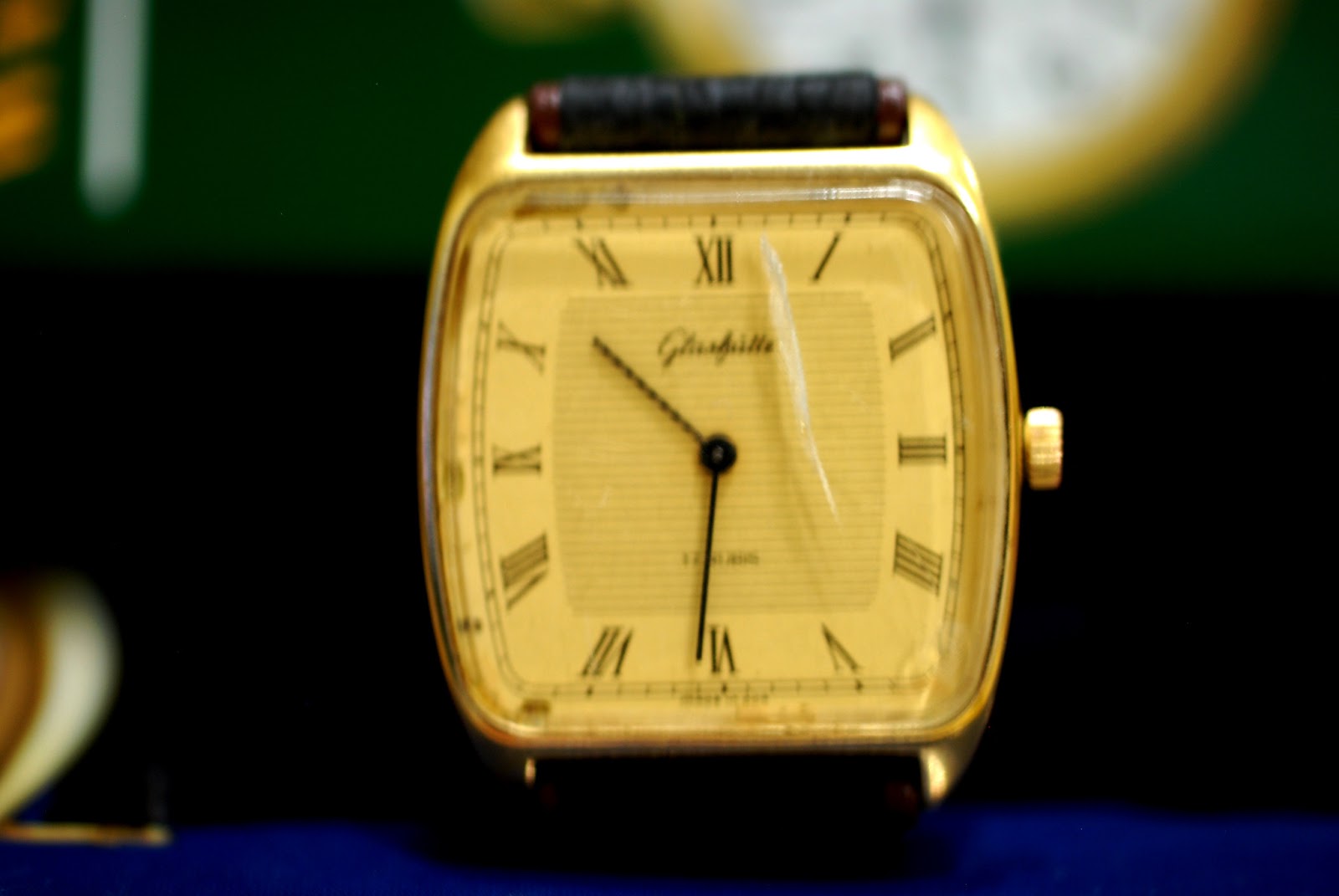
DIAL: GOLD TONE with BALCK ROMAN MARKER AND BLACK HANDS
CROWN: UNSIGNED GOLD TONE
BEZEL: -
MARKINGS/TANDA JENAMA : DIAL, CASEBACK, MOVEMENT
BAND/TALI :
 NEW GENUINE BLACK LEATHER BAND FIT 8" WRIST 
LUGS SIZE: 20mm
BAND WIDTH: 20mm
LENS/CERMIN : ACCRYLIC CRYSTAL (CRACKED between 12:00 to 4:00
MEASUREMENT/UKURAN : 33mm w/o CROWN X 39mm LUG TO LUG
WATER RESISTANT: NOT STATED
CONDITION/KONDISI : EXCELLENT WORKING CONDITIONAND KEEPING TIME
PRICE/HARGA: RM750 (NEGOTIABLE)
MARKET VALUE FOR THIS PREOWNED TIME PIECE IS RM1500
LISTING: RM990  SOLD:RM700

Brief History of Glashutte Watches

Glashutte Original was created in 1845, when the German master watchmakers, Ferdiand Al Lange, Julius Assmann, Ludwig Strasser, Johannes Durrstein, Adolf Schneider, Strasser and Rohde, Ernst Kassiske settled in the region of Glasshutte. These master watchmakers were awarded various gold model at the world exhibition and international competitions, thus creating the foundation and reputation of watching making industry of Glashutte. In 1878, Moritz Grossmann founded the German School of Watchmaking, hence building groundwork for more skillful watchmakers in the region of Glashutte and transforming the region into a reputed symbol of watchmaking excellence.
In the beginning of World War II, the watch manufactories in Glasutte was still in the production of military watches for the Navy and Air Force. Later, in the last day of War World II, Glashutte was bombed from the sky and the factories were badly destroyed. The reminding unaffected factories merged and found the VEB Glashutter Uhrenbetriebe under the rule of East German state.

RARE VINTAGE COLLECTIBLE GLASHUTTE SPEZIMATIC LARGE GENTS WATCH


BRAND/JENAMA : GLASHUTTE GENTS WRISTWATCH
MODEL : SPEZIMATIC
MOVEMENT/ENJIN :SUPERB 26 RUBIES GLASHUTTE GUB MANUAL WINDING MOVEMENT CAL.69-1
ORIGIN/BUATAN : GERMANY
NO. SIRI/SERIAL NO. : 478284
CIRCA/TAHUN : 1970's
CASING/KEMASAN : 20 MICRON ROSEGOLD PLATED & STAINLESS STEEL BACK
FUNCTION/FUNGSI : HOUR, MINUTES, SECOND,DATE AT 3:00
DIAL: CHAMPAGNE WITH RAISED GOLD TONE BATON MARKER AND HANDS
CROWN: UNSIGNED GP CROWN
BEZEL: -
MARKINGS/TANDA JENAMA : DIAL, CASEBACK, MOVEMENT
BAND/TALI :
NEW GENUINE BLACK LEATHER BAND FIT 8" WRIST
HIDDEN LUGS SIZE: 20mm
BAND WIDTH: 20mm
LENS/CERMIN : ACCRYLIC CRYSTAL
MEASUREMENT/UKURAN : 36mm W/O CROWN X 42mm LUG TO LUG
WATER RESISTANT: NOT STATED
CONDITION/KONDISI : COLLECTORS' ITEM- EXCELLENT WORKING CONDITION AND KEEPING TIME
PRICE/HARGA:RM1800 (NEGOTIABLE)
LISTING: RM SOLD:

Brief History of Glashutte Watches

Glashutte Original was created in 1845, when the German master watchmakers, Ferdiand Al Lange, Julius Assmann, Ludwig Strasser, Johannes Durrstein, Adolf Schneider, Strasser and Rohde, Ernst Kassiske settled in the region of Glasshutte. These master watchmakers were awarded various gold model at the world exhibition and international competitions, thus creating the foundation and reputation of watching making industry of Glashutte. In 1878, Moritz Grossmann founded the German School of Watchmaking, hence building groundwork for more skillful watchmakers in the region of Glashutte and transforming the region into a reputed symbol of watchmaking excellence.
In the beginning of World War II, the watch manufactories in Glasutte was still in the production of military watches for the Navy and Air Force. Later, in the last day of War World II, Glashutte was bombed from the sky and the factories were badly destroyed. The reminding unaffected factories merged and found the VEB Glashutter Uhrenbetriebe under the rule of East German state.

HISTORY OF GLASHUTTER UHRENBETRIEB (GUB)

Compares the pictures of Glashuette Original movements in older catalogues with those printed in the recent ones, the different movement designations are immediately evident: The older watches are equipped with the movement cal. 10-30, whereas the newer ones have the cal. 39. However, aside from the drastically improved optical finish, the two movements seem to be the same: the same wheels and the same screws seem to be located in the same places on both movements. So where are the differences that justify that new designation, or is this just a try to cheat, to pretend a new movement where there is none?
When the communist German Democratic Republic found its end as a souvereign state, the state-owned “Glashuetter Uhrenbetrieb” (GuB) was busy developing a new selfwinding movement. Solid it should be, and efficient. Before the works could be finished, the company was sold to the French movement manufacturer France Ebauches SA. This company tried to save itself from bankruptcy by means of German know-how and the cheap labour in Eastern Germany. The new selfwinding movement should compete with the Swiss movements produced by ETA, and was therefore developed specifically with a high momentum and maximum universality in mind. Before the short-time owner of the Glashuette watch manufactory had to develop a new movement, they found already a good movement in Glashuette: In 1978, the V.E.B. ("Volkseigener Betrieb" = People's owned company) Glashuetter Uhrenbetriebe (GUB) brought out their last completely new construction, the cal. 11-26, dubbed Spezichron.
This Spezichron was modernized in several steps under control of first the France Ebauches, then the Treuhand-Anstalt, and finally of Heinz W. Pfeifer, until it found its way as cal. 10-30 into the new watches of Glashuette Original. Under control of the Treuhandanstalt, which, from 1990 to 1994, took over the former East German state-owned companies and sought to bring them into the private sector, the movement cal. 10-30 was completed and used in a new and very cheap line of watches after 1993.
The Spezichron cal. 11-27 movement was the successor of the popular "Spezimatic", which was produced from 1964 until 1980. Compared to the Spezimatic, the new Spezichron was smaller and faster: 28,800 A/h, while the Spezimatic only had 18,000. With that movement, the East German GUB could compete with the common movements of Swiss origins. The Spezichron was solid and accurate. Additionally, a version with weekday display was made; it was designated cal. 11-27.
Yet there were plans for more complications, which could not be based on the trusted 10-30 movement; a new development was necessary. However, it was neither economically feasible nor desirable to have completely new cases and dials produced for the new base movement. Therefore, the starting point of the effort was the condition, that the new movement had the same dimensions, as well as the location of important parts, such as the winding stem, must be the same as in the old 10-30. Additionally, the planned new complication modules should have enough space on the movement’s front.
All elements of the 10-30 movement, which were tried and reliable, were taken over into the new construction, above all the complete escapement was transferred. Even these parts were refined, however, with the addition of a swan neck adjustement, for example. The result of the development was the new cal. 39 movement, which from the outside, looked like the old 10-30. Yet of the originally 130 parts, only 17 remained unchanged. The new movement had more jewels, a better adjustment, and, above all, a better ability to wear additional complication modules.
With the 10-30, every module had to be autonomous; that means, that each module had to consist of an upper an a lower baseplate, so that the final movement had four plate layers. The new cal. 39 movement was constructed in a way that its upper baseplate could serve as the lower base of the module, resulting in a “sandwich” of only three plate layers. This saves space which can be used for more complicated modules.
Finally, the optical qualities of the new movement were drastically improved: skeletonized rotor, finely grinded wheels, angled plates and teeth, the decoration work entirely done by hand. In spite of the still solid base of a movement designed to compete with the ETA-workhorses, the Glashuette Original cal. 39 without doubt is one of the finest selfwinding movements on the market.
The cal. 26 movement found in the watches of UNION/Glashuette, is based on that cal. 39 movement, but is changed in two essential ways: It consists of 12 parts less than its GO counterpart (mainly in the fine adjustement area), and its decoration is mostly machine-made. This saves a lot of money and enables UNION, to offer fine inhouse movements in well-made, competitively priced watches.
This movement was the successor of the popular "Spezimatic", which was produced from 1964 until 1980. Compared to the Spezimatic, the new Spezichron was smaller and faster: 28,800 A/h, while the Spezimatic only had 18,000. With that movement, the East German GUB could compete with the common movements of Swiss origins. The Spezichron was solid and accurate. Additionally, a version with weekday display was made; it was designated cal. 11-27.

A year later, in 1994, the company was bought by Heinz W. Pfeifer, and immediately the cal. 10-30 was thoroughly revised in order to equip high-class watches. More than 60 changes were made, until the movement, which internally was designated cal. 10-30/2, was used for the then new “Klassik”-line. However, the movement’s potential for refinement was exhausted. It was used in all self-winding Glashuette Original watches, including the chronographs, which added a chrono module to the base movement.
Yet there were plans for more complications, which could not be based on the trusted 10-30 movement; a new development was necessary. However, it was neither economically feasible nor desirable to have completely new cases and dials produced for the new base movement. Therefore, the starting point of the effort was the condition, that the new movement had the same dimensions, as well as the location of important parts, such as the winding stem, must be the same as in the old 10-30. Additionally, the planned new complication modules should have enough space on the movement’s front.

COLLECTOR ITEM SUPERB SPEZICHRON HI BEAT 22800 GLASHUTTE GUB GENTS WRISTWATCH


BRAND : GLASHUTTE
MODEL : SPEZICHRON 
MOVEMENT/ENJIN :SUPERB SPEZICHRON HI BEAT 22800 GLASHUTTE GUB 22 RUBIES AUTOMATIC MOVEMENT CAL.11-27
ORIGIN/BUATAN : GERMANY
NO. SIRI/SERIAL NO. : 049568
CIRCA/TAHUN : 1970's
CASING/KEMASAN : 20 MICRON GOLD PLATED & STAINLESS STEEL BACK 
FUNCTION/FUNGSI : HOUR, MINUTES, SECOND, NON QUICK DATE
DIAL: TWO TONE LIGHT/DARK BROWN WITH WHITE ARABIC MARKER AND HANDS
CROWN: UNSIGNED GOLD TONE
BEZEL: -
MARKINGS/TANDA JENAMA : DIAL, CASEBACK, MOVEMENT
BAND/TALI :
 NEW GENUINE BROWN LEATHER BAND FIT 8" WRIST
HIDDEN LUGS SIZE: 20mm
BAND WIDTH: 20mm
LENS/CERMIN : ACCRYLIC CRYSTAL
MEASUREMENT/UKURAN : 42mm WITH CROWN X 44mm LUG TO LUG
WATER RESISTANT: NOT STATED
CONDITION/KONDISI : EXCELLENT WORKING CONDITIONAND KEEPING TIME
PRICE/HARGA: RM2100 (NEGOTIABLE)
MARKET VALUE FOR THIS PREOWNED TIME PIECE IS RM2800
LISTING: RM990  SOLD:RM700

Brief History of Glashutte Watches

Glashutte Original was created in 1845, when the German master watchmakers, Ferdiand Al Lange, Julius Assmann, Ludwig Strasser, Johannes Durrstein, Adolf Schneider, Strasser and Rohde, Ernst Kassiske settled in the region of Glasshutte. These master watchmakers were awarded various gold model at the world exhibition and international competitions, thus creating the foundation and reputation of watching making industry of Glashutte. In 1878, Moritz Grossmann founded the German School of Watchmaking, hence building groundwork for more skillful watchmakers in the region of Glashutte and transforming the region into a reputed symbol of watchmaking excellence.
In the beginning of World War II, the watch manufactories in Glasutte was still in the production of military watches for the Navy and Air Force. Later, in the last day of War World II, Glashutte was bombed from the sky and the factories were badly destroyed. The reminding unaffected factories merged and found the VEB Glashutter Uhrenbetriebe under the rule of East German state.


AUTHENTIC VINTAGE SANDOZ SUBMARINE GENTS WRISTWATCH (SOLD)


BRAND/JENAMA: SANDOZ SUBMARINE
MADE IN/BUATAN: SWISS
CIRCA/TAHUN: 1980's
MODEL: SUBMARINE
CRYSTAL/CERMIN: MINERAL CRYSTAL
MOVEMENT/ENJIN: SANDOZ 25 JEWELS AUTOMATIC WINDING MOVEMENT ETA SA CAL 2824-2 (HI-BEAT 28,800 bph)
DIAL COLOR: BLACK GILT
FUNCTION/FUNGSI: DIVERS
HANDS/JARUM: LUMINOUS GOLD TONE MERCEDES HANDS
MARKERS/TANDA WAKTU: LUMINOUS DOT
BEZEL: BLACK WITH WHITE DIVING 60 MINUTES MARKS
CASING : STAINLESS STEEL/KELULI SEPENUHNYA
LUGS: 20mm
MEASUREMENT/UKURAN: 41mm DIAMETER INCLUDING CROWN and 42mm LUG TO LUG WITH CLAW LUGS
DITANDA/ENGARVED BACK CASING: SANDOZ SWISS ETA MOVEMET, 25 JEWELS, ALL STAINLESS STEEL, 100M
CROWN: SS/ KELULI
STRAP/TALI: AFTERMARKET SS JUBILEE BRACELET
SIZE STRAP/SAIZ TALI: 8"
EXCELLENT CONDITION, WORKING, KEEPING TIME, DISCONTINUED MODEL
PRICE/HARGA: SOLD (TO KPJM MEMBER)

Brief History of Sandoz Wristwatches
Henri Frédéric Sandoz (sometimes Frédéric Henri Sandoz), born in 1851,was a self-made man of Le Locle who in the 1870s founded Henri Sandoz & Cie., later producing complicated watches under the name of Cyma. In 1890, in partnership with two families named Schwob, Sandoz established a watch-making firm at Malleray, near Tavannes, in the French-speaking Bernese Jura of Switzerland. Their new business was known as Tavannes Watch Co. By the time of the death of Sandoz on 18 March 1913, many watches were made under the name of Henri Sandoz & Fils. The enterprise occupied a 'model factory' employing one thousand workers and producing 2,500 watches a day. Sandoz was reported to have a paternalistic policy towards his workforce, exercising a fierce social control.
 
Other names used by the Tavannes company at various times include Tavannes-Cyma, Bijou Watch Co., Tacy Watch Co., and Lisca. After the death of Sandoz, the company he founded went on growing. By 1938, it was manufacturing four thousand items a day.

Since 1971 the Sandoz brand name has been split into four main areas of production, due to its licences being leased or sold. This has led to four separate brands, Sandoz Singapore, Sandoz Hong Kong, Sandoz Swiss, and Sandoz Spain (Munreco). All of these produce watches under the Sandoz name, but each production company has its own line of products. Sandoz Swiss manufactures high quality watches, while Sandoz Hong Kong and Sandoz Singapore manufacture cheaper watches of lower quality. Sandoz Hong Kong products are assembled in Hong Kongusing Swiss movements from ETA SA